
Prussian names refer to the first names and surnames used in historical Prussia, a German-speaking kingdom whose eastern lands also kept Baltic and Lithuanian-influenced forms. Most are standard German. The rare ones come from East Prussian records.
Search for German names and you get Hans, Greta and a hundred others that could belong to any century. A wrong pick breaks a story or a family tree as soon as someone who knows the period reads it, and that’s the problem this list solves.
450+ Prussian names with meanings and origins, noble, military, East Prussian and Old Prussian picks for characters, family trees and baby names. Every name below comes with a meaning, an origin and a style label. Pick by era, rank or region.
- Prussian Names Generator
- Prussian Names and Meanings
- Traditional Prussian Male Names
- Germanic Prussian Names
- German Names from Prussia
- Military Prussian Names
- Prussian Names 1800s Male
- Prussian Noble Names
- Elegant Prussian Names
- Old Prussian Names Male
- Old Prussian Names Girl
- Prussian Last Names
- Prussian Surnames
- Prussian Names for Girls
- Fantasy Prussian Names
- Old-Fashioned Prussian Names
- Conclusion
- Prussian Names FAQs
This guide covers first names and surnames tied to Prussia, from the medieval Baltic tribes to the 1800s. It does NOT cover modern Polish, Russian or Lithuanian naming in the former Prussian lands. It works best for fiction, games, family-tree guesses and baby-name hunting. It won’t help if you need legally verified ancestry records.
Prussian Names Generator
Pick a name in seconds. Choose from 450+ Prussian names with meanings.
Loading the name generator. If this message stays on screen, a cache, speed or security plugin on your site is blocking the script.
Your shortlist
Tap Save on any name to build your shortlist.
Names and meanings come from the lists in this article. Meanings are based on word roots and can vary by source, so check church or civil records before using a name for family-tree work. Full names with “von” use invented place names.
A Prussian names generator is just a recipe you can run by hand in two minutes. Random online generators don’t know rank, they can’t separate eras, and they’ll hand a farmer a count’s name. Pick a first name from the lists below.
Then add a surname from the same rank and region, so a Masurian farmer and a Königsberg count don’t end up sounding alike. Spelling trips up most lists. Prussian records often use older forms such as Scharlotte or Lowisa, and a 1700s character reads more real with them.
Quick Note: use one old spelling per story for flavor, and keep the rest modern.
Prussian names are mostly German names with a regional twist. According to Behind the Name, its East Prussian list covers German names favored by people from East Prussia, a region now split among Poland, Russia and Lithuania. Think Friedrich and Wilhelmine for the court, Mertin and Endris for villages.
To build a Prussian name, follow these steps:
- Choose the era: royal court, 1800s town, or East Prussian village.
- Pick a first name from the matching table below.
- Add a surname from the same rank or region.
- Check the meaning and spelling before you commit.
Generator Examples
| Setting | Sample full name | Why it works |
|---|---|---|
| Royal court, 1700s | Friedrich Leopold Adler | Two royal-sounding first names plus the Prussian eagle (Adler) |
| Army officer, 1860s | Gotthard Brandt | Pious first name, short martial surname |
| Town clerk, 1800s | Traugott Krause | Pietist first name, common Low German surname |
| Masurian farmer | Mertin Kowalski | East Prussian first name, Polish-Masurian surname |
| Noblewoman, 1850s | Mathilde von Steinfeld | Noble first name, invented "von" place name |
| Village girl, East Prussia | Ennike Massoth | Regional first name, Old Prussian-rooted surname |
Tip: pull the first name and surname from the same table family whenever you can.
Prussian Names and Meanings
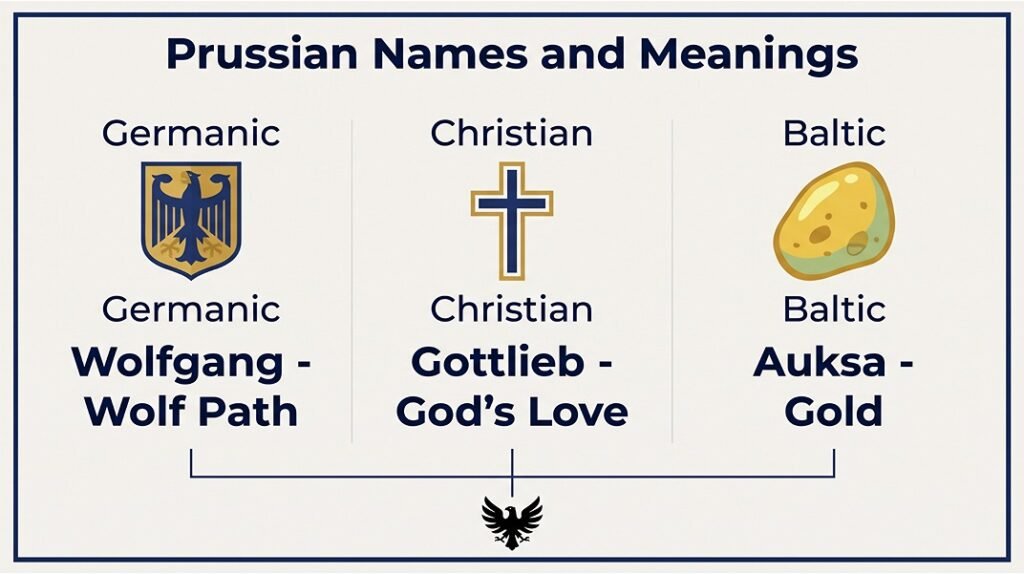
Every Prussian name flows from one of three streams. The first is Germanic names built from old word parts like hild (battle) and wolf. The second is Christian: Biblical and saint names that came with the church. The third is Baltic and Slavic, the forms used by Old Prussian, Lithuanian and Polish speakers who lived in the same lands.
Most people assume Prussian means German, full stop. The data says otherwise, as the study below shows. Meanings here come from word roots, so some are literal and some are folk glosses. Sieglinde reads as “victory” plus “gentle” because its roots say so. Sources disagree on a few.
Old Prussian names are Baltic names, not German ones. According to Irena Dukavičienė’s 2015 study of 13th-century records in Acta linguistica Lithuanica, more than half of the personal names examined are clearly Baltic in origin, and most of the foreign ones come from German. So “Prussian” covers two naming worlds, and most lists show only one.
Prussian last names often come from jobs, places and old Baltic roots. According to Geneanet’s surname notes, Massoth links to an Old Prussian word for “small,” and Liedke can come from an Old Prussian personal name. Müller or Schmidt could sit anywhere in Germany. Marohn and Massoth carry Old Prussian roots.
Prussian names vs general German names: Prussian names are better suited for stories set in Brandenburg-Prussia, the Kingdom of Prussia or East Prussia because they carry that region’s mix of court, church and Baltic influence. General German names work better when the setting is wider, such as Bavaria or Saxony. The key difference is regional flavor.
| Option | Best For | Key Benefit | Limitation |
|---|---|---|---|
| Germanic names (Dietrich, Brunhild) | Warriors, nobles, officers | Strong, period-correct sound | Can feel heavy in modern settings |
| Christian names (Gottlieb, Dorothea) | Townspeople, pastors' families | Matches church records | Common across all German lands |
| East Prussian regional forms (Mertin, Prenkus) | Villages, ancestry hunts | Real regional flavor | Spelling varies, sources are partly contributor-based |
| Old Prussian and Baltic names (Herkus, Auksa) | Baltic-focused fiction and fantasy | Rare and memorable | Few records survive |
Traditional Prussian Male Names
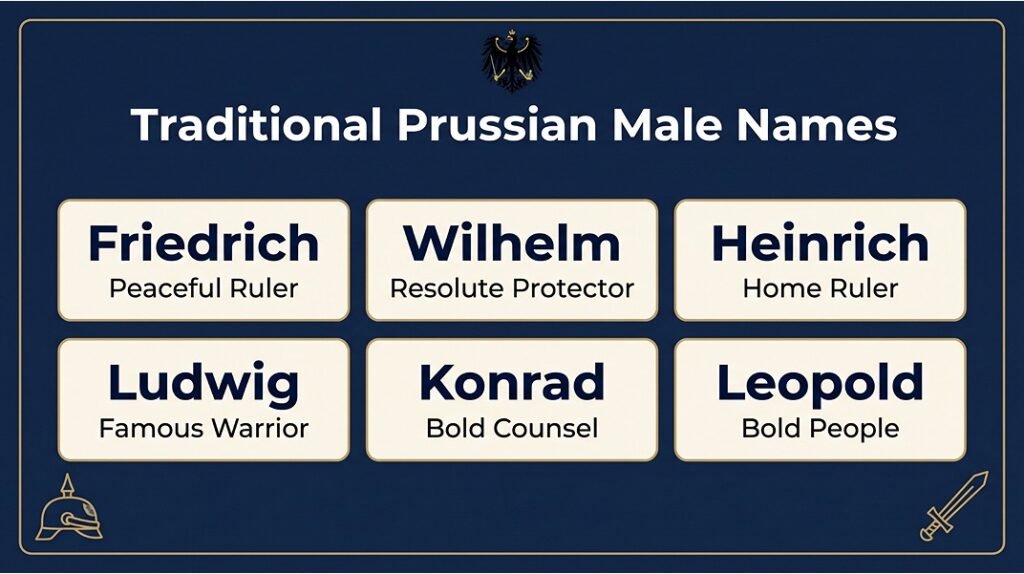
These are the names a Prussian household would have called out across a farmyard, a market square or a parade ground. Friedrich and Wilhelm ruled the royal line, while Johann, Georg and Karl filled the towns. Short, hard-edged, easy to say. That’s why they still work for a strong lead.
Here’s a take some readers will resist: skip Wilhelm for your hero. It’s the most overused Prussian name in fiction, and readers picture a Kaiser before they picture your character. Leopold or Bernhard gives the same weight without the baggage.
| Name | Meaning | Origin | Style |
|---|---|---|---|
| Friedrich | peaceful ruler | Old High German | Royal |
| Wilhelm | resolute protector | Germanic | Royal |
| Heinrich | home ruler | Germanic | Noble |
| Karl | free man | Germanic | Everyday |
| Johann | God is gracious | Hebrew via Latin | Church |
| Georg | farmer | Greek | Rural |
| August | venerable, majestic | Latin | Court |
| Ernst | serious, determined | Old High German | Stern |
| Ludwig | famous warrior | Old High German | Noble |
| Otto | wealth, fortune | Germanic | Imperial |
| Gustav | possibly "staff of the Goths" | Scandinavian | Dignified |
| Konrad | bold counsel | Old High German | Strong |
| Hermann | army man | Germanic | Heroic |
| Albrecht | noble and bright | Old High German | Courtly |
| Bernhard | brave as a bear | Germanic | Sturdy |
| Eduard | wealthy guardian | Old English via German | Refined |
| Ferdinand | adventurous voyager | Germanic via Spanish | Daring |
| Franz | Frenchman | Latin (Franciscus) | Warm |
| Gottfried | God's peace | Germanic | Pious |
| Hans | God is gracious (short for Johann) | Germanic form of Hebrew | Everyday |
| Joachim | God will establish | Hebrew | Pious |
| Leopold | bold people | Germanic | Courtly |
| Maximilian | the greatest | Latin | Grand |
| Paul | small, humble | Latin | Simple |
| Emil | rival, industrious | Latin | Middle-class |
| Julius | youthful | Latin | Classical |
| Hugo | mind, spirit | Germanic | Literary |
| Adolf | noble wolf | Germanic | Dated, carries heavy modern baggage |
| Alexander | defender of men | Greek | Cosmopolitan |
| Anton | priceless (folk meaning) | Latin | Gentle |
| Theodor | gift of God | Greek | Educated |
| Bruno | brown one | Germanic | Rugged |
| Felix | lucky | Latin | Light |
| Jakob | supplanter | Hebrew | Biblical |
| Moritz | of the Moors | Latin (Mauritius) | Playful |
| Oskar | divine spear | Old English and Irish | Romantic |
Tip: give royal-court characters a double name such as Friedrich Wilhelm, and keep ordinary characters to one given name plus a plain surname.
Germanic Prussian Names
Germanic names snap together. Each one is built from two old word parts, such as adal (noble), hild (battle), wolf, hart (brave) and bert (bright). Once you know the parts, you can read Hildebrand as “battle sword” at a glance. That also lets you invent believable new ones.
Some experts argue that “Prussian” names are just German names under another label. That’s valid for the royal court, where Germanic names were shared across every German state. But if you’re writing East Prussian village life, Christian and Baltic forms matter more than these warrior names. Use this table for nobles, officers and sagas.
| Name | Meaning | Origin | Style |
|---|---|---|---|
| Dietrich | ruler of the people | Old High German | Noble |
| Eberhard | brave as a boar | Germanic | Sturdy |
| Gerhard | brave spear | Germanic | Martial |
| Siegfried | victory and peace | Germanic | Heroic |
| Siegmund | victory protector | Germanic | Heroic |
| Walther | ruler of the army | Germanic | Chivalric |
| Reinhard | brave counsel | Germanic | Dignified |
| Reinhold | ruling counsel | Germanic | Stern |
| Manfred | man of peace | Germanic | Calm strength |
| Wolfgang | wolf path | Germanic | Bold |
| Gunther | battle warrior | Germanic | Legendary |
| Hartmann | hard, brave man | Germanic | Rugged |
| Hartwig | brave in battle | Germanic | Rugged |
| Berthold | bright ruler | Germanic | Medieval |
| Ulrich | prosperous ruler | Germanic | Noble |
| Wolfram | wolf and raven | Germanic | Poetic |
| Rüdiger | famous spear | Germanic | Knightly |
| Egbert | bright sword edge | Old English | Medieval |
| Eckhard | sword and brave | Germanic | Medieval |
| Erhard | honor and brave | Germanic | Plain |
| Gebhard | gift and brave | Germanic | Churchly |
| Hildebrand | battle sword | Germanic | Epic |
| Oswald | divine power | Old English | Pious |
| Lothar | famous army | Germanic | Frankish |
| Norbert | northern brightness | Germanic | Churchly |
| Winfried | friend of peace | Old English | Gentle |
| Brunhild | armored battle | Germanic | Legendary |
| Hildegard | battle enclosure, protector | Germanic | Medieval |
| Irmgard | whole, universal protection | Germanic | Old-fashioned |
| Gertrud | spear strength | Germanic | Sturdy |
| Sieglinde | victory and gentle | Germanic | Epic |
| Adelheid | noble kind | Old High German | Noble |
| Kunigunde | clan warrior | Germanic | Medieval |
| Mechthild | mighty in battle | Germanic | Medieval |
| Waltraud | ruling strength | Germanic | Vintage |
| Gudrun | battle secret | Old Norse and Germanic | Legendary |
| Edeltraud | noble strength | Germanic | Vintage |
| Gisela | pledge | Germanic | Courtly |
Tip: pair a first-half root with a second-half root, such as hild plus brand, to invent an in-period name.
German Names from Prussia
Prussia was largely Protestant, so Bible-based names such as Gottlieb, Immanuel and Tobias sat comfortably beside older saint names that had survived the Reformation. The philosopher Immanuel Kant, born in Königsberg in 1724, is the famous example. Faith sits right in the sound.
These names came with the Reformation. Or maybe I should say it this way: they became the default after it, since saint and Bible names had circulated for centuries. Huguenot refugees, welcomed to Brandenburg in the 1680s, added French flavor that soon sounded Prussian.
| Name | Meaning | Origin | Style |
|---|---|---|---|
| Christian | follower of Christ | Latin | Pious |
| Christoph | Christ-bearer | Greek | Pious |
| Gottlieb | God's love | German | Pietist |
| Gottlob | praise God | German | Pietist |
| Immanuel | God is with us | Hebrew | Scholarly |
| Johannes | God is gracious | Hebrew via Latin | Church |
| Matthias | gift of God | Hebrew via Greek | Church |
| Michael | who is like God | Hebrew | Church |
| Nikolaus | victory of the people | Greek | Warm |
| Peter | rock | Greek | Plain |
| Philipp | lover of horses | Greek | Courtly |
| Samuel | God has heard | Hebrew | Biblical |
| Simon | he has heard | Hebrew | Biblical |
| Stephan | crown | Greek | Church |
| Thomas | twin | Aramaic | Plain |
| Andreas | manly | Greek | Church |
| Daniel | God is my judge | Hebrew | Biblical |
| David | beloved | Hebrew | Biblical |
| Elias | my God is Yahweh | Hebrew | Biblical |
| Fabian | from the Fabius clan | Latin | Saintly |
| Jonas | dove | Hebrew | Biblical |
| Lorenz | man of Laurentum (laurel) | Latin | Saintly |
| Martin | of Mars | Latin | Reformation-era |
| Tobias | God is good | Hebrew | Biblical |
| Valentin | strong, healthy | Latin | Saintly |
| Sebastian | venerable | Greek | Saintly |
| Anna | grace | Hebrew | Everyday |
| Margarethe | pearl | Greek | Everyday |
| Katharina | pure | Greek | Royal and church |
| Dorothea | gift of God | Greek | Courtly |
| Elisabeth | God is my oath | Hebrew | Royal |
| Johanna | God is gracious | Hebrew | Everyday |
| Marie | beloved (disputed) | Hebrew | Everyday |
| Sophie | wisdom | Greek | Educated |
| Luise | famous warrior | Germanic | Royal (Queen Luise) |
| Magdalena | woman of Magdala | Hebrew via Greek | Church |
| Regina | queen | Latin | Dignified |
| Susanne | lily | Hebrew | Gentle |
| Barbara | foreign woman | Greek | Saintly |
| Ursula | little bear | Latin | Saintly |
| Agnes | pure | Greek | Saintly |
| Eva | life | Hebrew | Biblical |
| Martha | lady of the house | Aramaic | Biblical |
Tip: a Bible name as a middle name, such as Johann Gottlieb, adds period feel fast.
Military Prussian Names
Prussia has long been described as an army with a state attached, and the names of its officer class show exactly why. Many lean on word parts like gund and wig (both mean battle) and heri (army). They sound clipped on purpose. A sergeant could shout most of them across a courtyard without losing a syllable.
The second group below are real surnames of famous Prussian soldiers. Blücher, Scharnhorst, Gneisenau and Clausewitz all served in the Prussian army that fought Napoleon. Borrow them for flavor, but don’t hand one to a fictional hero unless the link is the point.
First Names with A Martial Ring
| Name | Meaning | Origin | Style |
|---|---|---|---|
| Helmut | helmet and courage | Germanic | Soldierly |
| Hartmut | hard, brave spirit | Germanic | Gritty |
| Gerwin | spear friend | Germanic | Knightly |
| Wiegand | warrior, fighter | Germanic | Rugged |
| Wigbert | battle and bright | Germanic | Medieval |
| Wolfhart | wolf and brave | Germanic | Fierce |
| Waldemar | famous ruler | Germanic and Slavic | Dynastic |
| Armin | soldier, warrior | Latin (Arminius) | Heroic |
| Arnold | eagle ruler | Germanic | Stately |
| Arnulf | eagle wolf | Germanic | Medieval |
| Burkhard | fortress and brave | Germanic | Sturdy |
| Degenhard | brave warrior | Germanic | Medieval |
| Eckart | sword edge and brave | Germanic | Knightly |
| Gernot | spear and need (battle) | Germanic | Epic |
| Gundolf | war wolf | Germanic | Fierce |
| Harald | army ruler | Germanic and Norse | Commanding |
| Heribert | army bright | Germanic | Commanding |
| Herwig | army fight | Germanic | Warlike |
| Ingo | from Ing, a Germanic god | Germanic | Mythic |
| Kuno | bold, brave | Germanic | Short and sharp |
| Leonhard | brave lion | Germanic | Courageous |
| Randolf | shield wolf | Germanic | Defensive |
| Rainer | counsel and army | Germanic | Strategist |
| Roland | famous land | Germanic | Chivalric |
| Rolf | famous wolf | Germanic | Terse |
| Volkmar | famous people | Germanic | Folk hero |
Surnames of Famous Prussian Soldiers
| Name | Meaning | Origin | Style |
|---|---|---|---|
| Blücher | Gebhard Leberecht von Blücher, field marshal at Waterloo | Mecklenburg family | Field marshal |
| Scharnhorst | Gerhard von Scharnhorst, army reformer | Lower Saxony | Reformer |
| Gneisenau | August von Gneisenau, Blücher's chief of staff | Saxon-born | Strategist |
| Clausewitz | Carl von Clausewitz, author of On War | Prussian officer family | Theorist |
| Moltke | Helmuth von Moltke the Elder, chief of the General Staff | Mecklenburg family | Staff officer |
| Roon | Albrecht von Roon, war minister | Pomerania-born | Minister |
| Seydlitz | Friedrich Wilhelm von Seydlitz, cavalry general | Silesian family | Cavalryman |
| Zieten | Hans Joachim von Zieten, hussar general | Brandenburg | Hussar |
| Yorck | Ludwig Yorck von Wartenburg, general at Tauroggen | Prussian general | Commander |
| Derfflinger | Georg von Derfflinger, field marshal of the Great Elector | Austrian-born | Veteran |
Tip: pair a martial first name with a plain surname from the surname sections for a believable officer.
Prussian Names 1800s Male
Names in the 1800s split into three moods. Pious compounds like Traugott and Leberecht suit the early decades. Short, brisk forms such as Max, Kurt and Fritz suit the later city-dwellers, and medieval revival names such as Reimar and Otfried suit Romantic-minded families who wanted something old and grand.
If you’re writing a Prussian officer in the 1860s, here’s what actually works: a pious or royal first name, one short surname, and a plain spelling that a reader can say aloud on the first try. Keep it plain. Rare names make memorable characters, but too many in one cast looks like a costume party.
| Name | Meaning | Origin | Style |
|---|---|---|---|
| Albert | noble and bright | Germanic | Cosmopolitan |
| Alfred | elf counsel | Old English | Cosmopolitan |
| Alwin | noble friend | Germanic | Romantic |
| Carsten | Christian (Low German form) | Low German | Coastal |
| Clemens | merciful | Latin | Gentle |
| Detlef | people's heritage | Low German | Northern |
| Edgar | rich spear | Old English | Romantic |
| Edmund | rich protector | Old English | Romantic |
| Hennig | pet form of Heinrich or Johannes | Low German | Northern |
| Erich | eternal ruler | Old Norse and Germanic | Northern |
| Ewald | law and rule | Germanic | Sturdy |
| Fritz | peaceful ruler (pet form of Friedrich) | German | Familiar |
| Gotthard | God and brave | Germanic | Pious |
| Herbert | army bright | Germanic | Late-century |
| Hilmar | battle and famous | Germanic | Romantic |
| Horst | thicket, grove | Low German | Outdoorsy |
| Jürgen | farmer (Low German Georg) | Low German | Northern |
| Kaspar | treasurer | Persian via Latin | Old-world |
| Kurt | bold counsel (short for Konrad) | German | Brisk |
| Lambert | land and bright | Germanic | Medieval |
| Leberecht | live rightly | German | Pietist |
| Lutz | famous warrior (short for Ludwig) | German | Brisk |
| Max | the greatest (short for Maximilian) | Latin | Brisk |
| Otfried | wealth and peace | Germanic | Medievalist |
| Reimar | counsel and famous | Germanic | Romantic |
| Richard | brave ruler | Germanic | Cosmopolitan |
| Robert | bright fame | Germanic | Cosmopolitan |
| Rudolf | famous wolf | Germanic | Noble |
| Theobald | people and bold | Germanic | Medieval |
| Traugott | trust in God | German | Pietist |
| Viktor | victor | Latin | Confident |
| Werner | guarding army | Germanic | Practical |
| Willibald | will and bold | Germanic | Old-school |
| Egon | sword edge (short form) | Germanic | Brisk |
| Ignaz | fiery (folk meaning) | Latin | Catholic-leaning |
| Bertram | bright raven | Germanic | Medieval |
Tip: readers know Fritz is Friedrich, so you can let family members use the pet form in dialogue.
Prussian Noble Names
A von before a surname marks nobility, and in Prussia the crown handed it out. That makes it the easiest detail to get wrong. Real noble names usually point to an actual castle, village or region, such as Dohna or Finckenstein in East Prussia, while made-up ones with English words, like “von Raven,” give the game away.
Prussian nobility also meant land. The Junkers, the landowning nobles east of the Elbe, shaped the officer corps and the civil service. If your character is a Graf or a Freiherr, put the title in front of the name, as in Freiherr Ottokar von Steinfeld.
Noble First Names
| Name | Meaning | Origin | Style |
|---|---|---|---|
| Adalbert | noble and bright | Old High German | Aristocratic |
| Anselm | divine helmet, protection | Germanic | Scholarly noble |
| Balduin | bold friend | Germanic | Chivalric |
| Berengar | bear spear | Germanic | Knightly |
| Bogislaw | glory of battle | Slavic (Pomeranian dukes) | Pomeranian noble |
| Ottokar | wealth guard | Germanic | Medieval |
| Wichard | battle and brave | Germanic | Junker |
| Adelgunde | noble battle | Germanic | Aristocratic |
| Ludovika | famous warrior (Latin form of Ludwig) | Latinized Germanic | Court |
| Dietlinde | people and gentle | Germanic | Aristocratic |
Noble Titles
| Name | Meaning | Origin | Style |
|---|---|---|---|
| Graf | count | German | Upper nobility |
| Gräfin | countess | German | Upper nobility |
| Freiherr | baron, free lord | German | Middle nobility |
| Freifrau | baroness | German | Middle nobility |
| Fürst | prince | German | High nobility |
| Herzog | duke | German | High nobility |
| Markgraf | margrave, border count | German | High nobility (Brandenburg link) |
| Junker | young lord, later a landowning noble | German | Eastern estate owner |
| Ritter | knight | German | Lesser nobility |
Real Prussian Noble Families
| Name | Meaning | Origin | Style |
|---|---|---|---|
| Bismarck | Otto von Bismarck, first chancellor of the German Empire | Altmark | Statesman |
| Hindenburg | Paul von Hindenburg, field marshal and president | Altmark roots | General |
| Dohna | East Prussian counts and estate owners | Saxon roots, East Prussian estates | Aristocratic |
| Dönhoff | East Prussian counts, Friedrichstein estate | East Prussia | Aristocratic |
| Finckenstein | East Prussian counts, Finckenstein castle | East Prussia | Aristocratic |
| Kleist | family of the poet Heinrich von Kleist | Pomerania | Literary and military |
| Arnim | family of the writer Achim von Arnim | Brandenburg | Romantic |
| Bülow | generals and statesmen | Mecklenburg and Prussia | Statesman |
| Marwitz | landowning family | Brandenburg | Junker |
| Schwerin | Field Marshal Kurt Christoph von Schwerin | Pomerania | Field marshal |
| Lehndorff | East Prussian counts, Steinort estate | East Prussia | Aristocratic |
| Eulenburg | court and diplomatic family | Prussia | Courtier |
| Alvensleben | old noble house | Altmark | Old nobility |
| Schulenburg | old noble house | Altmark | Old nobility |
| Hardenberg | Karl August von Hardenberg, state chancellor | Lower Saxony | Reformer |
| Itzenplitz | landowning family and ministers | Brandenburg | Junker |
| Hohenzollern | the ruling house of Prussia | Swabia (Zollern castle) | Royal |
| Podewils | ministers of Frederick the Great | Pomerania | Diplomat |
Tip: real families are fine for flavor, but a character who carries one of these surnames is claiming kinship, so most writers invent a place-based “von” name instead.
Elegant Prussian Names
Elegant names sound like candlelight and good paper. They tend to be long, soft and rhythmic, with endings in -ine, -ie or -a. Prussian courts loved them, because a name like Wilhelmine or Friederike could be shortened for family and still used in full at a ball. The long form is the point.
Use the long form in public scenes and the short form at home. Wilhelmine becomes Minna, Friederike becomes Frieda, and Henriette becomes Jette. That small shift shows closeness, class and mood, all without a single line of explanation in the narration.
Format: Name — meaning · origin · style
- Adele — noble · Germanic · Refined
- Amalia — industrious · Germanic · Courtly
- Antonia — priceless (folk meaning) · Latin · Classical
- Auguste — venerable · Latin · Imperial
- Augusta — majestic · Latin · Imperial
- Aurelie — golden · Latin · Bright
- Beatrix — she who brings joy · Latin · Stately
- Charlotte — free woman · Germanic via French · Royal
- Clementine — merciful · Latin · Gentle
- Constanze — constant · Latin · Cultured
- Cornelia — of the Cornelii clan · Latin · Classical
- Eleonore — shining one (folk meaning) · Old Provençal via French · Courtly
- Emilie — rival, industrious · Latin · Genteel
- Franziska — Frenchwoman · Latin · Warm
- Friederike — peaceful ruler · Germanic · Royal
- Gabriele — God is my strength · Hebrew · Soft
- Henriette — home ruler · Germanic via French · Court
- Hermine — army person · Germanic · Regal
- Josephine — God will add · Hebrew · Genteel
- Juliane — youthful · Latin · Genteel
- Karoline — free woman · Germanic · Courtly
- Leopoldine — bold people · Germanic · Courtly
- Marianne — Maria and Anna joined · Hebrew · Romantic
- Mathilde — mighty in battle · Germanic · Medieval-court
- Natalie — born at Christmas · Latin · Poised
- Ottilie — wealth, fortune · Germanic · Dainty
- Pauline — small · Latin · Dainty
- Philippine — lover of horses · Greek · Playful
- Rosalie — rose · Latin · Soft
- Sidonie — of Sidon · Phoenician via Latin · Rare
- Therese — harvester (disputed) · Greek · Refined
- Valerie — strong · Latin · Poised
- Viktoria — victory · Latin · Regal
- Wilhelmine — resolute protector · Germanic · Royal
Tip: say the full name aloud with a surname before you commit, because long first names need short surnames.
Old Prussian Names Male
Old Prussian was a Baltic language, closer to Lithuanian and Latvian than to German. It faded as German settlers and the Teutonic Order reshaped the region. Few personal names survived in writing, and most of them come from chancery documents written by German clerks, which means the spellings are filtered through German ears.
A 2025 paper by Darius Ivoška in Onomástica desde América Latina argues that authentic archival documents, especially those of the German Order, are the most reliable evidence for Old Prussian and Lithuanian historical names. Sources conflict on when the language died: some say the late 1600s, others the early 1700s. My read is that it faded over several generations, so no single date is safe.
| Name | Meaning | Origin | Style |
|---|---|---|---|
| Herkus | Herkus Monte, Natangian leader in the Great Prussian Uprising of the 1260s | Old Prussian | Rebel hero |
| Widewuto | legendary first king in later chronicles | Old Prussian (legend) | Legendary |
| Bruteno | legendary high priest, brother of Widewuto | Old Prussian (legend) | Legendary |
| Ansas | East Prussian form of Hans | East Prussian German | Rural |
| Armonis | variation of Hermann | East Prussian German | Rural |
| Bertulis | Lithuanian-style name used in East Prussia | East Prussian German | Rural |
| Blade | short form of Ladislaus | East Prussian German | Rare |
| Bladis | short form of Ladislaus | East Prussian German | Rare |
| Bronys | form of Bronius | East Prussian and Lithuanian | Rural |
| Cardel | diminutive of names ending in -kard | East Prussian German | Rural |
| Ceslaus | Latinized form of Czesław | East Prussian German | Latinized |
| Cilas | short form of Cäcilius | East Prussian and Lithuanian | Rural |
| Desider | form of Desiderius | East Prussian German | Learned |
| Dowid | form of David | East Prussian German | Biblical |
| Elies | variation of Elias | East Prussian German | Biblical |
| Endris | form of Heinrich | East Prussian German | Regional |
| Endriks | variation of Heinrich | East Prussian German | Regional |
| Ensel | diminutive of Ansas, like Hänsel | East Prussian German | Playful |
| Ertmon | form of Erdmann | East Prussian German | Regional |
| Gerge | contracted form of George | East Prussian German | Regional |
| Gils | form of Gallus | East Prussian German | Saintly |
| Jowalis | form of Yuval, recorded in the mid-1800s | East Prussian German (rare) | Rare |
| Kristups | form of Christopher | East Prussian German | Regional |
| Labrenz | form of Lorenz | East Prussian German | Regional |
| Lenert | form of Leonhard | East Prussian German | Regional |
| Mertin | form of Martin | East Prussian German | Rural |
| Pinkus | form of Pinchas | East Prussian German and Yiddish | Jewish-German |
| Prenkus | form of Franziskus | East Prussian German | Regional |
| Prenskas | diminutive of Prenkus | East Prussian German | Regional |
| Sellius | rare, meaning not recorded | East Prussian German (rare) | Rare |
| Tanius | short form of Antonius | East Prussian German | Regional |
| Timas | form of Timotheus | East Prussian German | Regional |
| Valtin | contracted form of Valentin | East Prussian German | Regional |
| Willus | short form of Wilhelm | East Prussian German | Regional |
Note: Herkus, Widewuto and Bruteno come from chronicle and legend. The rest are East Prussian male forms from Behind the Name, whose East Prussian page returned 82 submitted names when we checked it in 2026. The site says submitted-name accuracy can’t be guaranteed, so treat these as documented usage, not a final ruling.
Old Prussian Names Girl
Girls’ names from East Prussia mix German saints’ names with Lithuanian sounds. Ennike, a regional form of Annika, was popular in the 1700s according to Behind the Name. Many are short forms of longer saint names, such as Pine for Philippine, Cele for Cäcilie, Sitta for Sidonia and Palia for Apollonia, which gives the whole list a small, tender sound.
Families also fused double names. Anorte joins Anna and Dorothea, and Lenorte joins Lene and Dorothea. It’s a neat trick for a character whose name needs a story, and a grandmother can explain it in a single line.
| Name | Meaning | Origin | Style |
|---|---|---|---|
| Agnesia | Latinization of Agnes | East Prussian German (rare) | Rare |
| Agnet | variant of Agnes | East Prussian German | Regional |
| Albe | variant of Alba, or short for Albine | East Prussian German | Regional |
| Aldone | form of Aldona | East Prussian German | Baltic-flavored |
| Alsa | short form of Aldone | East Prussian German | Baltic-flavored |
| Anorte | contraction of Anna and Dorothea | East Prussian German | Fused |
| Auksa | form of Lithuanian Auksė, from the word for gold | East Prussian and Lithuanian | Unique |
| Brone | feminine form of Bronys | East Prussian German | Regional |
| Catarzina | variant of Katarzyna | East Prussian German (archaic) | Archaic |
| Cele | short form of Cäcilie | East Prussian German | Tender |
| Chaie | form of Chaya, "life" | East Prussian German | Jewish-German |
| Coelestine | form of Celestine, "heavenly" | East Prussian German | Elevated |
| Edwikke | variant of Hedwig | East Prussian German | Regional |
| Elze | form of Else | East Prussian German | Short |
| Endrike | feminine form of Endris | East Prussian German | Regional |
| Ennike | form of Annika, popular in the 1700s | East Prussian German | Period |
| Ennuszia | diminutive of Ennike | East Prussian German | Pet form |
| Erdme | form of Erdmuthe | East Prussian German | Regional |
| Erkme | possibly a short form of names with "Erk-" | East Prussian German | Rare |
| Euphrosina | form of Euphrosyne, "mirth" | East Prussian German | Learned |
| Ewe | variant of Ewa (Eve) | East Prussian German | Short |
| Gryta | short form of Magryta | East Prussian German | Short |
| Heinriette | form of Henriette | East Prussian German | Spelling variant |
| Katryne | form of Katrine | East Prussian German | Regional |
| Lelija | East Prussian name not derived from Roman Laelia | East Prussian German | Rare |
| Lenorte | contraction of Lene and Dorothea | East Prussian German | Fused |
| Lidvise | variant of Liudvise | East Prussian German | Baltic-flavored |
| Liuda | Lithuanian short form of names starting with Liud- | East Prussian and Lithuanian | Baltic-flavored |
| Liudvise | form of Liudvika | East Prussian German | Baltic-flavored |
| Lorentine | feminization of Lorenz | East Prussian German (rare) | Rare |
| Lowisa | archaic variant of Louise | East Prussian German | Archaic |
| Madline | form of Madeleine | East Prussian German | Regional |
| Magryta | form of Margarethe | East Prussian German | Regional |
| Maryke | form of Marike | East Prussian German | Regional |
| Palia | short form of Apollonia | East Prussian German | Short |
| Pine | short form of Philippine | East Prussian German | Short |
| Salme | contracted form of Salome | East Prussian German, Estonian, Finnish | Short |
| Scharlotte | spelling variant of Charlotte, found in the late 1700s and early 1800s | East Prussian German | Period |
| Silvestrine | feminine form of Silvester | East Prussian German | Rare |
| Sitta | short form of Sidonia | East Prussian German | Short |
| Szule | short form of Sulamith or Ursula | East Prussian German | Short |
| Taletha | form of Talitha | East Prussian German | Biblical |
| Tille | form of Tilla | East Prussian German | Short |
| Vyga | short form of Jadvyga | East Prussian German | Baltic-flavored |
| Zose | short form of Zofija, or a Germanized Zosė | East Prussian German | Baltic-flavored |
Tip: pair one of these with a Baltic-rooted surname from the next section, such as Ennike Massoth, for a village-register feel.
Prussian Last Names
What most guides skip is how mixed East Prussian surnames really are. Next to German names like Krause and Lehmann you’ll find Polish endings in -ski, Baltic roots, and Low German forms. That mix is the pattern. A single village register can hold all three, sometimes in the same family, once a daughter marries across a language line.
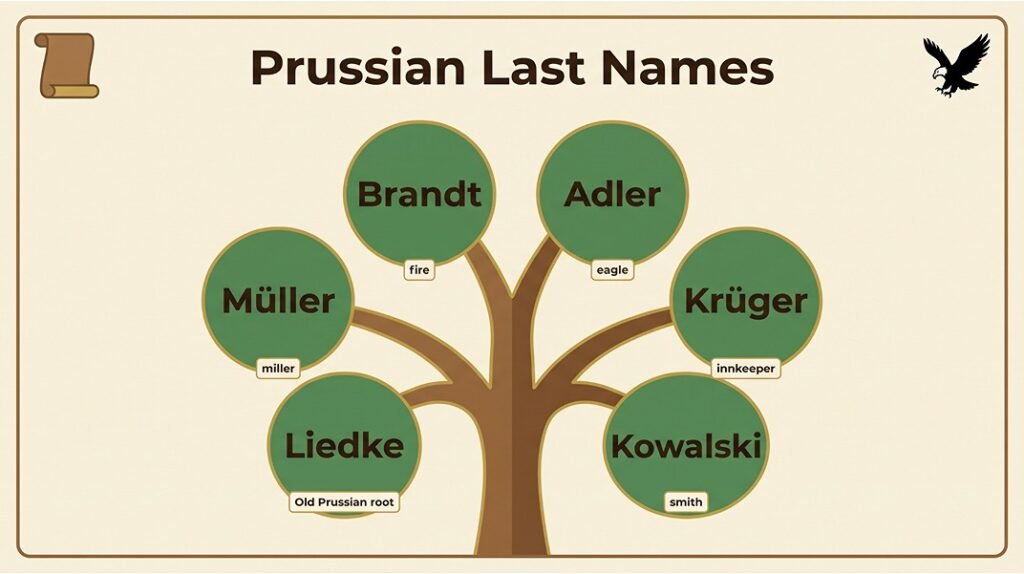
Geneanet’s surname notes show how Old Prussian roots survive in German spelling. Regier is described as an Old Prussian name common in West Prussia, and Massoth links to an Old Prussian word for “small.” Dingel traces to the Old Prussian name Dyngele. The first ten rows below follow those notes.
| Name | Meaning | Origin | Style |
|---|---|---|---|
| Liedke | variant of Lüdtke, or from an Old Prussian name | North German, Old Prussian | Baltic-rooted |
| Mahnke | pet form of Manegold, or from an Old Prussian name | North German, Old Prussian | Baltic-rooted |
| Marohn | from an Old Prussian personal name | East German | Baltic-rooted |
| Massoth | nickname from Old Prussian massais, "small" | German, Old Prussian | Baltic-rooted |
| Regier | from an Old Prussian name of uncertain origin | German, common in West Prussia | Baltic-rooted |
| Dingel | from the Old Prussian name Dyngele | German | Baltic-rooted |
| Gause | Old Prussian origin (unexplained) or Slavic "goose" | German | Baltic or Slavic |
| Moede | place-based name, or from an Old Prussian personal name | German | Mixed |
| Lubahn | Germanized Slavic or Old Prussian name with lub, "dear, to love" | German | Baltic-rooted |
| Reinicke | variant of Reinecke, sometimes from an Old Prussian name | North German | Mixed |
| Rahr | East Prussian variant of Rohr (reed) | East Prussian German | Regional |
| Preuß | the Prussian | German | Ethnic name |
| Prusinowski | from a village named for Prussians | Polish | Regional |
| Kowalski | from kowal, smith | Polish | Masurian |
| Nowak | new man | Polish | Masurian |
| Kaminski | from kamień, stone | Polish | Masurian |
| Zielinski | linked to zielony, green | Polish | Masurian |
| Mazur | from Masovia | Polish | Masurian |
| Wisniewski | from a place named for cherry trees | Polish | Masurian |
| Sadowski | from sad, orchard | Polish | Rural |
| Grabowski | from grab, hornbeam | Polish | Masurian |
| Schulz | village headman | German | Rural |
| Krause | curly | German | Everyday |
| Lehmann | feudal tenant | German | Rural |
| Krüger | innkeeper | Low German | Northern |
| Neumann | new man | German | Everyday |
| Lange | tall | German | Everyday |
| Tews | Low German short form of Matthias | Low German | Northern |
| Fröhlich | cheerful | German | Nickname |
| Kruse | curly | Low German | Northern |
| Schröder | tailor, cutter | Low German | Craft |
| Baumgart | orchard | German | Rural |
| Berger | hill dweller | German | Everyday |
| Hoffmann | farm steward | German | Everyday |
| Fischer | fisher | German | Craft |
| Weber | weaver | German | Craft |
Tip: for a character from the Baltic side of the family, choose from the first ten rows; for a Masurian one, pick a Polish surname above.
Prussian Surnames
Most Prussian surnames began as job titles, nicknames and place tags. A Schmidt worked iron, a Müller ground grain, and an Adler carries the feel of Prussia’s black eagle. Plain, short, easy. That’s why readers accept these without a pause, which frees your word count for the people who carry them, not the names.
Pair these with first names that match the rank. Ritter and König sound grander than Müller or Koch, but they were usually nicknames, not real titles. A farmer called König may have played the king at a village festival. Check the sense before you hand a title-like name to a peasant.
Format: Name — meaning · origin · style
- Brandt — burned clearing, or fire · German · Martial
- Adler — eagle · German · Proud
- Falk — falcon · German · Sharp
- Stahl — steel · German · Hard
- Ritter — knight · German · Chivalric
- Jäger — hunter · German · Outdoor
- Koch — cook · German · Domestic
- Schmidt — smith · German · Craft
- Müller — miller · German · Craft
- Wagner — wagon maker · German · Craft
- Becker — baker · German · Craft
- Richter — judge · German · Official
- Schneider — tailor · German · Craft
- Zimmermann — carpenter · German · Craft
- Schäfer — shepherd · German · Rural
- Keller — cellar keeper · German · Household
- Kaiser — emperor (nickname) · German · Grand
- König — king (nickname) · German · Grand
- Vogel — bird · German · Light
- Wolf — wolf · German · Fierce
- Bergmann — miner or hill dweller · German · Rugged
- Stein — stone · German · Solid
- Wendt — Wend, a Slavic neighbor · German · Border
- Winkler — dweller at a corner · German · Everyday
- Roth — red-haired or ruddy · German · Color
- Schwarz — black-haired or dark · German · Color
- Weiß — white-haired or fair · German · Color
- Braun — brown · German · Color
- Klein — small · German · Nickname
- Groß — big · German · Nickname
- Jung — young · German · Nickname
- Fuchs — fox · German · Clever
- Hahn — rooster · German · Proud
- Engel — angel · German · Gentle
- Busch — bush, thicket · German · Nature
- Baumann — farmer · German · Rural
Tip: a martial first name plus Brandt, Falk or Stahl gives an instant officer; Müller or Koch grounds a civilian.
Prussian Names for Girls
Everyday girls’ names in Prussia were short, warm and easy to call across a yard. Greta, Frieda and Emma could belong to a farm girl or a pastor’s daughter. The difference was the surname. Hedwig means battle strife, yet it was a gentle, saintly choice because St. Hedwig was a patron of Silesia.
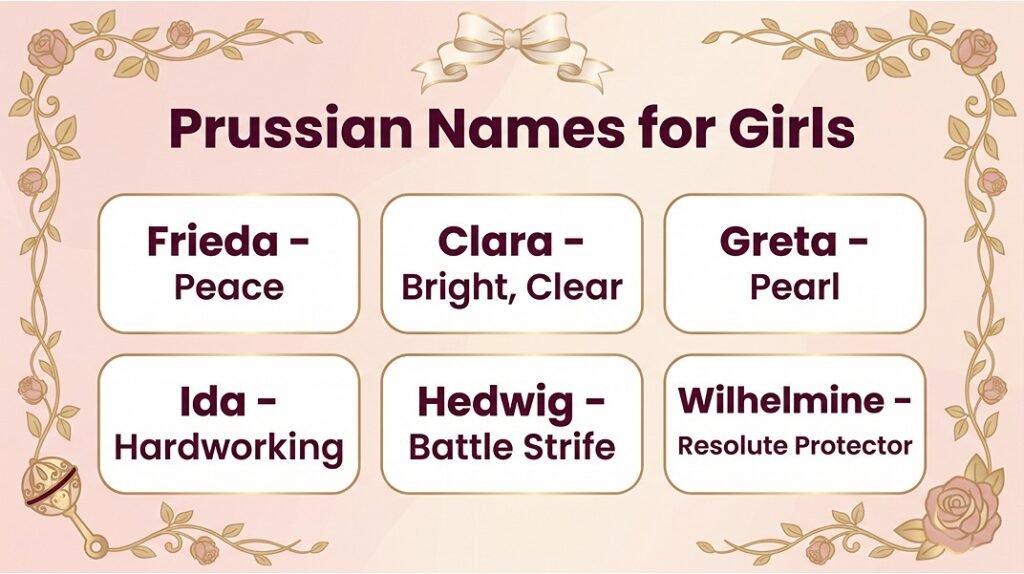
Spelling shifts with the date and the region. East Prussian records around 1800 sometimes show Scharlotte where later records show Charlotte, and the girl called Lotte at home may carry either on paper. For a modern baby, keep the sound and drop the old spelling, so Frieda or Helene feels classic instead of costumed.
| Name | Meaning | Origin | Style |
|---|---|---|---|
| Alma | nourishing | Latin | Soft |
| Annemarie | grace and beloved | Hebrew and Latin | Everyday |
| Alwine | noble friend | Germanic | Vintage |
| Berta | bright | Germanic | Sturdy |
| Clara | bright, clear | Latin | Classic |
| Dagmar | day maiden | Scandinavian | Northern |
| Edith | prosperous in war | Old English | Strong |
| Elfriede | elf strength | Old English and German | Vintage |
| Elsa | God is my oath (short for Elisabeth) | Hebrew via German | Soft |
| Emma | whole, universal | Germanic | Classic |
| Erna | earnest (feminine of Ernst) | Germanic | Plain |
| Frieda | peace | Germanic | Warm |
| Gerda | enclosure, protector | Norse and Germanic | Calm |
| Greta | pearl (short for Margareta) | Greek via Latin | Light |
| Hedwig | battle strife | Germanic | Saintly |
| Helene | torch, shining light | Greek | Classic |
| Ida | work, industrious | Germanic | Classic |
| Ilse | God is my oath (short for Elisabeth) | Hebrew via German | Short |
| Ingeborg | Ing's protection | Norse and Germanic | Northern |
| Irma | whole, universal | Germanic | Soft |
| Jutta | praised (form of Judith) | Hebrew | Northern |
| Käthe | pure (short for Katharina) | Greek | Warm |
| Kordula | little heart | Latin | Rare |
| Lina | tender (short for names ending in -lina) | German | Light |
| Liesel | pet form of Elisabeth | German | Playful |
| Liselotte | Elisabeth and Charlotte joined | German | Playful |
| Lotte | free woman (short for Charlotte) | German | Playful |
| Minna | love, memory (short for Wilhelmine) | Germanic | Homey |
| Renate | reborn | Latin | Hopeful |
| Rosa | rose | Latin | Classic |
| Sabine | woman of the Sabines | Latin | Classic |
| Thekla | God's glory | Greek | Rare |
| Trude | strength (short for Gertrud) | Germanic | Brisk |
| Walburga | powerful protection | Germanic | Church |
| Wiltrud | will and strength | Germanic | Vintage |
| Hanna | grace | Hebrew | Classic |
Tip: for a baby name, Frieda, Clara, Greta and Ida are easy to say and spell in modern America and still read as Prussian.
Fantasy Prussian Names
These names are invented, and that’s the point. They use real German word parts, so they sound right, but no register ever recorded them. Use them for fantasy kingdoms, steampunk armies or game factions that borrow Prussia’s feel without claiming its history.
The recipe is simple. Take a first name from the Germanic or military tables, then build a surname from a nature word plus a place ending: -wald (forest), -berg (mountain), -feld (field), -stein (stone), -hain (grove) or -horst (nest). Add von only for nobles. Done.
Format: Name — meaning · origin · style
- Aldric von Eisenwald — old ruler of the iron forest · invented, German roots · Dark fantasy
- Emmerich Falkenhain — home ruler of the falcon grove · invented, German roots · Knightly
- Hagen Schattenberg — thorn hedge of the shadow mountain · invented, German roots · Gothic
- Ansgar Sturmfeld — god’s spear of the storm field · invented, German roots · Heroic
- Dietmar Nebelwald — famous among the people, of the fog forest · invented, German roots · Mystic
- Falko Rabenstein — falcon of the raven stone · invented, German roots · Gothic
- Ingmar Eichenau — famed Ing of the oak meadow · invented, German roots · Pastoral
- Radulf Kronenfeld — counsel wolf of the crown field · invented, German roots · Courtly
- Sigrich Steinhardt — victory ruler, stone-hard · invented, German roots · Warlord
- Thankmar Winterfeld — famed thinker of the winter field · invented, German roots · Cold court
- Wendel Aschenberg — a Wend (Slavic neighbor) of the ash mountain · invented, German roots · Frontier
- Gero Eisenfels — spear of the iron cliff · invented, German roots · Soldierly
- Berno Donnerstein — bear of the thunder stone · invented, German roots · Brawler
- Odo Adlerhorst — wealth of the eagle’s nest · invented, German roots · Noble
- Ortwin Grauwald — spear friend of the gray forest · invented, German roots · Ranger
- Liudger Hohenrain — people’s spear of the high ridge · invented, German roots · Highlander
- Heimo Birkenau — keeper of the home at the birch meadow · invented, German roots · Pastoral
- Eckwin Wolfsfeld — sword friend of the wolf field · invented, German roots · Hunter
- Wolfrik Bärenthal — wolf ruler of the bear valley · invented, German roots · Beastly
- Hartlieb Hirschberg — brave and dear, of the stag mountain · invented, German roots · Huntsman
- Adelinde Rosenhain — noble and gentle, of the rose grove · invented, German roots · Courtly
- Alruna Nachtigall — secret rune of the nightingale · invented, German roots · Mystic
- Gundula Silberquell — little war-maid of the silver spring · invented, German roots · Warrior-mystic
- Ortrun Dornrose — spear secret of the thorn rose · invented, German roots · Gothic
- Reinhild Klarbach — counsel in battle by the clear brook · invented, German roots · Strategist
- Swanhild Schneefeld — swan battle-maid of the snow field · invented, German roots · Winter
- Ermelinde Lindenau — whole and gentle, of the linden meadow · invented, German roots · Pastoral
- Rotraud Morgenstern — fame and strength under the morning star · invented, German roots · Heroic
- Wolfhilde Eulenwald — wolf battle-maid of the owl forest · invented, German roots · Wild
- Bertrun Blauberg — bright secret of the blue mountain · invented, German roots · Mystic
- Hildrun Rotenfels — battle secret of the red cliff · invented, German roots · Warrior
- Gerhild Sonnenhof — spear and battle at the sun farm · invented, German roots · Frontier
- Walthild Mondschein — ruling battle-maid in the moonlight · invented, German roots · Dark court
- Runhild Birkenstein — secret battle-maid of the birch stone · invented, German roots · Folkloric
- Uta Lerchenfeld — prosperity of the lark field · invented, German roots · Gentle
- Kunhild Wolfsbrunn — clan battle-maid of the wolf well · invented, German roots · Wild
Tip: avoid reusing the same place ending twice in one cast, because it makes the world feel like one family.
Old-Fashioned Prussian Names
Old-fashioned names sound like a stern portrait on a parlor wall. They’re long, a little stern, and often tied to a saint’s day or a pious phrase. Gotthilf means “God’s help,” and Ehrenfried means “peace of honor.” Hand one to a character and you’ve signaled age, faith and class before the first line of dialogue even starts in the scene.
A caution on Aloysius, Dagobert and Hieronymus: they can sound like punchlines to English ears. Read them aloud in a serious scene and see if you smile. If you do, use the short form, such as Aloys or Bert. Families did the same in real life, and that’s how pet forms like Fritz and Lutz won out.
| Name | Meaning | Origin | Style |
|---|---|---|---|
| Amandus | worthy of love | Latin | Antique |
| Bonifaz | good fate | Latin (Bonifatius) | Saintly |
| Dagobert | shining day | Frankish | Merovingian |
| Ehrenfried | peace of honor | German | Pietist |
| Engelbert | bright angel | Germanic | Medieval |
| Eugen | well-born | Greek | Genteel |
| Friedhelm | peace helmet | Germanic | Sturdy |
| Gotthilf | God's help | German | Pietist |
| Hieronymus | sacred name | Greek | Scholarly |
| Hinrich | home ruler (Low German Heinrich) | Low German | Northern |
| Isidor | gift of Isis | Greek | Antique |
| Jobst | lord (Low German form of Jodocus) | Low German | Rustic |
| Bernward | bear guardian | Germanic | Medieval |
| Kornelius | of the Cornelii clan | Latin | Classical |
| Ludolf | famous wolf | Germanic | Medieval |
| Melchior | king of light | Hebrew | Biblical |
| Pankraz | all-powerful | Greek (Pancratius) | Saintly |
| Sixtus | sixth | Latin | Papal |
| Urban | city dweller | Latin | Papal |
| Veit | life (German form of Vitus) | Latin | Saintly |
| Wendelin | a Wend (Slavic neighbor) | Germanic | Rural |
| Wenzel | more glory (from Czech Václav) | Slavic | Bohemian |
| Zacharias | God remembers | Hebrew | Biblical |
| Aloysius | Latin form of Ludwig, famous warrior | Latin | Catholic |
| Gottwald | God rules | German | Pietist |
| Eulalia | well-spoken | Greek | Antique |
| Hulda | grace, favor | Germanic | Gentle |
| Irmtraud | whole strength | Germanic | Vintage |
| Rosamunde | horse protector (folk glosses vary) | Germanic | Romantic |
| Sibylle | prophetess | Greek | Mystic |
| Swantje | swan (Low German pet form) | Low German | Coastal |
| Thusnelda | wife of Arminius in Roman sources; meaning debated | Germanic | Legendary |
| Ulrike | prosperous ruler | Germanic | Stern |
| Veronika | bringer of victory | Greek | Saintly |
| Wilma | resolute protector (short for Wilhelmina) | Germanic | Homey |
| Gerlinde | spear and gentle | Germanic | Vintage |
| Herlinde | army and gentle | Germanic | Vintage |
| Hiltrud | battle strength | Germanic | Vintage |
Tip: one old-fashioned name per family is enough; a whole cast of them reads like a costume drama.
Conclusion
Prussian names are German, Christian and Baltic all at once, and that mix is what makes them feel real to a reader who knows the period. Start with the era, choose a first name from the matching table, then add a surname from the same rank or region. Check the meaning, say it aloud, and keep one old spelling for flavor pick one.
If you’re tracing a real family, treat these tables as a starting map, not proof. Confirm with church records and a tool like FamilySearch, because spellings shifted from clerk to clerk. If you’re writing fiction, take what fits and invent the rest. Either way, a name that carries a meaning does quiet work for your story.
Prussian Names FAQs
Are Prussians Russian or German?
Neither, strictly. The original Prussians were a Baltic people who spoke Old Prussian. Later the name passed to the German-speaking Kingdom of Prussia. The old East Prussian lands now sit in Poland, Russia and Lithuania, which is why people link the region to all three.
What are some cool old German names?
Try Gottfried, Wolfram, Hildegard, Engelbert, Sieglinde or Thekla. All of them appear in the tables above with meanings, so you can check the fit before you commit.
What are some Prussian last names?
Brandt, Krüger, Krause, Lehmann and Schulz are common German picks. For Baltic roots, look at Liedke, Marohn and Massoth. For a Masurian family, Kowalski or Mazur works.
What were Old Prussian names?
They were the personal names of the Baltic-speaking Old Prussians, such as Herkus. Few survive, and most come from German Order documents, so spellings are uncertain.
What is a rare German name?
Kunigunde, Pankraz, Wendelin and Thusnelda are rare today. The East Prussian forms Prenkus and Auksa are rarer still. Rarity depends on era, so match the name to your setting.
How did Prussia fall?
It fell in steps. The monarchy ended in the 1918 revolution, and Prussia became a free state in the Weimar Republic. In 1932 the national government took over Prussia’s state government. After the war, the Allies formally abolished the state in 1947.
What did Prussian people look like?
Prussia held Germans, Poles, Lithuanians, Masurians, Jewish families, Huguenot descendants and others. What most people picture is the uniform: dark blue coats and the spiked Pickelhaube helmet, which Prussia adopted in 1842.
What are typical Prussian names?
Friedrich, Wilhelm, Heinrich, Karl and Johann for men, and Charlotte, Luise, Sophie, Wilhelmine and Anna for women. Villages added regional forms such as Mertin and Endris.
What’s the best Prussian name for a male lead?
Leopold, Bernhard or Gotthard. They sound strong, fit the period and avoid the overused Wilhelm.
Are Prussian names the same as German names?
Mostly yes. The difference is flavor: Prussian lists add East Prussian forms, Baltic roots and Polish-Masurian surnames that you won’t find in a general German list.