
You need a name for a broken world, and dystopian names with meanings, origins and story roles. Find rebel, villain, hacker and city names that fit your world. Start picking yours.
Dystopian names refer to character, place and group names built for stories set in oppressive, broken or tightly controlled futures. They signal a character’s role, class or lost identity through sound, meaning or format.
Fast picks, Wren for a scout, Cassian for a cold senator, Nyx for a hacker, Saoirse for a freedom fighter and Unit K-17 for a citizen stripped of identity.
Writers who’ve tried random generators often report names that feel like they belong to a different book. This list fixes that by tying every name to a role and a reason.
- What is Dystopian Meaning?
- Dystopian Names Generator
- What is a Dystopian Name?
- Where do Dystopian Names Come From?
- Dystopian Character Names
- Dystopian Villain Names
- Unique Dystopian Names
- Dystopian Names for Writers
- Dystopian Boy Names
- Dystopian Girl Names
- Dark Dystopian Names
- Dystopian Rebel Names
- Futuristic Dystopian Names
- Post-Apocalyptic Names
- Dystopian Baby Names
- Dystopian Fantasy Names
- Dystopian Names for Places
- Dystopian Last Names
- Conclusion
- Dystopian Names FAQs
This works best for novelists, game masters, modders and worldbuilders who need role-based names fast. It won’t help if you need names rooted in one specific real-world culture. This guide covers English-language dystopian settings and names with Latin, Greek, Germanic, Celtic and Norse roots. It does NOT cover every naming tradition on Earth.
What is Dystopian Meaning?
Dystopian describes an imagined society where life is unfair, frightening and tightly controlled. According to Merriam-Webster, a dystopia is a place where people are unhappy and afraid because they are treated unfairly. In fiction, that means surveillance, scarcity and lost freedom. A dystopian name usually hints at that world before the character speaks names do real work.
Dystopian names matter because readers love this genre. According to Scholastic’s March 2025 announcement, The Hunger Games series has passed 100 million copies in print and digital worldwide, and the prequel Sunrise on the Reaping sold over 1.5 million English-language copies in its first week. That’s a huge audience, and it expects names that feel earned.
Dystopian Names Generator
Dystopian Names Generator
Choose a category, tap Generate, then save the names you like.
My picks (0)
This tool shows a quick sample. The full list below has 550+ names with meanings, origins and story roles.
A dystopian names generator works by mixing three parts: a role, a sound style and a meaning. The tool gives you raw options. You still decide what fits your regime. Most random generators skip that step, so their output feels detached from the story. A better method is to pick the role first, then browse names built for it.
You’ve probably tried one already, and it’s likely the names didn’t feel right. That’s normal. Reedsy’s Character Name Generator and Fantasy Name Generators give you volume, while Behind the Name lets you check meaning and origin before you commit to a name that will appear on 300 pages.
How should you use a dystopian name generator? Dystopian name generators work best when you choose the role, regime type and sound style first. Random tools give volume but rarely give meaning, so check each result on Behind the Name before you commit. One minute of checking per name saves a rewrite later.
Quick Formula for Building Your Own
| Step | What to choose | Example |
|---|---|---|
| Role | Rebel, ruler, enforcer, citizen or outsider | Rebel → Saoirse |
| Sound | Soft for civilians, hard for enforcers | Soft: Wren. Hard: Gunnar |
| Meaning | Match the root to the character’s fate | Verity (“truth”) for a whistleblower |
| Format | Real, invented, nature or coded | Unit K-17 for a state-assigned soldier |
To pick a dystopian name, follow these steps:
- Decide the character’s role: rebel, ruler, enforcer, citizen or outsider.
- Choose your regime type: surveillance, corporate, post-collapse or AI-ruled.
- Pick a style: real name, invented name, nature word or number.
- Check the meaning and origin on Behind the Name.
- Say it aloud and test it in one sentence.
What is a Dystopian Name?
A dystopian name is a name chosen to show a character’s role in an unfair or controlled society. According to Merriam-Webster, a dystopia is an imagined place where people are unhappy and usually afraid because they are treated unfairly, so these names often signal control, class or lost identity through sound and meaning.
Where do Dystopian Names Come From?
Dystopian names come from five main sources, Latin and Greek roots for rulers, plain English names for citizens, nature words for survivors, tech words for AI and hackers, and numbers for state-owned people. According to Scholastic, The Hunger Games series has passed 100 million copies worldwide, so readers already know these patterns.
Dystopian Character Names
Dystopian character names need a clear job. A reader should guess a character’s rank from the name alone, the way people guess it in real life from a title or a surname. Rank shows in the name. The five groups below cover the cast most stories need: rulers, enforcers, scientists, ordinary citizens and corporate heads.
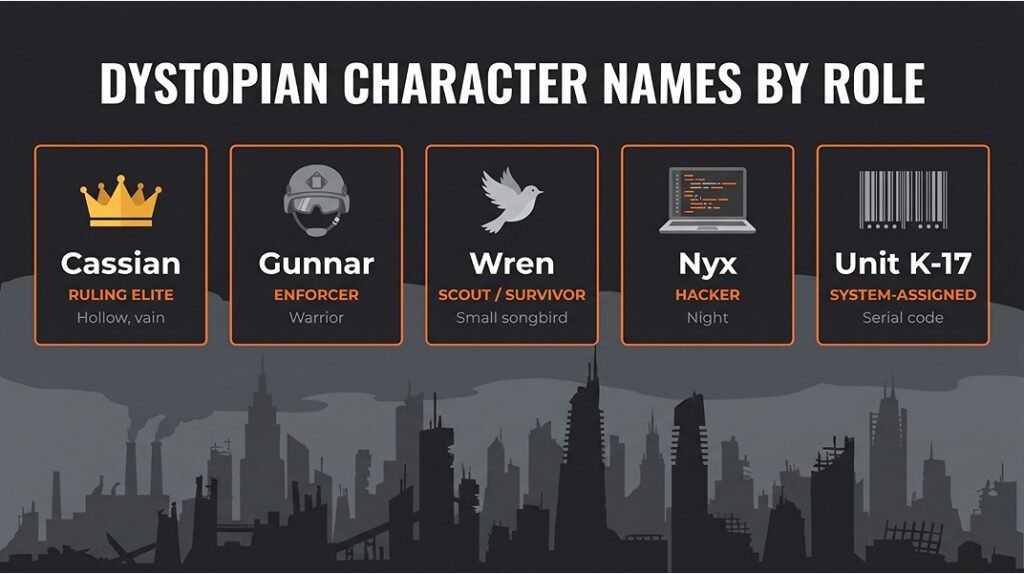
Checking matters. Some sites list Cassian as “hollow, vain.” Others call it a Roman family name with no clear root. I’ve seen conflicting data — some sources point to the Latin cassus (“empty, vain”), while others say nobody knows. My read: plausible, not proven, so I treat it as a likely meaning and verify on Behind the Name.
Ruling Elite Names
| Name | Meaning | Origin | Style-Role: why it works |
|---|---|---|---|
| Cassian | Hollow, vain (likely) | Latin | Ruling Elite / Strategist: a refined name for a cold senator or party official |
| Octavian | Of Octavius (eighth) | Latin | Heir: a young ruler groomed for power |
| Tiberius | Of the Tiber river | Latin | Aging Ruler: suspicious and tired |
| Augustus | Venerable, majestic | Latin | Supreme Leader: a grand title as a name |
| Severus | Stern | Latin | Chief Judge: harsh and humorless |
| Valerian | Strong, healthy | Latin | Elite General: trained to win |
| Maximus | Greatest | Latin | Games Master: runs the spectacle |
| Flavian | Golden-haired | Latin | Media Idol: the face of the regime |
| Aurelian | Golden | Latin | Wealthy Heir: raised in comfort |
| Regulus | Little king | Latin | Puppet Ruler: crown without control |
| Seneca | Old, elder | Latin | Advisor: a wise-sounding schemer |
| Lucretia | Wealth, gain | Latin | Elite Matriarch: owns half the city |
| Praetor | Leader, magistrate | Latin | Magistrate: a title used as a name |
| Prefect | Placed in charge | Latin | District Overseer: runs one sector |
| Regent | Ruler | Latin | Stand-In Ruler: holds the throne for someone else |
| Consul | Chief magistrate | Latin | Elected Figurehead: a vote with no power |
| Tribune | Tribe official | Latin | Public Voice: speaks “for” the people |
| Magnate | Great one | Latin | Industrial Ruler: owns the factories |
| Viceroy | Vice-king | French | Colonial Governor: rules a far province |
| Victoria | Victory | Latin | Propaganda Queen: always winning on screen |
| Augusta | Venerable | Latin | First Lady of the Regime: polished and distant |
| Aemilia | Rival | Latin | Political Rival: always scheming |
| Justina | Just | Latin | Ironic Judge: justice in name only |
| Honoria | Honor | Latin | Public Figure: stands for decency, hypocritically |
| Marcella | Little warrior | Latin | Security Chief: small name, hard grip |
Enforcer Names
Enforcers need names that sound like a boot on stone. Hard consonants and Germanic or Norse roots do that work quickly, so readers sense force before the first scene.
| Name | Meaning | Origin | Style-Role: why it works |
|---|---|---|---|
| Gunnar | Warrior | Old Norse | Enforcer: broad and blunt |
| Brandt | Fire, sword | Germanic | Riot Captain: burns through crowds |
| Ulrich | Wolf power | Germanic | Hound Commander: leads the pack |
| Rolf | Famous wolf | Germanic | Patrol Guard: always circling |
| Konrad | Brave counsel | German | Interrogation Chief: calm and deadly |
| Hagen | Enclosure | Germanic | Gate Guard: keeps people in |
| Wolfram | Wolf raven | Germanic | Dissident Hunter: tracks and finds |
| Dietrich | Ruler of the people | German | Police Commissioner: authority built in |
| Gerhard | Brave spear | Germanic | Border Officer: guards the line |
| Otto | Wealth | Germanic | Bureaucrat-Guard: a clerk with a baton |
| Siegfried | Victory, peace | Germanic | Propaganda Soldier: glorifies the regime |
| Thorsten | Thor’s stone | Old Norse | Wall Guard: stands like masonry |
| Ragnar | Warrior’s counsel | Old Norse | Raider Chief: leads the sweeps |
| Sven | Young man | Old Norse | Foot Soldier: common and blunt |
| Brunhild | Armored battle | Germanic | Female Commander: heavy and unbending |
| Hilda | Battle | Germanic | Prison Matron: keeps order with a key ring |
| Warden | Guardian | Old French | Prison Chief: a title as a name |
| Marshal | Horse servant; officer | Old French | Peace Officer: wears a badge, not a name |
| Sentinel | Guard | Latin / French | Watchtower Guard: sees everything |
| Bailiff | Steward; officer | Old French | Debt Collector: collects what you owe |
| Provost | Chief officer | Old French | District Enforcer: rules the local block |
Scientist Names
| Name | Meaning | Origin | Style-Role: why it works |
|---|---|---|---|
| Galen | Calm | Greek | Physician: steady hands, cold eyes |
| Hypatia | Highest | Greek | Mathematician: brilliant and endangered |
| Ada | Noble | Germanic | Code Pioneer: writes the first program |
| Isidore | Gift of Isis | Greek | Lab Director: runs the facility |
| Ptolemy | Warlike | Greek | Astronomer: maps the sky for the state |
| Euclid | Good glory | Greek | Systems Engineer: builds with pure logic |
| Ambrose | Immortal | Greek | Life-Extension Researcher: chases forever |
| Prometheus | Forethought | Greek | Fire Giver: steals forbidden tech |
| Daedalus | Skilled worker | Greek | Chief Engineer: builds the maze |
| Erasmus | Beloved | Greek | Humanist Doctor: fights the cold science |
| Eudora | Good gift | Greek | Pharmacist: controls the medicine |
| Sophia | Wisdom | Greek | AI Ethicist: asks the hard question |
| Thales | Blooming | Greek | Natural Philosopher: studies the broken earth |
| Zeno | Gift of Zeus | Greek | Logician: a paradox maker |
| Selene | Moon | Greek | Lunar Colony Doctor: works far from home |
| Faust | Fortunate | Latin | Bargainer: sells conscience for knowledge |
| Agatha | Good | Greek | Toxicologist: mixes the poison |
| Celeste | Heavenly | Latin | Astronomer: watches for the way out |
| Philo | Love | Greek | Social Scientist: studies why people obey |
| Paracelsus | Beyond Celsus | Latin / Greek | Alchemist: pushes forbidden medicine |
Citizen Names
Ordinary citizens need ordinary names. Plain, slightly old-fashioned choices make the cast feel like real people instead of heroes in disguise.
- Walter — ruler of the army — Germanic — Clerk: an old-fashioned name for a paper-pusher.
- Edith — prosperous in war — Old English — Seamstress: worn and familiar.
- Harold — army ruler — Old English — Foreman: plain and trusted.
- Mabel — lovable — Latin — Baker: kind and small.
- Clara — bright, clear — Latin — Teacher: a bright voice in a gray school.
- Frank — free man — Germanic — Informer: a quietly ironic name for someone not free.
- June — the month; youth — Latin — Factory Girl: a month, a label.
- Ruth — compassion — Hebrew — Nurse: care in a cold ward.
- Agnes — pure, holy — Greek — Widow: quiet and watched.
- Hugh — mind, spirit — Germanic — Radio Operator: short and forgettable.
- Rosa — rose — Latin — Flower Seller: color in a gray market.
- Stanley — stony clearing — Old English — Night Guard: stony and steady.
- Olive — olive tree — Latin — Orchard Keeper: peace in a tense town.
- Alma — nourishing — Latin — Cook: feeds the whole block.
- Cora — maiden — Greek — Daughter: young and watched.
- Dale — valley — Old English — Farmer: a valley dweller.
- Ivy — climbing plant — Old English — Street Kid: clings to the cracks.
- Nora — honor — Latin — Records Clerk: honor hidden in paperwork.
- Pearl — gem — Latin — Pawnbroker: a small treasure.
- Ralph — wolf counsel — Old English — Transit Driver: drives the same route daily.
- Vera — faith; truth — Slavic / Latin — Truth Seeker: questions the party line.
- Abel — breath — Hebrew — Victim: fragile, the one the regime picks first.
Corporate Executive Names
| Name | Meaning | Origin | Style-Role: why it works |
|---|---|---|---|
| Sterling | Excellent; silver penny | Old English | CEO: a polished brand |
| Prescott | Priest’s cottage | Old English | Board Chair: old money |
| Hartwell | Deer well | Old English | Pharma Chief: owns the cure |
| Winslow | Friend’s hill | Old English | Lobbyist: smooth and friendly |
| Thorpe | Village | Old Norse | Logistics Head: moves the goods |
| Kingsley | King’s meadow | Old English | Founder Heir: inherited the empire |
| Maxwell | Mack’s stream | Scots | Operations Chief: efficient and cold |
| Fairfax | Fair hair | Old English | PR Director: manages the image |
| Harcourt | Fortified court | Old French | Security Contractor: sells protection |
| Vance | Marsh | Old English | Fixer: cleans up messes |
| Whitlock | White lock of hair | Old English | Old-Money Chair: quiet and powerful |
| Beaumont | Beautiful mountain | Old French | Real Estate Mogul: owns the skyline |
| Delacroix | Of the cross | French | Media Mogul: controls the story |
| Sinclair | Saint Clair | Old French | Lab Owner: funds the experiments |
| Croft | Small farm | Old English | Land Baron: owns the farms the poor work |
Dystopian Villain Names
Dystopian villain names should sound like they’ve already won. Draco gave us the word “draconian,” so the name already means harsh law. Caligula means “little boot,” a childhood nickname that history made terrifying. Name a villain after a real tyrant and readers feel the weight right away.
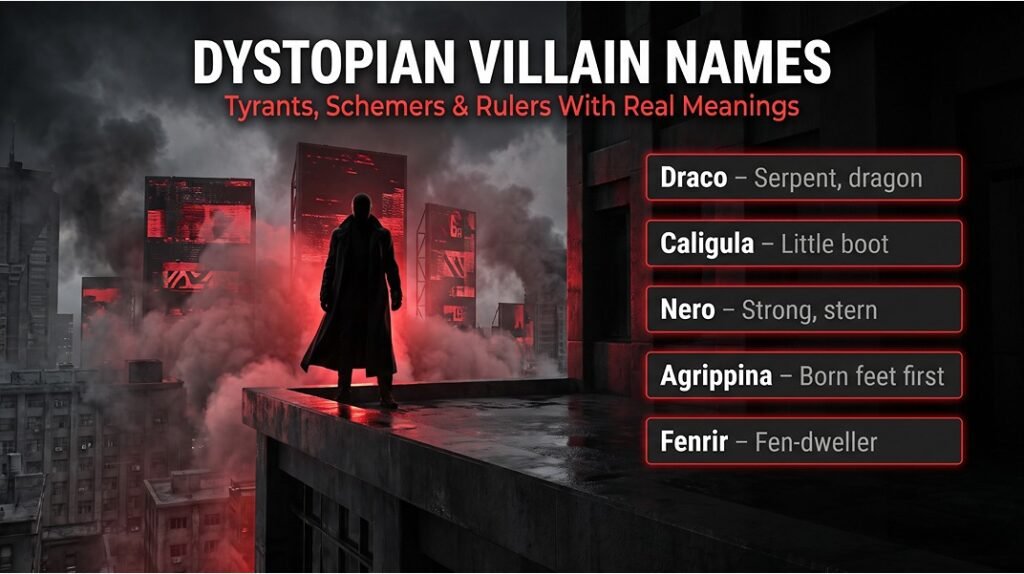
The best villain names are rarely loud. Subtle wins. A smooth name like Domitian or Agrippina reads like a magistrate’s signature, while spiky ones like Apep or Fenrir suit monsters and warlords. Pick the sound that matches how your villain rules, through paperwork or through fear, and let the meaning do the rest.
| Name | Meaning | Origin | Style-Role: why it works |
|---|---|---|---|
| Nero | Strong, stern | Latin | Tyrant: an infamous emperor’s name |
| Caligula | Little boot | Latin | Mad Ruler: a cute nickname turned dark |
| Brutus | Heavy, dull | Latin | Betrayer: the friend who strikes |
| Draco | Serpent, dragon | Greek | Harsh Lawgiver: source of “draconian” |
| Vlad | Rule with glory | Slavic | Ruthless Prince: fear as policy |
| Lucifer | Light bringer | Latin | Fallen Visionary: brilliant and proud |
| Styx | Hateful | Greek | Border Warden: guards the river of the dead |
| Thanatos | Death | Greek | Execution Chief: runs the final step |
| Nemesis | Retribution | Greek | Vengeful Hunter: always catches up |
| Damien | To tame | Greek | Smooth Persuader: tames crowds with charm |
| Belial | Worthlessness | Hebrew | Corrupt Official: rotten inside |
| Mammon | Wealth | Aramaic | Greed Baron: hoards the supply |
| Moloch | King | Hebrew | Devouring State: eats its young |
| Legion | Military unit | Latin | Faceless Army: many acting as one |
| Judas | Praised | Hebrew | Informant: sells friends for a reward |
| Iago | James; supplanter | Spanish | Manipulator: whispers in the right ear |
| Macbeth | Son of life | Scots Gaelic | Usurper: takes the throne by force |
| Regan | Little king | Irish | Cruel Heir: ambitious and sharp |
| Delilah | Delicate | Hebrew | Seductive Spy: wins trust, then uses it |
| Medusa | Guardian | Greek | Gaze Control: her stare freezes crowds |
| Circe | Hawk | Greek | Mind-Changer: turns people into beasts |
| Hecate | Far-reaching (disputed) | Greek | Hidden Power Broker: works from the dark |
| Lamia | Devourer | Greek | Predator Politician: feeds on followers |
| Ursula | Little bear | Latin | Matron Overseer: maternal and cruel |
| Agrippina | Born feet first | Latin | Schemer: poisons her way up |
| Domitian | Of Domitius | Latin | Paranoid Emperor: trusts no one |
| Commodus | Convenient | Latin | Spoiled Heir: power without skill |
| Hadrian | From Hadria | Latin | Wall Builder: fences the world |
| Despot | Master | Greek | Absolute Ruler: a title as a name |
| Autarch | Self-ruler | Greek | Sole Authority: answers to no one |
| Tyrant | Absolute ruler | Greek | Blunt Villain: leaves no doubt |
| Ravana | Roaring | Sanskrit | Demon King: a booming ruler |
| Apep | Serpent of chaos | Egyptian | Chaos Warlord: wants the world to burn |
| Fenrir | Fen-dweller | Old Norse | Beast Lord: a wolf that breaks its chains |
| Hel | Hidden | Old Norse | Death Queen: rules the quiet below |
Unique Dystopian Names
Unique dystopian names stand out because they carry a reason. Octavia sounds pretty until you learn it means “eighth,” and suddenly it reads like a child numbered at birth, which is exactly the kind of quiet horror this genre runs on. Small twist. Big payoff. Pick names that hide a second meaning, and your world feels planned instead of random.
Most writers assume a unique name needs a strange spelling. The books readers still quote say otherwise: Winston, Katniss, Rue. Plain names did the heavy lifting. The lists below mix three styles, which are numbers for state-owned people, nature words for ordinary survivors, and real names with hidden meanings.
| Option | Best For | Key Benefit | Limitation |
|---|---|---|---|
| Real names with hidden meanings | Rulers, rebels, citizens | Feels natural and rewards curious readers | Needs a quick meaning check |
| Invented names | Fantasy-leaning worlds | Fully original | Hard to say aloud, and meaning is up to you |
| Nature words | Poor districts, scouts, survivors | Short, earthy, easy to remember | Easy to overuse (Raven, Phoenix) |
| Numbers and codes | State-owned or engineered people | Instant sense of lost identity | Tiring across a big cast |
System-Assigned Names (Numbered)
Use these for people the state owns, counts or builds. Each entry shows the name, what the label means, its format and the role it fits.
- Unit K-17 — serial code — numeric, state-assigned — System-Assigned / Soldier: an engineered fighter stripped of identity.
- Citizen 4471 — census number — numeric, state-assigned — Citizen: a worker the state counts but never names.
- Subject 09 — lab designation — numeric, scientific — Test Subject: the survivor of an experiment.
- Ward A-12 — care-home label — alphanumeric — Orphan: raised and named by the state.
- Cell 306 — prison location — numeric — Prisoner: known only by where they are kept.
- Tag 7-Delta — transport label — alphanumeric — Laborer: moved around like cargo.
- Asset R-208 — ledger entry — alphanumeric — Corporate Property: a worker owned on paper.
- Batch 44-Echo — hatchery group — alphanumeric — Engineered Citizen: grown in a lot, not born.
- Cog 12 — machine part — word plus number — Factory Worker: replaceable by design.
- Node Seven — network point — word plus number — AI Operator: a human used as a relay.
- Surrogate 39 — stand-in — word plus number — Ritual Proxy: attends ceremonies for the wealthy.
- Vessel 5 — container — word plus number — Carrier: chosen for breeding or sacrifice.
- Aux-114 — auxiliary unit — alphanumeric — Support Guard: low-rank staff with no name of their own.
- Quota 21 — labor target — word plus number — Laborer: named by the work they owe.
- Ledger 6 — account book — word plus number — State Accountant: a clerk lost in a vast archive.
- Mark 902 — brand or tattoo — word plus number — Branded Citizen: tracked by a mark on the body.
- Replica 3 — copy — word plus number — Clone: the third version of someone.
- Lot 59 — auction item — word plus number — Sold Person: traded like goods.
- Seed 12 — origin — word plus number — Program Child: raised by a breeding scheme.
- Drone 8 — remote unit — word plus number — Remote Soldier: a pilot or a controlled fighter.
- Index 33 — archive entry — word plus number — Filed Citizen: lost inside a data system.
- Signal 71 — transmission — word plus number — Surveillance Monitor: watches screens all day.
- Gamma-9 — third caste — Greek letter plus number — Caste Citizen: a mid-rank worker.
- Delta-12 — fourth caste — Greek letter plus number — Low-Caste Worker: bottom of the ladder.
- Null-0 — nothing — word plus number — Erased Person: someone deleted from the records.
Some writers argue that codes make a big cast hard to follow. That’s valid for a 400-page novel with 40 characters. But if you’re writing a short story, a game squad of five or a single flashback, a code lands harder than a real name.
Nature-Inspired Names
| Name | Meaning | Origin | Style-Role: why it works |
|---|---|---|---|
| Wren | Small songbird | Old English | Survivor / Scout: a fragile-sounding name for an underestimated rebel |
| Briar | Thorny shrub | Old English | Hidden Thorn: soft look, sharp edge |
| Fern | Feathery plant | Old English | Ruin Dweller: grows where nothing should |
| Hazel | Hazel tree | Old English | Farm Worker: humble and rooted |
| Willow | Willow tree | Old English | Survivor: bends but doesn’t break |
| Rowan | Little red one; rowan tree | Irish / Old Norse | Guardian: the tree once hung as a protective charm |
| Alder | Alder tree | Old English | Marsh Dweller: a damp, forgotten settlement |
| Linden | Linden tree | Old English | Old-World Citizen: keeps pre-collapse memory |
| Sorrel | Sour reddish plant | Old French | Sharp Tongue: bitter wit |
| Thistle | Prickly plant | Old English | Stubborn Fighter: hard to pull out |
| Moss | Tiny soft plant | Old English | Quiet Survivor: grows on ruins |
| Clover | Meadow plant | Old English | Ironic Lucky One: luck in a bleak place |
| Sparrow | Small common bird | Old English | Everyday Citizen: overlooked on purpose |
| Heron | Wading bird | Old French | Watcher: patient and still |
| Lark | Dawn songbird | Old English | Hope Bearer: sings at first light |
| Finch | Small seed-eater | Old English | Messenger: tiny and quick |
| Kestrel | Small falcon | French | Scout / Drone Pilot: hovers and watches |
| Osprey | Fish hawk | Latin via French | Sea Raider: hunts coastal ruins |
| Cedar | Evergreen tree | Greek via Latin | Elder: endures every winter |
| Juniper | Evergreen shrub | Latin | Hardy Survivor: grows in poor soil |
| Aspen | Trembling poplar | Old English | Nervous Informer: leaves that shake |
| Ash | Ash tree; cinders | Old English | Burnt-World Child: carries the fire’s memory |
| Hawthorn | Thorny hedge tree | Old English | Border Guard: a living barrier |
| Bryony | Climbing vine | Latin / Greek | Rumor Spreader: climbs unnoticed |
| Sage | Wise; healing herb | Latin | Healer: calm advisor |
| Flint | Hard spark stone | Old English | Spark Maker: starts fires |
| Basalt | Dark volcanic rock | Latin | Foundation Worker: heavy and unmoving |
| Slate | Gray stone | Old French | Gray Citizen: blank and uniform |
| Tarn | Mountain lake | Old Norse | Hermit: cut off from the city |
| Reed | Tall grass; red | Old English | Bending Citizen: survives by yielding |
| Marigold | Mary’s gold (a golden flower) | Middle English | Hope in Gray: color in a dull city |
| Dahlia | Flower named for Anders Dahl | Swedish | Elite Garden Child: cultivated and delicate |
| Yarrow | Healing herb | Old English | Field Medic: stops the bleeding |
| Bracken | Large fern | Old Norse | Wasteland Dweller: spreads over ruins |
| Heath | Open wild land | Old English | Wanderer: no walls, no home |
Dystopian Names for Writers
Writers don’t need a thousand names they need the right twenty. Your reader’s seen ten Hunger Games clones, they’d notice a lazy name in a second, and they won’t forgive it by chapter three. So build a small, deliberate cast. Give each name a job, a sound and a reason to exist.
What most guides skip is the link between a name and power. In a regime, names are tools: they show who owns whom, and they change when a character rises, falls or gets erased. Track every name in Scrivener or Notion, and check that no two main characters start with the same letter.
Naming Equals Class and Control
Orwell gave his hero the plainest name possible, Winston Smith, so he could stand for any citizen. Margaret Atwood went further: Offred is “of Fred,” a name that says who owns her. Suzanne Collins split Panem by sound, with Roman-style Capitol names (Cinna, Seneca, Coriolanus) against earthy district names (Rue, Primrose). Soft and plain for the ruled, formal and old for the rulers.
Name by Regime Type
| Regime | Naming Pattern | Examples From This List | Why It Works |
|---|---|---|---|
| Surveillance state | Short plain names for citizens, titles for watchers | Citizen 4471, Warden, Argus | The watched feel replaceable, the watchers feel official |
| Corporate state | Brand-like surnames and product codes | Sterling, Asset R-208, Titan | Names read like contracts |
| Post-collapse | Scavenged words, plants and old names | Rust, Cairn, Wren | People rename themselves from what’s left |
| AI-ruled | Greek letters, tech words, serial codes | Axiom, Zeta, Node Seven | Humans take system labels |
If you’re building a surveillance state where everyone’s watched, here’s what actually works: give ordinary people short, soft names and give the watchers long, formal ones. The contrast does the worldbuilding for you.
Clichés to Avoid
- Phoenix, Raven, Storm and Nova. Everyone reaches for them first.
- Apostrophe names like K’rael, which look original but explain nothing.
- Birds and flames for every rebel. Pick one or two sources, then vary the rest.
Real vs Invented Names
Real names vs invented names, Real names are better suited for grounded dystopias because readers trust them instantly. Invented names work better when your world sits far from Earth. The key difference is explanation: real names carry meaning for free, while invented ones need you to build it.
Dystopian Boy Names
Dystopian boy names work best when they sound ordinary on the surface and heavy underneath. Jonah means “dove,” yet sailors blamed the biblical Jonah for a storm. Jericho recalls a city whose walls fell. You get the point. Pick a name whose meaning argues with the character, and readers feel the tension before the first scene ends.
Think about role first. A quiet clerk might be Tomas, a boy soldier Viktor, a stubborn leader Gideon. The Latin and Russian names below lean toward ruling regimes, while the Irish and Norse ones feel like exiles, smugglers and outsiders who never quite belonged to the city.
| Name | Meaning | Origin | Style-Role: why it works |
|---|---|---|---|
| Silas | Of the forest | Latin | Wanderer: an outsider who lives beyond the walls |
| Jonah | Dove | Hebrew | Unlucky Courier: carries bad news |
| Elias | Yahweh is my God | Greek form of Hebrew | Underground Preacher: leads secret meetings |
| Caleb | Faithful, wholehearted | Hebrew | Loyal Follower: obeys until he doesn’t |
| Atticus | Of Attica (Athens) | Latin | Moral Voice: educated and principled |
| Felix | Lucky | Latin | Ironic Survivor: luck in an unlucky world |
| Magnus | Great | Latin | Regional Governor: grand name, real power |
| Theo | Gift of God | Greek | Young Medic: warm and approachable |
| Soren | Stern | Danish | Cold Analyst: calculates without feeling |
| Dorian | From Doris (a Greek region) | Greek | Polished Informant: charming and vain |
| Lucian | Light | Latin | Truth Teller: leaks the secrets |
| Marcus | Of Mars | Latin | Career Soldier: disciplined and obedient |
| Orion | Hunter | Greek | Navigator: guides refugees by the stars |
| Tobias | God is good | Hebrew | Ironic Believer: faith under a godless regime |
| Gideon | Mighty warrior | Hebrew | Resistance Leader: small band, big nerve |
| Ezra | Help | Hebrew | Archivist: keeps forbidden records |
| Micah | Who is like God? | Hebrew | Conscience Figure: questions every order |
| Jude | Praised | Hebrew | Lost Cause: patron of the hopeless |
| Emmett | Whole, universal | Germanic | Everyman: could be anyone in the ration line |
| Edmund | Wealth protector | Old English | Guard Captain: protects the rich |
| Harlan | Hare land | Old English | Rural Survivor: a farm-country voice |
| Ronan | Little seal | Irish | Smuggler: slips through checkpoints |
| Callum | Dove | Scots Gaelic | Quiet Peacemaker: avoids a fight |
| Finnian | Fair, white | Irish | Scribe: a calm record keeper |
| Anders | Manly, brave | Scandinavian | Factory Worker: sturdy and common |
| Leif | Heir, descendant | Old Norse | Exile: last of a banished line |
| Vaughn | Small | Welsh | Unseen Spy: easily overlooked |
| Kieran | Little dark one | Irish | Shadow Runner: a night courier |
| Dmitri | Follower of Demeter | Russian / Greek | Security Agent: state-police flavor |
| Viktor | Victor | Latin / Russian | Forced Hero: a victory nobody asked for |
| Mikhail | Who is like God? | Russian / Hebrew | Party Official: stiff and formal |
| Lev | Lion; heart | Russian / Hebrew | Dissident: roars quietly |
| Rafael | God heals | Hebrew | Underground Doctor: treats the wanted |
| Tomas | Twin | Aramaic | Doubter: questions the official story |
| Jericho | City of the moon | Hebrew / Canaanite | Wall Breaker: a name that recalls falling walls |
| Zephyr | West wind | Greek | Drifter: moves where the wind goes |
| Ignatius | Fiery | Latin | Zealot: burning belief |
| Lazarus | God has helped | Hebrew / Greek | Returnee: survived what should have killed him |
| Bram | Father of many (from Abraham) | Dutch / Hebrew | Community Elder: gathers survivors |
| Reuben | Behold, a son | Hebrew | Eldest Son: an heir with a burden |
Dystopian Girl Names
Dystopian girl names often balance softness and steel. Wren is tiny, yet a girl named Wren who survives a collapsed city is not small at all. Greek and Irish names add a mythic edge. Welsh and Norse ones feel cold and weathered, like someone raised on rations and wind.
Try naming the girl for the thing the regime wants from her. Octavia and Tertia mean “eighth” and “third,” so they read like birth-order labels. Aurelia means “golden,” which suits a gilded heir. Names like these show a girl’s value in the system without a single line of backstory.
| Name | Meaning | Origin | Style-Role: why it works |
|---|---|---|---|
| Maren | Of the sea | Latin | Drowned-Coast Survivor: tide-worn and tough |
| Lyra | Lyre | Greek | Propaganda Singer: the voice of the state |
| Seren | Star | Welsh | Beacon: guides others out |
| Vesper | Evening | Latin | Night Courier: moves after curfew |
| Mira | Peace; wonderful | Slavic / Latin | Ironic Peacekeeper: no peace nearby |
| Esme | Esteemed, loved | Old French | Hidden Favorite: loved in secret |
| Odessa | Long journey | Greek | Refugee: always traveling |
| Greta | Pearl | German / Greek | Pragmatic Survivor: small and tough |
| Liesel | Pledged to God | German | Quiet Keeper: guards a hidden book |
| Tilda | Mighty in battle | Germanic | Quiet Fighter: gentle name, hard heart |
| Thea | Goddess | Greek | Cult Leader: worshipped by followers |
| Delphine | Of Delphi; dolphin | Greek / French | Oracle: predicts the regime’s next move |
| Zora | Dawn | Slavic | New-Day Rebel: believes in sunrise |
| Anya | Grace | Russian | Orphan: soft name, hard life |
| Nadia | Hope | Slavic | Message Carrier: hope in motion |
| Irina | Peace | Russian / Greek | Ironic Soldier: name says peace, job says war |
| Petra | Rock | Greek | Steady Leader: doesn’t crack |
| Calliope | Beautiful voice | Greek | Broadcaster: speaks on state radio |
| Cordelia | Heart | Latin | Honest Daughter: refuses to flatter |
| Winifred | Blessed peacemaking | Welsh | Old Mediator: negotiates between camps |
| Maeve | She who intoxicates | Irish | Charismatic Leader: draws crowds |
| Niamh | Bright, radiant | Irish | Radiant Rebel: lights up a room |
| Aoife | Beauty, radiance | Irish | Warrior: a legendary fighter’s name |
| Brigid | Exalted one | Irish | Flame Keeper: tends forbidden fire |
| Sorcha | Brightness | Irish | Lamp Bearer: light in a tunnel |
| Eira | Snow | Welsh | Frozen-World Scout: a cold-climate survivor |
| Gwen | White, blessed | Welsh | Healer: pure and calm |
| Freya | Noble lady | Old Norse | Matriarch: leads a settlement |
| Astrid | Divinely beautiful | Old Norse | Pilot: strong Nordic feel |
| Ingrid | Ing’s beauty | Old Norse | Border Officer: cool and composed |
| Sigrid | Beautiful victory | Old Norse | Commander: wins with calm |
| Runa | Secret lore | Old Norse | Secret Keeper: knows hidden things |
| Thalia | To flourish | Greek | Garden Keeper: grows food in secret |
| Daphne | Laurel | Greek | Runaway: flees pursuit, like the myth |
| Iris | Rainbow, messenger | Greek | Messenger: carries code between cells |
| Octavia | Eighth | Latin | Numbered Child: named for her birth order |
| Tertia | Third | Latin | Numbered Daughter: third in line, no name of her own |
| Aurelia | Golden | Latin | Elite Heir: gilded and trapped |
| Valeria | Strong, healthy | Latin | Guard Officer: bred for strength |
| Seraphina | Fiery ones | Hebrew | Zealot: burning conviction |
Dark Dystopian Names
Dark dystopian names do their work in the first syllable. Umbra (shadow), Dirge (a funeral song) and Hollow need no explanation, and readers feel dread before they know why. Short names hit hardest. A single harsh sound, like the “x” in Vex or Hex, can say more than a paragraph of backstory.
Dark names work by suggestion, not decoration they work when the reader senses a threat the narrator hasn’t named yet. Use them for villains, enforcers or a haunted settlement, and keep them rare. If every character sounds like a funeral, none of them do.
| Name | Meaning | Origin | Style-Role: why it works |
|---|---|---|---|
| Morrigan | Great queen; phantom queen | Irish | War Omen: appears before a battle |
| Cain | Acquired | Hebrew | Betrayer: the first murderer in the old story |
| Abaddon | Destruction | Hebrew | Wasteland Warlord: the name means ruin |
| Lilith | Night creature (disputed) | Hebrew / Akkadian | Outcast Leader: exiled and feared |
| Azrael | Angel of death | Hebrew / Islamic tradition | Executioner: quiet and final |
| Mortimer | Still water | Old French | Pallid Official: cold and bureaucratic |
| Lethe | Forgetfulness | Greek | Memory-Wipe Technician: erases minds |
| Sable | Black | Old French | Mourner: wears black for the dead |
| Bane | Destroyer, poison | Old English | Assassin: kills quietly |
| Dirge | Funeral song | Latin | Funeral Singer: sings the dead away |
| Requiem | Rest | Latin | Last-Rites Priest: closes the file on a life |
| Mortis | Death | Latin | Death Official: signs the execution orders |
| Umbra | Shadow | Latin | Shadow Agent: unseen and unnamed |
| Tenebris | Darkness | Latin | Cult Head: rules from the dark |
| Obsidian | Volcanic glass | Latin | Blade Maker: cold and sharp |
| Blight | Plague, ruin | English | Plague Carrier: spreads sickness |
| Pallor | Paleness | Latin | Sickly Heir: ill with something unspoken |
| Wraith | Ghost | Scots | Missing Person: lingers in the records |
| Specter | Apparition | Latin | Rumored Spy: no one confirms they exist |
| Dusk | Twilight | Old English | Curfew Marshal: enforces the dark hours |
| Corvin | Raven-like | Latin | Omen Watcher: black-clad observer |
| Sorrow | Grief | Old English | Widow: lost someone to the regime |
| Harrow | To torment; to plow | Old English | Interrogator: breaks people down |
| Vex | To trouble | Latin | Troublemaker: keeps officials on edge |
| Hex | Curse | German | Saboteur: breaks systems |
| Decimus | Tenth | Latin | Decimated Soldier: one in ten |
| Typhon | Monstrous storm giant | Greek | Storm Tyrant: a chaos bringer |
| Erebus | Darkness | Greek | Hidden Fortress Name: a place below the world |
| Nihil | Nothing | Latin | Nihilist: believes in nothing |
| Gall | Bitter bile; nerve | Old English | Bitter Informant: sour and brazen |
| Raze | To tear down | Old French | Demolition Chief: flattens districts |
| Moros | Doom | Greek | Fate Bringer: doom made flesh |
| Noctis | Of the night | Latin | Night Guard: patrols in the dark |
| Hollow | Empty | Old English | Emptied Citizen: nothing left inside |
| Ruin | Collapse | Latin | Scavenger Leader: lives in the wreckage |
Dystopian Rebel Names
Dystopian rebel names should sound like something worth shouting at a barricade. Short names with a clean meaning, such as Saoirse (“freedom”) or Verity (“truth”), give a movement its own slogan. Readers remember them. A rebel whose name also works as a rallying cry is half-written already.
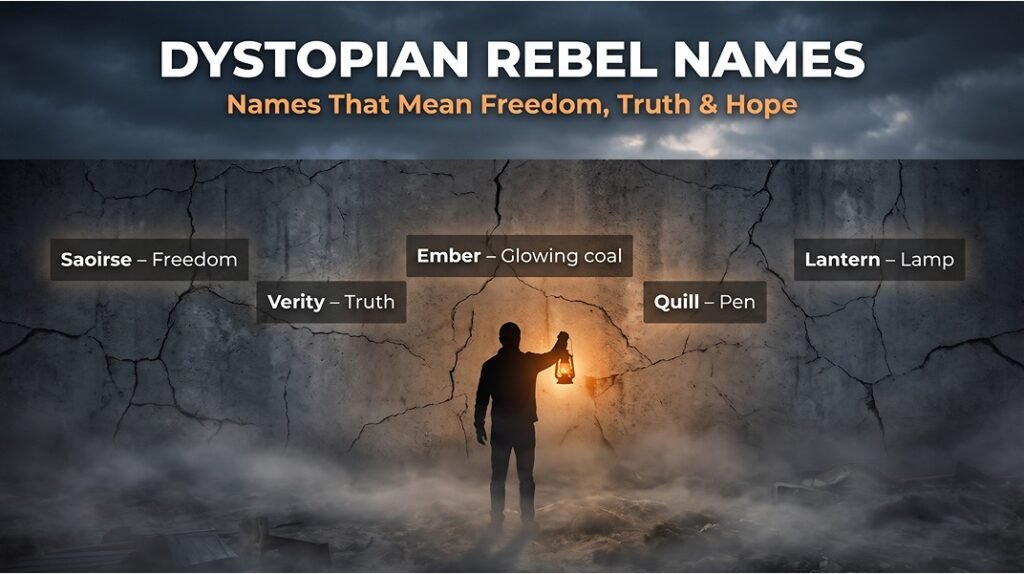
Obvious hope names can feel cheesy. Liberty or Valor works when the regime has stripped those words from daily speech, because then the name itself is an act of defiance. If your world doesn’t do that, go quieter. A name like Quill or Wick points to the pamphlet, the candle, the small tool that starts a fire.
| Name | Meaning | Origin | Style-Role: why it works |
|---|---|---|---|
| Ember | Glowing coal | Old English | Rebel / Hope Symbol: a character who sparks revolt |
| Saoirse | Freedom | Irish | Freedom Fighter: the name is the cause |
| Verity | Truth | Latin | Whistleblower: exposes the lie |
| Liberty | Freedom | Latin | Banner Name: defiance worn as a name |
| Valor | Courage | Latin | Front-Line Fighter: bold and direct |
| Scintilla | Spark | Latin | Igniter: starts the uprising |
| Rhiannon | Great queen | Welsh | Leader: royal bearing without a crown |
| Boudica | Victory | Brittonic | Warrior Queen: echoes a real rebellion |
| Wallace | Welshman; foreigner | Old English / Scots | Outsider Rebel: recalls a Scottish freedom fighter |
| Joan | God is gracious | Hebrew via Latin | Martyr: a girl who leads armies |
| Aurora | Dawn | Latin | Dawn Bringer: promises a new day |
| Rhys | Ardor, enthusiasm | Welsh | Hot-Headed Recruit: acts first |
| Bran | Raven | Welsh / Irish | Messenger: a black bird, bad news for the regime |
| Dara | Oak | Irish | Steady Anchor: holds the group together |
| Fiadh | Wild | Irish | Forest Fighter: lives outside the walls |
| Sloane | Raider | Irish | Raider: hits supply convoys |
| Rory | Red king | Irish | Charismatic Captain: people follow him |
| Amara | Grace | Igbo | Organizer: unites neighborhoods |
| Imani | Faith | Swahili / Arabic | Believer: keeps the cause alive |
| Zahra | Radiant, blooming | Arabic | Orator: lights up crowds |
| Malik | King | Arabic | Commander: leads from the front |
| Tariq | Night visitor; morning star | Arabic | Night Raider: strikes after dark |
| Thorn | Sharp spike | Old English | Hidden Threat: small but painful |
| Rook | Crow; chess piece | Old English | Strategist: guards the corners of the board |
| Quill | Pen | Old French | Pamphleteer: writes the truth |
| Vigil | Wakefulness | Latin | Night Watcher: guards the safe houses |
| Beacon | Signal fire | Old English | Signal Sender: warns others |
| Clarion | Clear trumpet | Latin | Town Crier: calls people to act |
| Akira | Bright, clear | Japanese | Clear-Eyed Planner: sees every move ahead |
| Sora | Sky | Japanese | Free Spirit: refuses to be fenced in |
| Ren | Lotus (among its meanings) | Japanese | Quiet Rebel: blooms in mud |
| Mei | Plum blossom; beautiful | Chinese | Hidden Strength: soft name, firm will |
| Arjun | Bright, white | Sanskrit | Archer: a sharpshooter |
| Veda | Knowledge | Sanskrit | Teacher: teaches banned subjects |
| Asha | Hope | Sanskrit / Swahili | Hope Bearer: carries the message |
| Kiran | Ray of light | Sanskrit | Signal Operator: sends the call |
| Nia | Purpose | Swahili | Organizer: driven and focused |
| Cato | Wise | Latin | Stoic Dissenter: stands firm against tyranny |
| Lysander | Liberator | Greek | Liberator: the name says it |
| Eleutheria | Freedom | Greek | Symbol: a living banner |
| Zuri | Beautiful | Swahili | Public Face: charismatic and trusted |
| Harper | Harp player | Old English | Bard: sings the resistance songs |
| Pilgrim | Traveler | Latin | Refugee Guide: leads people north |
| Lantern | Lamp | Latin | Safe-House Keeper: keeps a light on |
| Wick | Candle cord; village | Old English | Slow Burner: a patient planner |
Futuristic Dystopian Names
Futuristic dystopian names borrow from code, science and old myth. Axiom sounds like logic itself. Daemon is both a background process and a spirit. Pythia was the oracle at Delphi, so she makes a fitting name for a prediction engine. Each one feels new but hides an old root, which is why they age well.
These names fit three kinds of characters: hackers, AIs and corporate brands. Keep hacker handles short, one or two syllables, because people type them fast. AI names can run longer and carry myth, like Mnemosyne (“memory”). Corporate names usually borrow giants and gods, and Titan or Atlas feel too large to question.
| Name | Meaning | Origin | Style-Role: why it works |
|---|---|---|---|
| Nyx | Night | Greek | Hacker / Underground: a short, dark, cyberpunk-friendly handle |
| Axiom | Self-evident truth | Greek | Logic AI: cold and certain |
| Vector | Carrier | Latin | Virus Author: carries the payload |
| Kernel | Core, seed | Old English | System Core: hidden at the center |
| Proxy | Acting for another | Latin | Anonymous Agent: hides identities |
| Daemon | Spirit | Greek | Background AI: runs unseen |
| Syntax | Arrangement | Greek | Code Poet: speaks in rules |
| Aegis | Shield | Greek | Firewall AI: defends the network |
| Argus | Watchful giant (hundred-eyed) | Greek | Surveillance AI: many eyes |
| Janus | Doorway | Latin | Double Agent: two faces |
| Hermes | Messenger god | Greek | Data Courier: carries secrets |
| Atlas | Enduring | Greek | Corporate Grid: carries the world |
| Helix | Spiral | Greek | Gene Engineer: edits the code of life |
| Lumen | Light | Latin | Hologram Tech: a unit of light |
| Volt | Unit of electric force | Italian | Street Courier: fast and charged |
| Cobalt | Goblin ore | German | Mercenary: cold blue steel |
| Neon | New | Greek | Street Kid: bright but cheap |
| Chrome | Color | Greek | Augmented Fighter: metal body |
| Titan | Giant | Greek | Megacorp: too big to question |
| Echo | Repeated sound | Greek | Copy Bot: repeats what it hears |
| Zeta | Sixth letter | Greek | Sixth-Gen AI: a version label |
| Sigma | Letter; sum | Greek | Data Analyst: adds up every citizen |
| Omicron | Little O | Greek | Obscure Program: a version no one trusts |
| Orbit | Path around | Latin | Station Citizen: lives in a loop |
| Pulse | Beat | Latin | Network Heartbeat: hosts a live feed |
| Static | Still; noise | Greek | Jammer: blocks signals |
| Relay | Fresh horses (a hand-off) | Old French | Message Link: passes data along |
| Mnemosyne | Memory | Greek | Archive AI: stores every memory |
| Cassandra | Unheeded prophet | Greek | Warning Program: nobody listens |
| Pythia | Oracle priestess | Greek | Prediction Engine: foresees the regime’s next move |
| Kairos | Right moment | Greek | Timing Hacker: strikes at the perfect second |
| Chronos | Time | Greek | Time-Control AI: sets everyone’s schedule |
| Logos | Word, reason | Greek | Propaganda Engine: weaponized words |
| Ion | Going; charged particle | Greek | Energy Runner: moves power around |
| Cache | Hiding place | French | Data Smuggler: hides what the state wants deleted |
| Sol | Sun | Latin | Solar Colony Leader: controls the light |
| Prism | Something sawn | Greek | Info Filter: splits every message |
| Tensor | Stretcher | Latin | Machine-Learning Mind: stretches across the net |
| Lattice | Framework | Old French | Network Architect: builds the grid |
| Glyph | Carving | Greek | Symbol Coder: writes in signs |
Post-Apocalyptic Names
Post-apocalyptic names are built from what’s left. Survivors rename themselves from rubble, tools and weather, which gives you words like Rust, Cairn and Sirocco. They sound rough on purpose. A reader hears the ruined world in them before seeing a single burnt street.
Most guides give wasteland names that sound like action-movie extras, all muscle and no meaning, which is a missed chance. The strongest post-collapse names are practical. Cistern and Aquifer tell you water is the scarce thing, and Tinder tells you nobody has matches. Let objects tell the story. A scavenger named Glean needs no backstory.
| Name | Meaning | Origin | Style-Role: why it works |
|---|---|---|---|
| Rust | Corrosion | Old English | Scrapper: lives on corroded metal |
| Dust | Fine powder | Old English | Desert Wanderer: part of the landscape |
| Scrap | Leftover piece | Old Norse | Junk Trader: sells what others threw out |
| Gravel | Small stones | Old French | Road Mender: repairs the last highways |
| Tinder | Fire fuel | Old English | Fire Keeper: guards the spark |
| Soot | Smoke residue | Old English | Furnace Worker: always dirty |
| Shard | Broken fragment | Old English | Glass Hunter: scavenges old windows |
| Cairn | Stone heap | Scottish Gaelic | Trail Guide: marks the safe path |
| Barrow | Burial mound | Old English | Gravedigger: buries the dead |
| Tallow | Candle fat | Middle English | Candle Maker: sells light |
| Kindle | To light | Old Norse | Fire Starter: brings warmth |
| Remnant | What remains | Latin | Last Survivor: the final one |
| Relic | Remains | Latin | Old-World Archivist: keeps broken tech |
| Vestige | Trace | Latin | Memory Carrier: remembers the before |
| Glean | To gather | Old French | Forager: picks what’s left of the fields |
| Forager | One who searches for food | Old French | Food Scout: always hunting |
| Dune | Sand hill | Dutch | Desert Nomad: moves with the sand |
| Mesa | Table (a flat hill) | Spanish | Plateau Settler: lives high and hidden |
| Arroyo | Dry gully | Spanish | Canyon Smuggler: uses dry riverbeds |
| Sirocco | Hot desert wind | Italian | Dust-Storm Rider: rides the wind |
| Haboob | Dust storm | Arabic | Storm Runner: moves under cover of dust |
| Mirage | Illusion | French | Con Artist: sells false hope |
| Oasis | Fertile spot | Greek / Egyptian | Water Trader: controls the one good well |
| Gale | Strong wind | Middle English | Sky Pilot: flies low over ruins |
| Tundra | Treeless plain | Sami / Russian | Ice Wanderer: survives the frozen north |
| Drift | Pushed along | Old Norse | Nomad: no fixed home |
| Salvage | Rescued goods | Latin / French | Wreck Diver: pulls treasure from sunken cities |
| Char | To burn | Middle English | Burnt Survivor: scarred and quiet |
| Cinder | Burnt remnant | Old English | Fire Survivor: walked out of the flames |
| Husk | Dry shell | Middle English | Hollowed Veteran: used up by war |
| Lode | Vein of ore | Old English | Miner: digs for metal |
| Rubble | Broken stone | Middle English | Demolition Crew: clears the old streets |
| Wreck | Destruction | Old Norse | Ship-Breaker: strips old hulls |
| Cistern | Water tank | Latin | Water Guardian: guards the supply |
| Aquifer | Water bearer | Latin | Well Keeper: knows where water hides |
Dystopian Baby Names
Dystopian baby names come from a state that wants a say in every cradle. In many stories parents don’t choose; the regime hands out approved names, often virtue words like Mercy or Temperance. They sound sweet. They’re also orders, and the gap between the gentle sound and the cold purpose is what makes them chilling.
- Honor — integrity — Latin — Regime Child: a virtue the state claims to value.
- Mercy — compassion — Latin — Ironic Child: born in a merciless state.
- Constance — steadfast — Latin — Loyal Daughter: obedient from birth.
- Temperance — self-restraint — Latin — Approved Girl: the name of discipline.
- Prudence — caution — Latin — Careful Child: learns to keep quiet.
- Patience — endurance — Latin — Waiting Child: raised to wait in lines.
- Charity — Christian love — Latin — Ration Child: grew up on handouts.
- Faith — trust — Old French — Believer: raised in the state creed.
- Hope — expectation — Old English — Last-Good-Year Child: born before things got worse.
- Grace — kindness — Latin — Spared Child: chosen to be kept.
- Unity — oneness — Latin — Collective Child: born of the movement.
- Joy — happiness — Old French — Mandatory Smile: grim irony in a gray city.
- Harmony — agreement — Greek — Order Child: raised to conform.
- Fidelity — loyalty — Latin — Oath Child: pledged at birth.
- Piety — devotion — Latin — Temple Child: raised by the faith.
- Amity — friendship — Latin — Treaty Child: named for a peace deal.
- Clemency — mercy — Latin — Pardon Baby: born after an amnesty.
- Obedience — compliance — Latin — Perfect Citizen: blunt and unsettling.
- Diligence — careful work — Latin — Worker Child: bred for labor.
- Providence — foresight — Latin — Prophecy Child: said to be chosen by fate.
- Gratitude — thankfulness — Latin — Grateful Subject: mandated thanks.
- Modesty — restraint — Latin — Veiled Girl: taught to disappear.
Real parents search this phrase too. The gentler picks below, such as Hope, Faith, Grace and Joy, are real names today with a quiet storybook edge. If you’re a writer, treat the same list as a naming system for children born inside the regime, where each name tells you what the state expects from that child.
Dystopian Fantasy Names
Dystopian fantasy names fit stories where swords and magic meet an oppressive state. Think crown-run mines, burned libraries and sorcerers on a leash. The names below lean on Old English, Welsh and Cornish roots, so they feel old without being copied from any famous saga. Every one has a real meaning behind it.
My opinion, and some fantasy writers will disagree, is that invented names stuffed with apostrophes, like K’rael, are weaker than real old names. A name such as Aelfric (“elf ruler”) has history built in, while an apostrophe name needs you to explain it. If you love invented names, anchor them with a real root. Readers sense when a word has bones.
| Name | Meaning | Origin | Style-Role: why it works |
|---|---|---|---|
| Aldric | Old ruler | Germanic | Old King: ancient ruler of a crumbling realm |
| Aethelred | Noble counsel | Old English | Weak King: a crown without control |
| Elowen | Elm | Cornish | Forest Healer: hides in the woods |
| Tamsin | Twin | Cornish | Twin Sister: bonded to a lost sibling |
| Morwenna | Maiden | Cornish / Welsh | Sea-Town Girl: lives by a harsh coast |
| Kerensa | Love | Cornish | Beloved: love as a weakness |
| Jago | Supplanter | Cornish | Pirate: a coastal outlaw |
| Tristan | Tumult | Celtic | Tragic Knight: sorrow built into the name |
| Branwen | Fair raven | Welsh | Rebel Princess: beauty and omen together |
| Taliesin | Shining brow | Welsh | Bard: a poet who sings dissent |
| Alaric | Ruler of all | Germanic | Conqueror: a king of kings |
| Godric | Good ruler | Old English | Church Knight: an honest-sounding enforcer |
| Leofric | Dear ruler | Old English | Gentle Lord: a noble who cares |
| Oswin | Divine friend | Old English | Monk: gentle and devout |
| Wulfstan | Wolf stone | Old English | Hunter: tracks outlaws |
| Eldred | Old counsel | Old English | Counselor: an advisor to the weak crown |
| Aelfric | Elf ruler | Old English | Hedge Wizard: a forbidden magic user |
| Hereward | Army guardian | Old English | Outlaw Captain: leads a hidden camp |
| Sigmund | Victory protector | Germanic | Dragon Slayer: fights monsters and kings |
| Cerys | Love | Welsh | Healer: a gentle presence |
| Tegan | Fair, lovely | Welsh | Young Scout: a bright new recruit |
| Edric | Wealthy ruler | Old English | Merchant Lord: buys loyalty |
| Osric | Divine ruler | Old English | Royal Spy: whispers in the court |
| Thurstan | Thor’s stone | Old Norse / Old English | Mountain Guard: guards the pass |
| Halvard | Rock guardian | Old Norse | Gatekeeper: stands at the fortress door |
Dystopian Names for Places
Dystopian names for places work like propaganda. A city called Haven or Solace promises comfort, so the reader expects the opposite. The irony is the point. Rulers pick gentle names for brutal places, and ordinary people give them rougher nicknames. Thomas More coined “Utopia” in 1516 from Greek roots that can read as “no place,” and writers have been playing with that joke ever since.
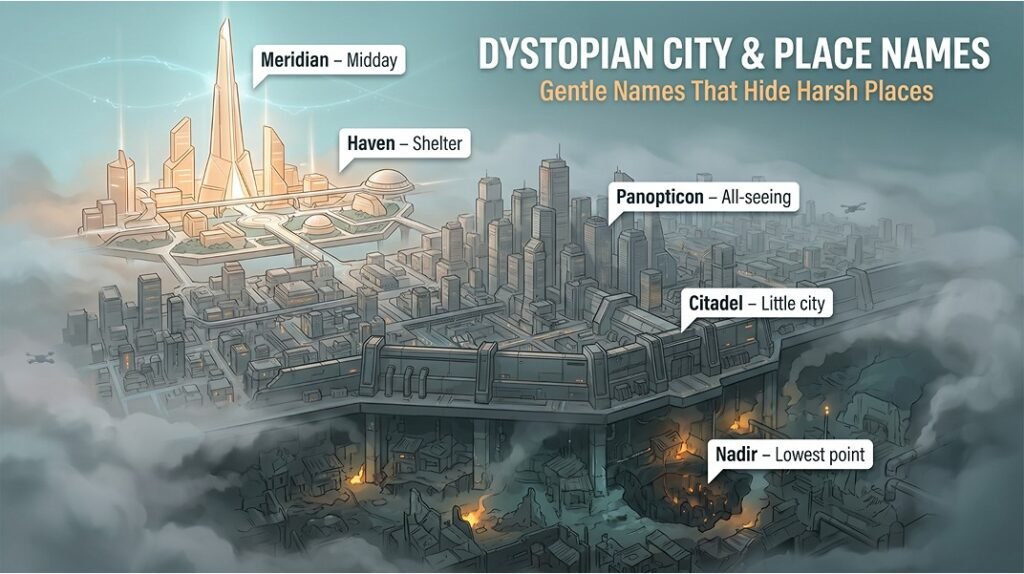
Use three layers. First, an official name, like Meridian. Second, a nickname the poor use, like The Hive or The Warren. Third, a district code, like Sector Nine. Together the layers show how power sounds from the top and from the bottom of the same city. It also gives you three ways to name one place.
Cities and Capitals
| Name | Meaning | Origin | Style-Role: why it works |
|---|---|---|---|
| Meridian | Midday; highest point | Latin | Capital: the noon of power |
| Citadel | Little city | Italian | Fortress Capital: a city inside a wall |
| Concord | Agreement | Latin | Ironic Capital: peace by force |
| Sanctum | Holy place | Latin | Temple City: ruled by a creed |
| Bastion | Fortress | French | Walled Stronghold: a last line of defense |
| Carcer | Prison | Latin | Prison City: everyone is held |
| Panopticon | All-seeing | Greek | Surveillance City: every window watched, after Bentham’s prison design |
| Halcyon | Calm, peaceful days | Greek | Ironic Paradise: a peace that is staged |
| Elysium | Blessed afterlife | Greek | Elite Orbital City: heaven for the rich |
| Arcadia | Pastoral paradise | Greek | Gated Garden Town: green and exclusive |
| Utopia | No place (More, 1516) | Greek | Propaganda Name: perfect on paper |
| Solace | Comfort | Latin | Refuge Town: a false promise |
| Haven | Harbor, shelter | Old English | Last Refuge: safe, or so they say |
| Ironhold | Iron fortress | English compound | Mining Fortress: built on forced labor |
| Greyhaven | Gray harbor | English compound | Fog Port: smugglers and fishers |
| Ashfall | Falling ash | English compound | Burnt Town: rebuilt from cinders |
| Dominion | Rule | Latin | Empire Seat: the capital of control |
| Zenith | Highest point | Arabic | Sky City: where the powerful live |
| Nadir | Lowest point | Arabic | Slum Underbelly: the bottom of the world |
| Vanguard | Front guard | French | Frontier Fortress: first to fight |
Districts and Settlements
| Name | Meaning | Origin | Style-Role: why it works |
|---|---|---|---|
| Redoubt | Fortified refuge | French | Last Fort: the final stand |
| Enclave | Enclosed area | French | Walled Community: a safe pocket |
| Outpost | Remote station | English | Border Camp: far from help |
| Cordon | Guard line | French | Quarantine Line: no crossing |
| Quarantine | Forty days | Italian | Sealed Zone: a district locked down |
| Perimeter | Boundary | Greek | Fence Line: the edge of the world |
| Lowtown | Poor district | English compound | Slum: where the workers live |
| Highspire | Tall tower | English compound | Elite Tower: above the smog |
| Sprawl | Spread out | English | Endless Suburbs: the same block repeated |
| Undercroft | Underground vault | Medieval English | Hidden Cellars: a black market below |
| Hive | Beehive | Old English | Crowded Blocks: packed to the ceiling |
| Warren | Rabbit colony | Old French | Tunnel Slum: a maze of passages |
| Terminus | Boundary; end | Latin | Last Train Station: the end of the line |
| Foundry | Metal-casting works | Latin / French | Factory Ward: smoke and sparks |
| Threshold | Doorway | Old English | Border Gate: the line between zones |
Regimes and Factions
| Name | Meaning | Origin | Style-Role: why it works |
|---|---|---|---|
| The Directorate | Governing board | Latin | Ruling Council: faceless and formal |
| The Ministry | Service office | Latin | Bureaucracy: echoes Orwell’s ministries |
| The Bureau | Desk, cloth | French | Surveillance Agency: files on everyone |
| The Collective | Gathered group | Latin | Shared-Ownership State: no private life |
| The Syndicate | Group of officials | Greek | Crime-Corp Cartel: runs the black market |
| The Accord | Agreement | French | Treaty Government: peace on paper |
| The Authority | Power | Latin | Faceless Ruler: no name, no face |
| The Protectorate | Guardianship | Latin | Occupation Government: protection by force |
| The Conclave | Locked room | Latin | Secret Council: decisions in the dark |
| The Tribunal | Judge’s platform | Latin | Show-Trial Court: verdict decided in advance |
Dystopian Last Names
Dystopian last names quietly tell readers a character’s place in the world. Trade surnames like Tanner, Cooper and Mason suggest a society where jobs are inherited and freedom is thin. Smith is the plainest of all, and Orwell’s choice of it for Winston is widely read as a sign of an ordinary man. Common means interchangeable.
Match surnames to class. Trade names fit workers, double-barreled names fit elites, and foreign-sounding names can mark outsiders or refugees. The Russian, Spanish and Japanese surnames below add range, but pair them with a real cultural background instead of using them only to sound exotic. That keeps a diverse cast respectful and believable.
| Name | Meaning | Origin | Style-Role: why it works |
|---|---|---|---|
| Voss | Fox | Low German | Cunning Official: sly and quick |
| Kessler | Kettle maker | German | Craft Clan: a family of coppersmiths |
| Hollis | Holly dweller | Old English | Country Family: lives near the trees |
| Marlowe | Remnant of a lake | Old English | Poet Dissident: a writer’s name |
| Lockwood | Enclosed wood | Old English | Gated Family: closed off by choice |
| Ashworth | Ash tree enclosure | Old English | Landed Family: owns the land |
| Blackburn | Dark stream | Old English | Mill Family: works by a dirty river |
| Graves | Grove (or gravel) | English / Old French | Gravedigger Family: grim from birth |
| Mercer | Merchant | Old French | Trader Class: sells to everyone |
| Tanner | Leather worker | Old English | Dirty-Trade Worker: smelly and low-ranked |
| Cooper | Barrel maker | Middle English | Craft Caste: makes the storage |
| Fletcher | Arrow maker | Old French | Weapons Maker: arms the guard |
| Sawyer | Wood cutter | Middle English | Lumber Camp Worker: hard physical labor |
| Thatcher | Roof maker | Old English | Rural Builder: keeps the rain out |
| Mason | Stoneworker | Old French | Wall Builder: builds the walls |
| Carver | Wood or stone carver | English | Artisan Caste: shapes statues of leaders |
| Smith | Metalworker | Old English | Everyman: a plain surname like Orwell’s Winston |
| Archer | Bowman | Old French | Marksman: a sharp-eyed guard |
| Fowler | Bird catcher | Old English | Trapper: hunts what flies |
| Wainwright | Wagon builder | Old English | Transport Guild: builds the carts |
| Cartwright | Cart builder | Old English | Hauler: moves goods through checkpoints |
| Slater | Roof-slate worker | English | Roofer: works at height |
| Chandler | Candle maker | Old French | Light Seller: sells what the grid can’t |
| Porter | Gatekeeper; carrier | Old French | Checkpoint Worker: opens and closes the gate |
| Reeve | Local official | Old English | Village Officer: the state’s local face |
| Steward | Keeper of the hall | Old English | Household Servant: serves the elite |
| Falk | Falcon | German / Scandinavian | Watcher: sees from above |
| Kruger | Innkeeper or potter | German | Tavern Keeper: hears every secret |
| Lindqvist | Linden twig | Swedish | Quiet Citizen: soft and ordinary |
| Nygaard | New farm | Norwegian | Settler Family: first on a new frontier |
| Dahl | Valley | Scandinavian | Valley Folk: remote and cut off |
| Petrov | Son of Peter | Russian | Party Family: loyal on paper |
| Volkov | Wolf’s son | Russian | Hardliner: a wolf by name |
| Sokolov | Falcon’s son | Russian | Pilot Family: raised for the skies |
| Kovacs | Smith | Hungarian | Metalworker: shapes the iron |
| Novak | New man | Czech / Slovak | Newcomer: a stranger in town |
| Rossi | Red-haired | Italian | Common Citizen: everywhere and nowhere |
| Moretti | Dark-complexioned | Italian | Street Family: knows the alleys |
| Ortega | Nettle | Spanish | Border Family: prickly and tough |
| Castillo | Castle | Spanish | Fortress Guard: lives behind a wall |
| Reyes | Kings | Spanish | Fallen Nobility: lost their crown |
| Nakamura | Middle village | Japanese | Corporate Clan: a major-company family |
| Tanaka | Middle of the rice paddy | Japanese | Farm Family: rooted in the land |
| Kuroda | Black rice field | Japanese | Ranch Family: scorched fields |
| Dvorak | Courtyard (farm) dweller | Czech | Estate Worker: tends the manor grounds |
Conclusion
You now have 550+ dystopian names sorted by role, meaning and origin, plus a simple way to choose one. Start with the role, match it to the regime, check the meaning on Behind the Name and say the name out loud. If it still sounds right at the end of a long sentence, it’s yours.
Remember the pattern readers feel without noticing: plain names for the ruled, formal names for the rulers, codes for the owned. Save this list, mix two or three styles in one cast and track them in Scrivener or Notion. Then go write the scene.
Dystopian Names FAQs
What are some dystopian girl names?
Good dystopian girl names include Wren, Ember, Saoirse, Vesper, Octavia and Tertia. Soft nature names suit survivors, while numbered Latin names like Octavia and Tertia suggest children named by birth order. Pick based on the role your character plays in the regime.
What are some dark fantasy names?
What are some dark fantasy names?
What are some good names for a dystopian story?
Match names to role and class, plain names for citizens (Walter, Edith), formal Latin names for rulers (Octavian, Severus) and codes for state-owned people (Unit K-17). The contrast between these groups shows power without any extra explaining.
What are good dystopian names?
Good dystopian names are short, carry a meaning that fits the role and sound different from the names of rival groups. Cassian for an elite, Wren for a scout and Nyx for a hacker all pass that test.
What are cool dystopian last names?
Try trade surnames like Tanner, Mercer and Wainwright, or short Germanic and Slavic ones like Voss, Volkov and Kessler. Choose a surname that hints at the family’s job or class in your world.
What’s the best name for a dystopian rebel?
Pick a name tied to freedom or truth, such as Saoirse, Verity or Ember. Short names with a clear meaning work best because readers remember them and they double as slogans.
What is the most famous dystopian?
George Orwell’s 1984 (1949) is usually named as the most famous dystopian novel, thanks to terms like Big Brother and doublethink. Brave New World (1932), Fahrenheit 451 (1953), The Handmaid’s Tale (1985) and The Hunger Games (2008) follow close behind.
What are some dystopian words?
Common dystopian words include totalitarian, surveillance, propaganda, censorship, regime, conformity, rationing and dissident. Story-specific coinages are worth studying too, such as Newspeak and doublethink from 1984 and Panem from The Hunger Games.
How do I choose a name for a dystopian villain?
Match the name to how your villain rules. Smooth Roman names like Domitian suit polished officials. Harsh ones like Apep or Fenrir suit warlords. Pick one and test it aloud.
How do you name a character in a dystopian novel?
Decide the character’s role, class and regime type first. Then choose a style: real name, nature word, tech word or code. Check the meaning on Behind the Name, say it aloud and test it in a sentence before you commit.
Should dystopian names be real or invented?
Real names with meanings usually work better because readers trust them and you get meaning for free. Invented names suit worlds far from Earth, but anchor them to a real root so they don’t feel random.
Are numbers a good idea for dystopian names?
Yes, in small doses. Use a code for people the state owns, like Unit K-17, and real names for everyone else. A whole cast of numbers gets hard to follow quickly.
How many names does a dystopian story need?
Most stories only need 10 to 20 memorable names. Give strong names to main characters and let background figures have plain ones. Unusual names on every page tire readers fast.
Should I use numbers as names in my dystopian story?
Yes, but sparingly. Use numbers like Unit K-17 for people the state owns and real names for everyone else. A cast made only of codes becomes hard to follow.
Why does a dystopian name often have a double meaning?
Because irony fits the genre. A name like Mercy or Halcyon promises comfort in a cruel world. The gap between name and reality shows how the regime hides its power.
When should I use nature names in a dystopian story?
Use them for poor districts, survivors and scouts. Names like Wren, Fern and Moss feel humble and earthy, which contrasts well with formal Latin names for rulers.
How do I make a dystopian name sound futuristic?
Borrow from science and myth, like Axiom, Helix or Pythia. Greek and Latin tech words feel new but carry old roots. Avoid piling on apostrophes.
What’s a good place name for a dystopian city?
Pick a gentle word that hides cruelty, like Haven, Solace or Concord. Add a second, rougher nickname the poor use, such as The Hive.