
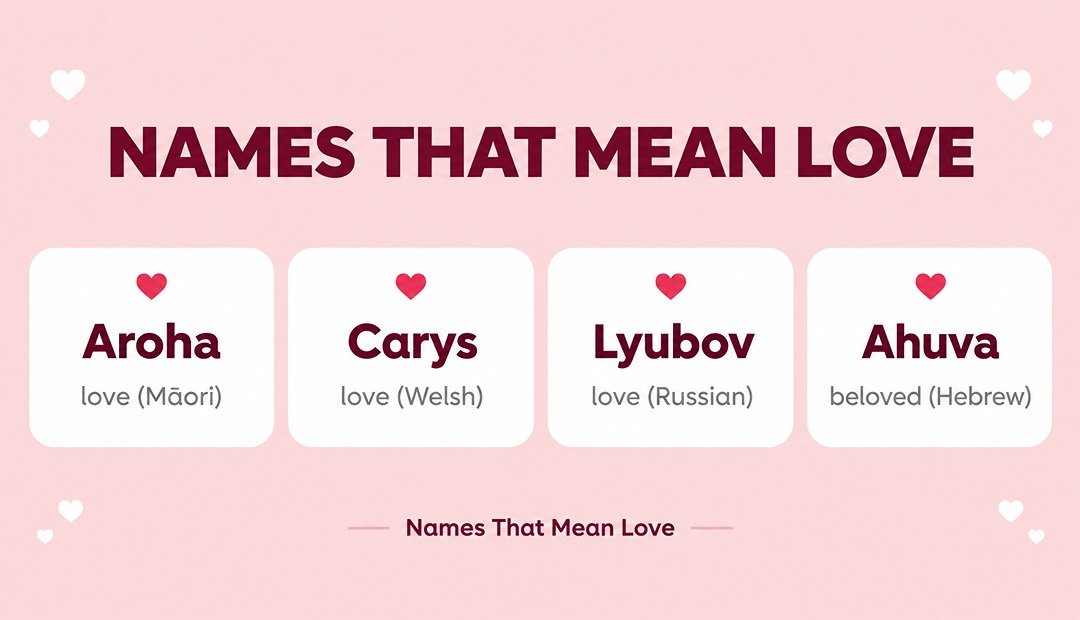
Names that mean love are given names whose roots translate to “love,” such as Ahava or Amor, or to close ideas like “beloved” and “dear,” such as David or Cara. This guide tags every name as Love or Adjacent so you can see which is which.
You’ll find 304 names below, grouped by gender, language and vibe. Each row has a meaning, an origin, a style note and a label. Love means the word itself translates to love. Adjacent means beloved, dear or cherished. Linked means tied to love by story, not by translation. Myth means a common claim that doesn’t hold up. Rows are numbered so you can keep your own shortlist.
This guide covers given names for babies, pets and characters. It does NOT cover surnames, legal naming rules or religious naming customs. It works best when meaning comes first and style second. It won’t help if you need exact popularity counts, because those change every year on the SSA site.
- What Names Mean Little Love?
- Classic Girl Names That Mean Love
- Boy Names That Mean Love
- Girl Names That Mean Love
- Names That Mean Love and Strength
- Unique Names That Mean Love for Girl
- Girl Names That Mean Love and Strength
- Modern and Stylish Girl Names Linked to Love
- Boy Names That Mean Love and Devotion
- Gender-Neutral Names That Mean Love
- Cultural Love Names from Around the World
- Arabic and Middle Eastern Names
- Rare and Distinctive Names Meaning Love
- Expanding the List: Additional Names That Mean Love
- Love Names and Modern Branding Trends
- Names that mean love Greek
- Sanskrit and Indian Names
- European Love Names
- Unisex names that mean love
- Names that mean love in Japanese
- Choosing the Right Love Name for Your Context
- Conclusion
- FAQs About Names That Mean Love
What Names Mean Little Love?
Little love names are mostly diminutives and pet forms of “love” or “dear.” They’re soft and a bit playful, and they suit parents who want sweetness without the word “love” stamped on the name. Amorette, Carina and Mignonette lead the pack. Rare, but easy to say.
Names that mean little love are mainly diminutive or pet forms of words for love and dear. According to Behind the Name, Carina comes from Italian for “dear little one,” while Amorette is a French diminutive built on amour. Mignonette, Chérie and Amoretta follow the same pattern, adding warmth without a heavy meaning.
The Latin name that means love most directly is Amor, while Amanda and Amata carry softer versions of the idea. According to Behind the Name, Amanda means “worthy of love” and Amata means “beloved.” Venus, the Roman goddess, comes from the Latin word for love and desire, which makes it a bolder pick.
| Name | Meaning | Origin | Style | Type |
|---|---|---|---|---|
| Amorette (ah-mor-ET) | “little love” | French | Sweet, rare, girl | Love |
| Amoretta | “little love” | Italian | Romantic, rare, girl | Love |
| Amorcito (ah-mor-SEE-toh) | “little love” (a term of endearment) | Spanish | Pet-name style, boy | Love |
| Carina (kah-REE-nah) | “dear little one” | Italian | Soft, easy, girl | Adjacent |
| Mignonette (meen-yuh-NET) | “little darling” | French | Vintage, rare, girl | Adjacent |
| Chérie (sheh-REE) | “dear, darling” | French | Retro, girl | Adjacent |
| Cher | “dear” | French | Short, bold, girl-leaning | Adjacent |
| Cara | “dear, beloved” | Italian | Short, classic, girl | Adjacent |
| Darling | “dear one” | English | Quirky, rare, unisex | Adjacent |
| Diletta (dee-LET-tah) | “beloved” | Italian | Elegant, rare, girl | Adjacent |
| Mavourneen (mah-VOOR-neen) | “my darling” | Irish | Vintage, rare, girl | Adjacent |
| Querida (keh-REE-dah) | “dear, beloved” | Spanish | Warm, rare, girl | Adjacent |
| Pyari (PYAH-ree) | “beloved, dear” | Hindi | Sweet, rare, girl | Adjacent |
“Little” in these names rarely means small. It signals affection. Think of the way you’d call a toddler “sweetheart,” which is exactly what Cara does in Italian, Querida does in Spanish, and Pyari does in Hindi. Pick the one that fits your family’s language, not just the sound.
Classic Girl Names That Mean Love
Classic names carry love quietly. Amy comes from the Old French aimée, meaning “beloved,” and it has stayed in steady use for centuries. Amanda, Mabel and Esme follow the same pattern, each tied to a Latin or French root for “loved,” “lovable” or “esteemed.” Nothing flashy.
Female names that mean heart include Corazón in Spanish, Libi in Hebrew, Hridaya in Sanskrit and Kokoro in Japanese. According to Behind the Name, Cordelia may come from Latin cor, meaning heart, though the origin is debated. Cora is often linked to heart too, but it actually traces to a Greek word for maiden.
| Name | Meaning | Origin | Style | Type |
|---|---|---|---|---|
| Amy | “beloved” | Old French | Classic, easy | Adjacent |
| Aimee (AY-mee) | “beloved” | French | Classic, polished | Adjacent |
| Amanda | “worthy of love” | Latin | Retro, familiar | Adjacent |
| Amandine (ah-mahn-DEEN) | “worthy of love” | French | Elegant, rare | Adjacent |
| Amabel | “lovable” | Latin | Vintage, rare | Adjacent |
| Mabel | “lovable” (short for Amabel) | Latin/English | Vintage revival | Adjacent |
| Esme (EZ-may) | “esteemed, loved” | Old French | Vintage, chic | Adjacent |
| Charity | “love, benevolence” (Latin caritas) | Latin/English | Virtue name | Love |
| Philippa | “lover of horses” | Greek | Classic, sporty | Adjacent |
| Philomena (fil-uh-MEE-nuh) | “lover of strength” | Greek | Vintage, bold | Adjacent |
| Cordelia | “heart” (origin debated) | Latin or Celtic | Literary, graceful | Linked |
| Adora | “adored” | Latin | Soft, vintage | Adjacent |
| Amata (ah-MAH-tah) | “beloved” | Latin | Rare, classic | Adjacent |
| Venus | “love, desire” | Latin | Bold, mythic | Love |
One name needs a flag. Cordelia is often listed as “heart,” but the root is debated, with some sources pointing to Latin and others to a Celtic phrase. We tag it Linked, not Love. Venus is the opposite case: the Latin word for love and desire, borrowed whole.
Boy Names That Mean Love
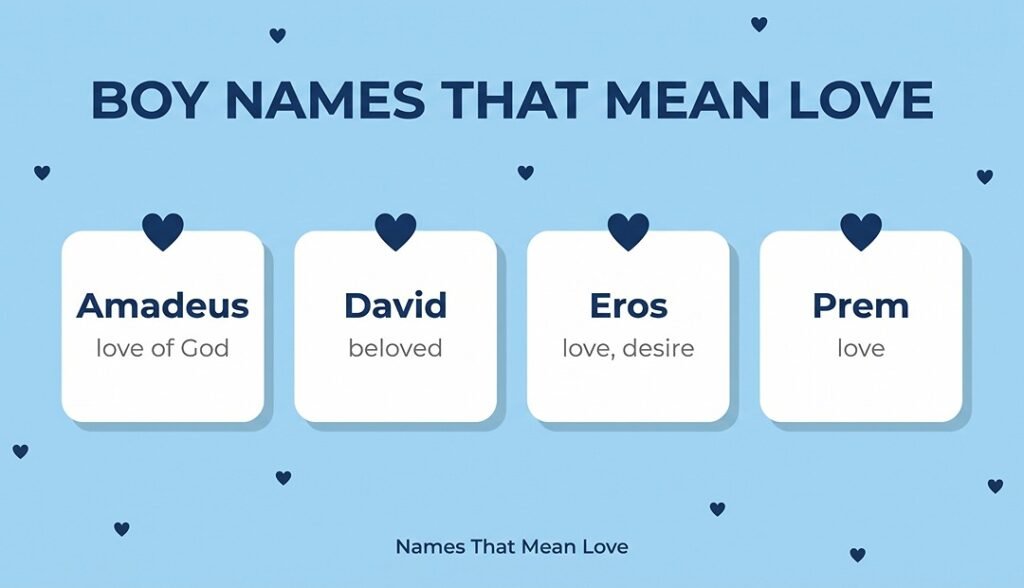
Boy names that mean love lean ancient and musical. Amadeus means “love of God,” Eros is the Greek word for love and desire, and David means “beloved” in Hebrew. Gottlieb and Amadeo carry the same “love of God” idea in German and Spanish. Short, strong, and rarely cute.
Love names vs love-adjacent names: love names are better suited for parents who want a literal meaning because the root word translates directly to “love.” Love-adjacent names work better when you want a softer feel with a documented “beloved” or “dear” meaning. The key difference is how direct the translation is.
| Name | Meaning | Origin | Style | Type |
|---|---|---|---|---|
| Amadeus (ah-mah-DAY-us) | “love of God” | Latin | Rare, musical | Love |
| Amadeo | “love of God” | Spanish/Italian | Warm, rare | Love |
| Amias | “beloved” (origin uncertain) | Latin/English | Vintage, rare | Adjacent |
| Amato | “beloved” | Italian | Smooth, rare | Adjacent |
| Aimé (ay-MAY) | “beloved” | French | Refined, rare | Adjacent |
| Eros | “love, desire” | Greek | Bold, mythic | Love |
| Anteros | “love returned” | Greek | Very rare, mythic | Love |
| Cupid | “desire” | Latin | Playful, novelty | Linked |
| Philo | “loving, fond of” | Greek | Short, retro | Adjacent |
| David | “beloved” | Hebrew | Classic, familiar | Adjacent |
| Gottlieb | “love of God” | German | Old-world, rare | Love |
| Lewin | “dear friend” | Old English | Vintage, rare | Adjacent |
| Darwin | “dear friend” | Old English | Scholarly, unusual | Adjacent |
| Caradoc | “beloved” | Welsh | Legendary, rare | Adjacent |
Some readers will push back on this one: skip Cupid and Eros as a first name. They’re clever on paper, but you’d hear the jokes by first grade in a crowded classroom, and it’s hard to un-ring that bell. Middle names work well. Amias and Amato are quieter ways to get the same idea.
Girl Names That Mean Love
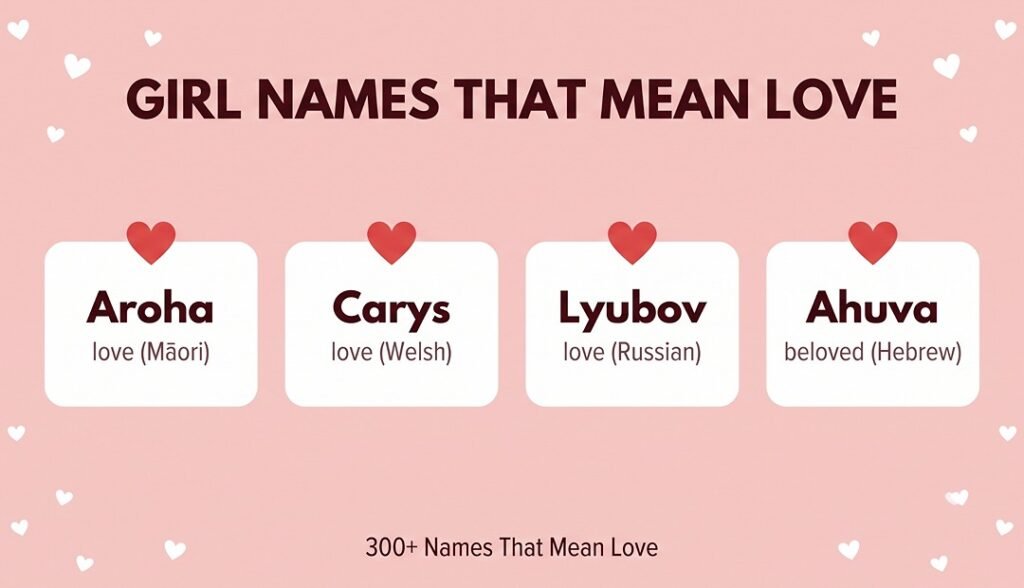
These are the literal ones. Aroha, Lyubov, Ásta, Carys and Sevgi all translate straight to “love” in their home languages (Māori, Russian, Icelandic, Welsh and Turkish). Nayeli goes a step further and means “I love you” in Zapotec. Most are short, which helps. Say each one out loud before you commit.
| Name | Meaning | Origin | Style | Type |
|---|---|---|---|---|
| Amore (ah-MOR-ay) | “love” | Italian | Romantic, rare | Love |
| Aroha (ah-ROH-hah) | “love, compassion” | Māori | Short, rising | Love |
| Lyubov (lyoo-BOHV) | “love” | Russian | Strong, rare | Love |
| Ásta (AH-stah) | “love” | Icelandic | Short, Nordic | Love |
| Carys (KAIR-iss) | “love” | Welsh | Modern, crisp | Love |
| Cerys (KAIR-iss) | “love” | Welsh | Spelling variant of Carys | Love |
| Sevgi (SEV-gee) | “love, affection” | Turkish | Short, rare | Love |
| Sevda (SEV-dah) | “love, passion” | Turkish | Intense, rare | Love |
| Nayeli (nah-YEH-lee) | “I love you” | Zapotec | Lyrical, known in Mexico | Love |
| Lerato (leh-RAH-toh) | “love” | Sotho/Tswana | Warm, rare | Love |
| Rudo (ROO-doh) | “love” | Shona | Short, rare | Love |
| Ifunanya (ee-foo-NAH-nyah) | “love” | Igbo | Long, rare | Love |
If you want a name that means love but still feels familiar in an American classroom, here’s what actually works: start with Carys. It’s crisp, easy to spell after one try, and the Welsh root is well documented. Sevda and Ifunanya need more explaining. That’s fine; the story is part of the charm.
| Option | Best For | Key Benefit | Limitation |
|---|---|---|---|
| Literal love names (Aroha, Carys) | Parents who want the exact meaning | Meaning is clear and easy to source | Fewer familiar options in English |
| Love-adjacent names (Amy, David, Cara) | Parents who want a classic feel | Familiar and easy to pronounce | Means “beloved,” not “love” |
| Love-deity names (Venus, Freya, Eros) | Writers, pet owners, myth fans | Strong story and instant recognition | Meaning isn't love; can feel themed |
| Virtue names (Charity, Cherish) | Vintage-leaning or faith-minded parents | Clear English meaning | Can feel dated or heavy |
Names That Mean Love and Strength
Most people assume Valentine means love the etymology says otherwise. It comes from a Latin root for “strong” or “healthy,” and the love link grew out of Saint Valentine’s feast day and the traditions that followed. Valentino and Valentin share the root. Want both ideas at once? Carwyn is the cleaner pick, since it means “blessed love” in Welsh.
| Name | Meaning | Origin | Style | Type |
|---|---|---|---|---|
| Valentine | “strong, healthy” (love link via Saint Valentine) | Latin | Classic, seasonal | Linked |
| Valentino | “strong, healthy” | Italian | Bold, stylish | Linked |
| Valentin | “strong, healthy” | French/German | Crisp, rare | Linked |
| Carwyn (KAR-win) | “blessed love” | Welsh | Strong, rare | Love |
| Aziz | “mighty, beloved” | Arabic | Strong, classic | Adjacent |
| Wafi (WAH-fee) | “loyal, faithful” | Arabic | Short, rare | Linked |
| Wafa | “faithfulness, loyalty” | Arabic | Short, unisex | Linked |
| Angus | “one strength” (named for a Celtic god of love) | Gaelic | Bold, classic | Linked |
Aziz brings both ideas at once, while Wafi and Wafa add loyalty. Angus is a quiet find: its Gaelic root means “one strength,” and the name is tied to a Celtic god of love and youth. Honest note: very few names pair love and strength in one root. That’s why this table is short.
Unique Names That Mean Love for Girl
Unique doesn’t have to mean invented. Loveday is a real Cornish name that began as a medieval term for a day of settling disputes, and Cariad and Carwen are Welsh for “love” and “blessed love.” Beloved, Amada and Amadea give you the idea in plain English, Spanish or Latin. All are rare in the US, which is the point.
| Name | Meaning | Origin | Style | Type |
|---|---|---|---|---|
| Loveday | “love-day,” a medieval day for settling disputes | Cornish/English | Vintage, rare | Linked |
| Cariad (KAH-ree-ad) | “love, darling” | Welsh | Lyrical, rare | Love |
| Carwen | “blessed love” | Welsh | Soft, rare | Love |
| Beloved | “dearly loved” | English | Statement name, very rare | Adjacent |
| Amada | “beloved” | Spanish | Warm, rare | Adjacent |
| Amadea | “loves God” | Latin | Elegant, rare | Love |
| Cherish | “to hold dear” | English | Virtue name | Adjacent |
| Amity | “friendship” | Latin | Virtue name, rare | Linked |
Cariad (KAH-ree-ad) will get misread on day one, so write the sound on a card for the daycare, and teach the grandparents before the first family dinner. A name is only unique if people can say it.
Girl Names That Mean Love and Strength
Valentina is the standout. It shares the “strong, healthy” root with Valentine and picks up the same love link through Saint Valentine. Aziza means “powerful” and “precious” in Arabic, and Fidelia and Constance lean on loyalty, with meanings of “faithful” and “constant.” Philomena, listed earlier, means “lover of strength.”
| Name | Meaning | Origin | Style | Type |
|---|---|---|---|---|
| Valentina | “strong, healthy” (love link via Saint Valentine) | Latin | Stylish, familiar | Linked |
| Aziza | “powerful, precious” | Arabic | Strong, rare | Adjacent |
| Fidelia | “faithful” | Latin | Vintage, rare | Linked |
| Constance | “constant” | Latin | Classic, vintage | Linked |
Some experts argue that a name’s meaning barely matters once a child is old enough to define it herself. That’s valid for names you choose mainly on sound. Fair enough. But if meaning is the reason you’re searching, Aziza gives your daughter a story she can own: strength and being cherished in one word.
Modern and Stylish Girl Names Linked to Love
Modern lists love Amara, so here’s the honest version. I’ve seen conflicting data some sources say it carries a Latin link to amor, others trace it only to Igbo “grace” and a Greek word for “unfading.” My read is that the Latin link is folk etymology. That makes Amara love-linked, not love.
| Name | Meaning | Origin | Style | Type |
|---|---|---|---|---|
| Amara | “grace” (Igbo); “unfading” (Greek-linked); Latin love link is folk etymology | Igbo/Greek | Modern, soft | Linked |
| Amora | Modern coinage from amor; “blackberry” in Portuguese | Latin-inspired | Modern, rare | Linked |
| Mila | “dear, gracious” | Slavic | Short, modern | Adjacent |
| Milena | “dear, gracious” | Slavic | Elegant, rising | Adjacent |
| Cora | “maiden” (not “heart”) | Greek | Vintage revival | Myth |
| Layla | “night” (not “love”) | Arabic | Lyrical, widely used | Myth |
| Amelia | “work” (not “love”) | Germanic | Classic, widely used | Myth |
Three popular picks don’t mean love at all. Amelia comes from a Germanic root for “work,” Layla means “night” in Arabic, and Cora traces to a Greek word for maiden. They land on love lists because of sound or story. We tag them Myth. Or maybe I should say it this way: they’re lovely names, just not love names.
Boy Names That Mean Love and Devotion
Devotion names say love through loyalty. Habib and Mahboob mean “beloved” in Arabic and Urdu, and Wadud means “loving.” Olufemi is Yoruba for “God loves me.” Fidel and Fidelio come from the Latin word for faithful, Lemuel means “devoted to God,” and together they suit parents who care more about steadiness than sweetness.
| Name | Meaning | Origin | Style | Type |
|---|---|---|---|---|
| Habib | “beloved” | Arabic | Warm, classic | Adjacent |
| Mahboob | “beloved” | Arabic/Urdu | Rich, rare in the US | Adjacent |
| Wadud | “loving” | Arabic | Rare, gentle | Love |
| Olufemi (oh-loo-FEH-mee) | “God loves me” | Yoruba | Rhythmic, rare | Love |
| Fidel | “faithful” | Latin | Strong, rare | Linked |
| Fidelio | “faithful” | Latin | Musical, rare | Linked |
| Lemuel | “devoted to God” | Hebrew | Vintage, literary | Linked |
| Romeo | “pilgrim to Rome” (not “love”) | Italian | Romantic, theatrical | Myth |
Romeo gets a myth check. Despite the reputation, it means “pilgrim to Rome,” not love. It’s still a fine pick, and the story helps, but keep the label honest when relatives ask where the meaning comes from.
Gender-Neutral Names That Mean Love
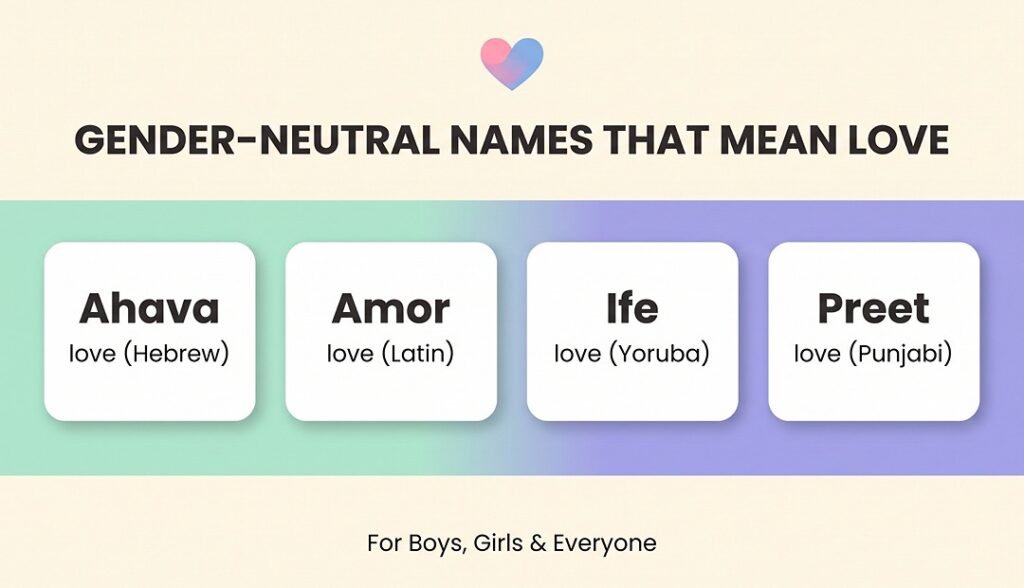
Gender-neutral love names are easier to find than you’d think. Ahava (Hebrew, “love”), Amor (Latin, “love”) and Mehr (Persian, “kindness, love”) all work for any child. Punjabi names built on preet, meaning love, like Harpreet and Gurpreet, are used for boys and girls alike. Ife and Femi come from Yoruba.
| Name | Meaning | Origin | Style | Type |
|---|---|---|---|---|
| Amor | “love” | Latin/Spanish | Short, bold | Love |
| Ahava (ah-HAH-vah) | “love” | Hebrew | Lyrical, rare | Love |
| Bellamy | “beautiful friend” | French | Preppy, trendy | Adjacent |
| Preet | “love, affection” | Punjabi/Hindi | Short, crisp | Love |
| Harpreet | “love of God (Hari)” | Punjabi | Spiritual, common in Sikh families | Love |
| Gurpreet | “love for the guru” | Punjabi | Spiritual, common in Sikh families | Love |
| Mehr | “love, kindness” (also “sun”) | Persian | Short, bright | Love |
| Kokoro | “heart, spirit” | Japanese | Soft, modern | Linked |
| Kealoha (kay-ah-LOH-hah) | “the love” | Hawaiian | Melodic, rare | Love |
| Aloha | “love, affection, compassion” | Hawaiian | Bright, playful | Love |
| Ife (EE-feh) | “love” | Yoruba | Short, gentle | Love |
| Femi (FEH-mee) | “love me” | Yoruba | Short, friendly | Love |
| Thando (TAHN-doh) | “love” | Zulu | Warm, simple | Love |
| Ai | “love” (when written 愛) | Japanese | Minimal, one syllable | Love |
Kealoha and Aloha bring Hawaiian warmth. Thando brings Zulu simplicity, and Ai is a one-syllable standout, though its meaning depends on which Japanese character is used. Kokoro means “heart,” not love, so it’s tagged Linked. Short names like these age well, and they’re easy to pair with a classic middle name.
Cultural Love Names from Around the World
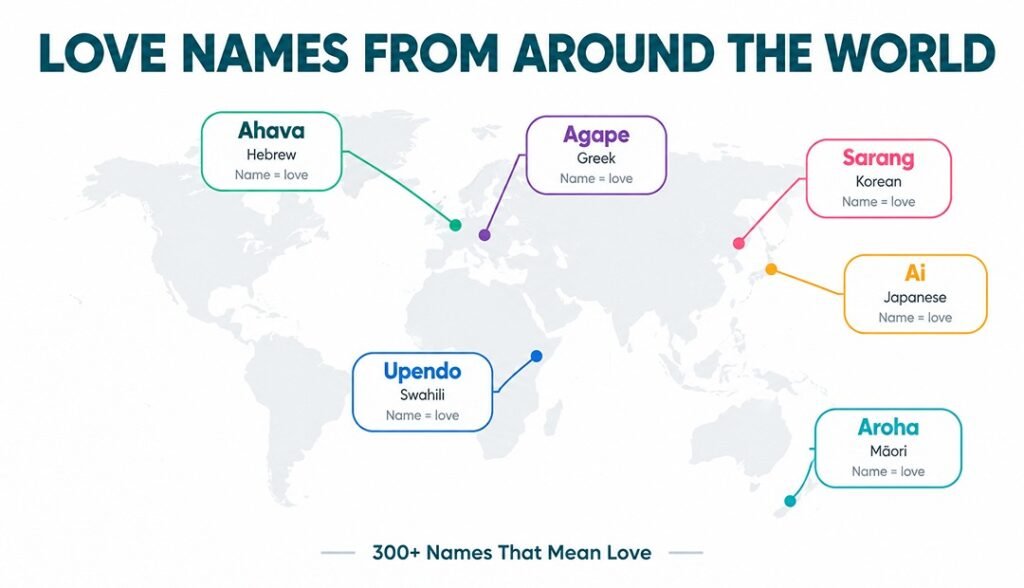
Love shows up in every language. The best names keep the local sound, so each row below holds the original spelling, plus a rough pronunciation where it helps. Hebrew gives us Ahuva and Dodi, Swahili gives us Upendo and Pendo, and Tagalog gives us Mahal.
A name from a language you don’t speak carries history you may not know. Thandiwe and Ifeoluwa, for example, sit inside Zulu and Yoruba naming traditions, where a name often records a family’s story or faith. Ask someone from the culture, and learn the pronunciation before you decide.
Hebrew Names That Mean Love
| Name | Meaning | Origin | Style | Type |
|---|---|---|---|---|
| Ahuva (ah-HOO-vah) | “beloved” | Hebrew | Gentle, rare | Adjacent |
| Haviva (khah-VEE-vah) | “beloved” | Hebrew | Bright, rare | Adjacent |
| Dodi (DOH-dee) | “my beloved” | Hebrew | Sweet, short | Adjacent |
| Jedidiah | “beloved of God” | Hebrew | Biblical, rare | Adjacent |
| Jedidah | “beloved” | Hebrew | Biblical, rare | Adjacent |
| Yedid (yeh-DEED) | “beloved, friend” | Hebrew | Short, rare | Adjacent |
| Eldad | “God has loved” | Hebrew | Biblical, rare | Adjacent |
Pacific Island Names
| Name | Meaning | Origin | Style | Type |
|---|---|---|---|---|
| Kuʻuipo (koo-oo-EE-poh) | “my sweetheart” | Hawaiian | Lyrical, rare | Adjacent |
| Ipo | “sweetheart” | Hawaiian | Short, rare | Adjacent |
| Kaipo | “the sweetheart” | Hawaiian | Warm, boy-leaning | Adjacent |
| Alofa (ah-LOH-fah) | “love” | Samoan | Soft, rare | Love |
| Ofa (OH-fah) | “love” | Tongan | Short, rare | Love |
| Loloma (loh-LOH-mah) | “love” | Fijian | Lyrical, rare | Love |
African Names
| Name | Meaning | Origin | Style | Type |
|---|---|---|---|---|
| Upendo (oo-PEN-doh) | “love” | Swahili | Warm, rare | Love |
| Pendo (PEN-doh) | “love” | Swahili | Short, easy | Love |
| Penda | “loved, beloved” | Swahili | Short, soft | Adjacent |
| Ifeoluwa (ee-feh-oh-LOO-wah) | “God's love” | Yoruba | Long, melodic | Love |
| Ifedayo (ee-feh-DAH-yoh) | “love turns to joy” | Yoruba | Rhythmic, rare | Love |
| Oluwafemi | “God loves me” | Yoruba | Long, formal | Love |
| Thandi (TAHN-dee) | “beloved” | Zulu/Xhosa | Short, bright | Adjacent |
| Thandiwe (tahn-DEE-weh) | “beloved” | Zulu/Xhosa | Lyrical, rare | Adjacent |
| Thandeka (tahn-DEH-kah) | “beloved, lovable” | Zulu | Soft, rare | Adjacent |
| Tadiwa | “we are loved” | Shona | Short, rare | Love |
| Fikirte | “my love” | Amharic | Soft, rare | Love |
Asian and Andean Names
| Name | Meaning | Origin | Style | Type |
|---|---|---|---|---|
| Sarang | “love” | Korean | Short, lyrical | Love |
| Mahal | “love, dear” (also “expensive”) | Tagalog | Short, rare as a name | Love |
| Cinta (CHIN-tah) | “love” | Indonesian/Malay | Soft, short | Love |
| Kasih | “love, affection” | Indonesian/Malay | Short, gentle | Love |
| Thương | “love, to cherish” | Vietnamese | Soft, rare outside Vietnam | Love |
| Ái | “love” | Vietnamese | Short, rare | Love |
| Munay | “to love, love” | Quechua | Rare, rhythmic | Love |
Arabic and Middle Eastern Names
Love sits at the center here. Habiba means “beloved,” Wadad means “love and affection,” Hiyam means “intense love,” and Ishq goes further still, naming passionate love in Arabic and Urdu. Persian adds Dilara, Dilruba and Delaram, which all play on dil, the word for heart. Kurdish contributes Evin, a modern favorite that means love.
Spelling matters. Habiba can appear as Habibah or Habeeba, and Wadad as Widad, because Arabic letters don’t map neatly onto English ones. Pick one spelling and stick with it for good. Then check the transliteration with a native speaker if you can, since a single vowel can shift the sound.
| Name | Meaning | Origin | Style | Type |
|---|---|---|---|---|
| Habiba | “beloved” | Arabic | Warm, classic | Adjacent |
| Wadad (wah-DAHD) | “love, affection” | Arabic | Rare, gentle | Love |
| Hanan | “tenderness, compassion” | Arabic | Soft, unisex | Adjacent |
| Khalila | “beloved friend” | Arabic | Soft, rare | Adjacent |
| Ishq | “passionate love” | Arabic/Urdu | Intense, very rare | Love |
| Mohabbat | “love” | Urdu | Rare, lyrical | Love |
| Hiyam (hee-YAHM) | “intense love” | Arabic | Rare, girl | Love |
| Ashiq | “lover” | Arabic/Urdu | Rare, boy | Love |
| Mawdud | “beloved” | Arabic | Formal, boy | Adjacent |
| Habibullah | “beloved of God” | Arabic | Formal, boy | Adjacent |
| Habibi | “my beloved” (an endearment) | Arabic | Pet-name style | Adjacent |
| Evin | “love” | Kurdish | Modern, soft | Love |
| Dilbar | “sweetheart, charmer” | Persian | Rare, girl | Adjacent |
| Dilara | “heart-adorning, beloved” | Persian | Elegant, rising | Adjacent |
| Dilruba | “heart-stealer, sweetheart” | Persian/Urdu | Lyrical, rare | Adjacent |
| Delaram | “heart's ease” | Persian | Gentle, rare | Linked |
| Sevim | “love, affection” | Turkish | Soft, rare | Love |
Rare and Distinctive Names Meaning Love
Rare names give you room to stand out, but they come with trade-offs. Amour, Caritas and Dashuri are direct translations of love in French, Latin and Albanian, while Maite and Maitane are Basque and wonderfully soft. Gráinne is Irish, and its meaning is debated, so check your sources before you commit.
Popularity helps you judge how rare is rare. According to the U.S. Social Security Administration’s 2024 data, Liam and Olivia ranked as the most popular boy and girl names, which shows parents still lean toward classic, easy-to-say names. The names here sit far outside that top tier, so pull exact counts on ssa.gov before you decide. Rare is not the same as better.
| Name | Meaning | Origin | Style | Type |
|---|---|---|---|---|
| Amour | “love” | French | Bold, very rare | Love |
| Amice | “friendship” (medieval form of Amicia) | Latin/English | Vintage, very rare | Adjacent |
| Caritas | “love, esteem” | Latin | Virtue name, very rare | Love |
| Gráinne (GRAWN-yah) | Debated: possibly “grain”; sometimes linked to grá, “love” | Irish | Legendary, rare | Linked |
| Maite (MY-teh) | “beloved” | Basque | Soft, rare | Adjacent |
| Maitane (my-TAH-neh) | “lovable” | Basque | Lyrical, rare | Adjacent |
| Dashuri (dah-SHOO-ree) | “love” | Albanian | Rare, soft | Love |
| Liebe (LEE-beh) | “love” | Yiddish/German | Vintage, rare | Love |
| Lieve (LEE-veh) | “dear, beloved” | Dutch/Flemish | Gentle, rare | Adjacent |
| Amorosa | “loving” | Italian | Romantic, very rare | Adjacent |
| Carissima | “dearest” | Italian | Operatic, very rare | Adjacent |
| Caro | “dear” | Italian/Spanish | Short, unisex | Adjacent |
Mythic Names Linked to Love
These names don’t mean love. They belong to the gods of it.
| Name | Meaning | Origin | Style | Type |
|---|---|---|---|---|
| Ishtar | Goddess of love and war; meaning uncertain | Akkadian | Fierce, rare | Linked |
| Inanna | “lady of heaven” | Sumerian | Ancient, rare | Linked |
| Astarte | Greek form of the Phoenician goddess Ashtart | Phoenician/Greek | Dramatic, rare | Linked |
| Oshun | Orisha of love and rivers | Yoruba | Fluid, rare | Linked |
| Erzulie | Spirit of love in Haitian Vodou | Haitian Creole | Lyrical, rare | Linked |
| Branwen | “white raven”; Welsh heroine linked to love | Welsh | Mythic, rare | Linked |
| Áine (AWN-yeh) | “radiance”; Irish goddess of love and summer | Irish | Bright, rare | Linked |
| Hathor | “house of Horus”; Egyptian goddess of love and beauty | Egyptian | Regal, very rare | Linked |
| Xochiquetzal | “flower feather”; Aztec goddess of love and beauty | Nahuatl | Striking, very rare | Linked |
Expanding the List: Additional Names That Mean Love
Most names above have cousins. Philip has Felipe and Filippo, and David has Dafydd and Dewi. Variants matter because they change the feel without changing the meaning, and a name can sound warm in Spanish or polished in French while keeping the same root, as Amadeus does with Amedeo and Amédée.
Nicknames help too. Pippa comes from Philippa, Mandy from Amanda, and Jed from Jedidiah. The Punjabi preet family alone spans dozens of combinations, and a handful are listed below. If a long name feels like a mouthful, check for a short form before you cross it off.
Amy, Amanda and Amadeus Families
| Name | Meaning | Origin | Style | Type |
|---|---|---|---|---|
| Amie | “friend” (feminine of ami); often read as “beloved” | French | Sweet, vintage | Adjacent |
| Amée | “beloved” | Old French | Rare, the root of Amy | Adjacent |
| Amabelle | “lovable” | Latin/French | Romantic, rare | Adjacent |
| Mabelle | “lovable” | Latin/French | Vintage, rare | Adjacent |
| Amatus | “beloved” | Latin | Rare, boy | Adjacent |
| Amando | “worthy of love” | Spanish | Warm, boy | Adjacent |
| Amandus | “worthy of love” | Latin | Classical, rare | Adjacent |
| Amancio | “loving” | Spanish | Old-world, rare | Adjacent |
| Amedeo | “love of God” | Italian | Artistic, rare | Love |
| Amédée | “love of God” | French | Refined, rare | Love |
| Amadeu | “love of God” | Catalan/Portuguese | Rare, boy | Love |
| Amado | “beloved” | Spanish/Portuguese | Warm, rare | Adjacent |
| Amador | “lover” | Spanish | Rare, boy | Love |
| Amadora | “lover” | Spanish/Portuguese | Rare, girl | Love |
Dear, Darling and Philip Families
| Name | Meaning | Origin | Style | Type |
|---|---|---|---|---|
| Darlene | “little darling” | English | Retro, girl | Adjacent |
| Darla | “darling” | English | Retro, short | Adjacent |
| Cheri | “dear” | French | Retro, girl | Adjacent |
| Sheri | “dear” | French/English | Retro, girl | Adjacent |
| Carine | “dear” | French | Soft, rare | Adjacent |
| Felipe | “lover of horses” | Spanish | Warm, boy | Adjacent |
| Filippo | “lover of horses” | Italian | Warm, boy | Adjacent |
| Philippe | “lover of horses” | French | Polished, boy | Adjacent |
| Phillip | “lover of horses” | English | Classic, boy | Adjacent |
| Philipp | “lover of horses” | German | Crisp, boy | Adjacent |
| Pippa | “lover of horses” (from Philippa) | English | Playful, girl | Adjacent |
David, Theophilus and Erasmus Families
| Name | Meaning | Origin | Style | Type |
|---|---|---|---|---|
| Davida | “beloved” | Hebrew | Vintage, girl | Adjacent |
| Davina | “beloved” | Scottish | Soft, girl | Adjacent |
| Dafydd (DAV-ith) | “beloved” | Welsh | Distinct, boy | Adjacent |
| Dewi (DEH-wee) | “beloved” (Welsh form of David) | Welsh | Short, boy | Adjacent |
| Davide | “beloved” | Italian | Smooth, boy | Adjacent |
| Davi | “beloved” | Portuguese | Short, boy | Adjacent |
| Dawid | “beloved” | Polish | Crisp, boy | Adjacent |
| Dawit | “beloved” | Amharic | Short, boy | Adjacent |
| Dawud | “beloved” | Arabic | Classic, boy | Adjacent |
| Jed | “beloved” (short for Jedidiah) | Hebrew | Short, boy | Adjacent |
| Yedidya | “beloved of God” | Hebrew | Modern Israeli, boy | Adjacent |
| Théophile | “loved by God” | French | Refined, rare | Adjacent |
| Teófilo | “loved by God” | Spanish | Warm, rare | Adjacent |
| Erasmus | “beloved” | Greek | Scholarly, rare | Adjacent |
| Erastus | “beloved” | Greek | Biblical, rare | Adjacent |
| Erasmo | “beloved” | Spanish/Italian | Warm, rare | Adjacent |
More Love-Linked Names and Spellings
| Name | Meaning | Origin | Style | Type |
|---|---|---|---|---|
| Annabel | “lovable” (medieval variant of Amabel) | English | Romantic, familiar | Adjacent |
| Annabelle | “lovable” | English | Romantic, familiar | Adjacent |
| Desiree | “desired” | French | Elegant, vintage | Linked |
| Afrodita | Goddess of love (form of Aphrodite) | Spanish/Romanian | Bold, rare | Linked |
| Freyja | “lady”; Norse goddess of love | Old Norse | Mythic, rare | Linked |
| Radha | “prosperity”; beloved of Krishna | Sanskrit | Devotional, classic | Linked |
| Caradog | “beloved” | Welsh | Rare, boy | Adjacent |
| Valentyna | “strong, healthy” | Ukrainian | Distinct, girl | Linked |
| Habibah | “beloved” | Arabic | Alternate spelling | Adjacent |
| Preethi | “love” | Kannada/Tamil/Telugu | Soft, girl | Love |
| Maya | “love, affection” (Nepali); “illusion” (Sanskrit) | Nepali/Sanskrit | Short, familiar | Linked |
| Libi (LEE-bee) | “my heart” | Hebrew | Sweet, girl | Linked |
| Lev | “heart” | Hebrew | Short, boy | Linked |
Preet, Tamil, Slavic and Cornish Additions
| Name | Meaning | Origin | Style | Type |
|---|---|---|---|---|
| Manpreet | “love of the heart/mind” | Punjabi | Common in Sikh families, unisex | Love |
| Navpreet | “new love” | Punjabi | Fresh, unisex | Love |
| Amarpreet | “eternal love” | Punjabi | Spiritual, unisex | Love |
| Jaspreet | “love of glory” | Punjabi | Familiar, unisex | Love |
| Sukhpreet | “peaceful love” | Punjabi | Gentle, unisex | Love |
| Anbarasan | “king of love” | Tamil | Formal, boy | Love |
| Dragana | “dear, precious” | Slavic | Strong, girl | Adjacent |
| Dragica | “dear, precious” | Slavic | Soft, girl | Adjacent |
| Ljubiša (lyoo-BEE-shah) | “love, dear” | Serbian | Strong, boy | Love |
| Ljubica (LYOO-bee-tsah) | “dear” (also “violet”) | Serbian | Soft, girl | Adjacent |
| Milen | “dear, gracious” | Bulgarian | Short, unisex | Adjacent |
| Drago | “dear, precious” | Slavic | Strong, boy | Adjacent |
| Kerensa (kuh-REN-zuh) | “love” | Cornish | Lyrical, girl | Love |
| Kerenza | “love” | Cornish | Lyrical, girl | Love |
Love Names and Modern Branding Trends
Love names have moved well beyond the nursery. Beauty, wellness and hospitality businesses often borrow words like chérie, amore and aloha because the warmth is built in. Parents feel the same pull, which is part of why Aroha and Amara keep showing up on modern lists. Warmth sells.
Pets and characters loosen the rules. A dog named Amor or a heroine named Ahuva doesn’t need to survive a job interview in 2050, so playfulness wins. Writers can use the Linked and Myth tags as plot seasoning: a character named Layla who has nothing to do with love is a neat bit of irony. Naming a business? Run a trademark check first.
- Pets: Amor, Cupid, Darling, Darla, Chérie
- Romance characters: Eros, Anteros, Ahuva, Dodi
- Ironic characters: Layla, Romeo, Amelia
Names that mean love Greek
Greek has several words for love, and each gives a name its own flavor. Agape means unconditional love, Philia means affection or friendship, and Eros means desire. Agapi, Agapios, Agapito and Agapita all grow from the same agape root. Philip, Philippa and Philomena grow from philos, which means fond of.
What name means love in Greek? The most direct answer is Agape or Agapi, with Eros as the passionate option. Erato, the Muse of love poetry, shares her root with Eros. Pothos and Himeros name “longing” and “desire,” and they’re rare enough to feel fresh.
| Name | Meaning | Origin | Style | Type |
|---|---|---|---|---|
| Agape (ah-GAH-pay) | “unconditional love” | Greek | Rare, spiritual | Love |
| Agapi (ah-GAH-pee) | “love” | Greek | Soft, common in Greece | Love |
| Agapito | “beloved” | Spanish/Italian | Old-world, boy | Adjacent |
| Agapita | “beloved” | Spanish | Old-world, girl | Adjacent |
| Agapios | “beloved” | Greek | Rare, boy | Adjacent |
| Philia | “love, affection, friendship” | Greek | Rare, abstract | Love |
| Aphrodite | Goddess of love; meaning uncertain | Greek | Bold, mythic | Linked |
| Erato (EH-rah-toh) | “lovely” (Muse of love poetry) | Greek | Lyrical, rare | Linked |
| Theophilus | “loved by God” | Greek | Biblical, rare | Adjacent |
| Pothos | “longing” | Greek | Mythic, very rare | Linked |
| Himeros | “desire” | Greek | Mythic, very rare | Linked |
| Psyche (SY-kee) | “soul”; mortal lover of Eros in myth | Greek | Mythic, rare | Linked |
| Philothea | “lover of God” | Greek | Vintage, very rare | Adjacent |
| Philemon | “affectionate” | Greek | Biblical, rare | Adjacent |
| Philip | “lover of horses” | Greek | Classic, strong | Adjacent |
Philip needs a plain-language note. It means “fond of horses,” not “love itself,” so it sits in the Adjacent group, not the Love group.
Sanskrit and Indian Names
Sanskrit packs a lot of love vocabulary into short names. Prema and Prem mean love, Sneha means affection, Priya means dear or beloved, and Pritam means beloved. Anurag adds attachment, and Pranay adds love with a sense of devotion. Rohan gets a myth check: it means “ascending,” not love.
Regional languages add more. Tamil gives Anbu (“love”), Kannada and Telugu use Preethi and Prema, and Punjabi has the preet family. Maitri and Metta describe loving-kindness, a gentler idea than romance. Kama and Rati belong to the god and goddess of love in Hindu tradition.
| Name | Meaning | Origin | Style | Type |
|---|---|---|---|---|
| Prema | “love” | Sanskrit | Soft, girl | Love |
| Preeti | “love, joy” | Sanskrit | Bright, girl | Love |
| Priti | “love, joy” | Sanskrit | Short, girl | Love |
| Sneha | “affection, love” | Sanskrit | Gentle, girl | Love |
| Snehal | “affectionate, loving” | Sanskrit | Gentle, unisex | Love |
| Snehil | “loving, affectionate” | Sanskrit | Gentle, boy | Love |
| Priya | “beloved, dear” | Sanskrit | Familiar, easy | Adjacent |
| Priyanka | “dear, beloved” | Sanskrit | Familiar, girl | Adjacent |
| Priyam | “beloved” | Sanskrit | Short, boy | Adjacent |
| Prem | “love” | Sanskrit/Hindi | Short, boy | Love |
| Pranay | “love, affection” | Sanskrit | Modern, boy | Love |
| Anurag | “love, attachment” | Sanskrit | Formal, boy | Love |
| Kama | “desire, love” (god of love) | Sanskrit | Mythic, rare | Love |
| Rati | “pleasure, love” (goddess of passion) | Sanskrit | Mythic, rare | Love |
| Premal | “loving” | Sanskrit | Gentle, boy | Love |
| Pritam | “beloved” | Sanskrit/Hindi | Familiar, boy | Adjacent |
| Bhakti | “devotion” | Sanskrit | Spiritual, girl | Linked |
| Hridaya | “heart” | Sanskrit | Rare, girl | Linked |
| Mamata | “affection, motherly love” | Sanskrit | Warm, girl | Adjacent |
| Maitri | “friendliness, loving-kindness” | Sanskrit | Gentle, unisex | Adjacent |
| Metta | “loving-kindness” | Pali | Buddhist term, rare | Adjacent |
| Anbu | “love” | Tamil | Short, unisex | Love |
| Anbarasi | “queen of love” | Tamil | Traditional, girl | Love |
| Rohan | “ascending” (not “love”) | Sanskrit | Popular, boy | Myth |
European Love Names
European languages hide love in unexpected places. Slavic names built on mil or drag mean “dear” or “precious,” as in Milan, Draga and Ludmila. Welsh gives Caron, Norse gives Freya, and German gives Minna, an old word tied to love and memory. Corazón is simply the Spanish word for heart.
Ljubomir is a strong example: it blends “love” and “peace” in a single Slavic name. Minna and Lieven are underused in the US. Origins vary from language to language, so confirm each one on Behind the Name before you finalize.
Slavic and Balkan Names
| Name | Meaning | Origin | Style | Type |
|---|---|---|---|---|
| Milan | “gracious, dear” | Slavic | Crisp, boy | Adjacent |
| Miloš (MEE-losh) | “gracious, dear” | Serbian | Strong, boy | Adjacent |
| Milica (MEE-lee-tsah) | “dear, gracious” | Serbian | Soft, girl | Adjacent |
| Ljubomir (lyoo-BOH-meer) | “love and peace” | Slavic | Strong, boy | Love |
| Lubomira | “love and peace” | Slavic | Rare, girl | Love |
| Ludmila | “dear to the people” | Slavic | Vintage, girl | Adjacent |
| Draga | “dear, precious” | Slavic | Short, girl | Adjacent |
| Dragan | “dear, precious” | Slavic | Strong, boy | Adjacent |
| Dragomir | “precious peace” | Slavic | Strong, boy | Adjacent |
| Dragoș (DRAH-gosh) | “dear, precious” | Romanian | Strong, boy | Adjacent |
| Lyuba | “love” (short for Lyubov) | Russian | Short, girl | Love |
Welsh, Norse, Germanic and Spanish Names
| Name | Meaning | Origin | Style | Type |
|---|---|---|---|---|
| Caron | “loving, kind-hearted” | Welsh | Soft, unisex | Adjacent |
| Freya | “lady”; Norse goddess of love | Old Norse | Mythic, modern | Linked |
| Minna | “love, memory” | German | Vintage, short | Love |
| Lieven (LEE-ven) | “dear” | Flemish | Rare, boy | Adjacent |
| Corazón | “heart” | Spanish | Rare, bold | Linked |
Unisex names that mean love
The gender-neutral table earlier had 14 names. Here are a few more, all from Japan, where gender-neutral names are common. Ren can be written with a character meaning “love,” though a different character makes it “lotus.” Mana and Aito work the same way.
Unisex names pair easily with traditional middle names. Ahava Rose, Amor James and Kealoha Jane all balance sound and meaning. For siblings, match the root, not the spelling. Mila and Milan share the Slavic root for “dear,” and the set feels intentional without being matchy.
| Name | Meaning | Origin | Style | Type |
|---|---|---|---|---|
| Ren | “love” (when written 恋); “lotus” with 蓮 | Japanese | Short, modern | Love |
| Mana | “love” (when written 愛) | Japanese | Soft, unisex | Love |
| Aito | “love” (when written with 愛) | Japanese | Rare, boy-leaning | Love |
Names that mean love in Japanese
In Japanese, a name’s meaning lives in the kanji, not the sound. Ai (愛) means love, and it appears in Aiko, Aimi, Aika, Airi and Manami. The same sound written with a different character can mean something else entirely. That’s why a Japanese name needs its characters listed, not just its spelling.
Parents choose the characters, so the “meaning” of Aiko varies by family. It can be “love child” or “beloved child,” depending on the kanji. Ask a Japanese speaker, or check a kanji dictionary, before you finalize. The rows below show the most common readings.
| Name | Meaning | Origin | Style | Type |
|---|---|---|---|---|
| Aiko (EYE-koh) | “love child” or “beloved child” | Japanese | Classic, girl | Love |
| Aimi | “love and beauty” | Japanese | Modern, girl | Love |
| Aika | “love song” or “love fragrance” | Japanese | Melodic, girl | Love |
| Airi | “love” plus a second character | Japanese | Modern, girl | Love |
| Manami | “love and beauty” | Japanese | Soft, girl | Love |
| Aina | “love” plus a second character | Japanese | Soft, girl | Love |
| Aisa | “love” plus a second character | Japanese | Modern, girl | Love |
A baby needs a name that works at age 5 and age 50, so test it with your surname and initials. A pet can be playful. A character should hint at personality or irony. Parents who've shortlisted names from big lists often report that the final choice hinged on how the name sounded with the surname, not on the meaning alone.
To choose a name that means love, follow these steps:
- Say it aloud with your surname.
- Check the meaning on Behind the Name.
- Look up popularity on the SSA database.
- Test nicknames and initials.
- Ask a native speaker about usage.
Three tools make this faster. Behind the Name checks etymology, Nameberry shows style and trend context, and the SSA baby names database shows how common a name is.
Cultural respect check:
- Learn the pronunciation from a native speaker, not just a respelling.
- Find out whether the name is tied to a faith, a title or a family role.
- Keep the original spelling and diacritics when you can.
Try pairings like Carys Esme, Aroha Mae or David Amadeus, and match siblings by root, not by spelling.
Conclusion
A name that means love can be literal or gentle, ancient or brand new. The labels here exist so you can tell which is which: Love for the word itself, Adjacent for beloved and dear, and Linked or Myth for the rest.
Pick five favorites, check each on Behind the Name and the SSA database, and say them aloud with your surname. Then ask one person who speaks the language what they hear. The right name usually stops you mid-scroll.
FAQs About Names That Mean Love
What Latin name means love?
Amor is the Latin word for love, and it works as a name in Spanish and English. Amanda means “worthy of love,” Amata means “beloved,” Amadeus means “love of God,” and Venus is the Roman goddess of love.
What names mean little love?
Amorette and Amoretta mean “little love.” Carina means “dear little one,” and Mignonette means “little darling.”
What female name means heart?
Corazón (Spanish), Libi (Hebrew, “my heart”) and Hridaya (Sanskrit) all mean heart. Kokoro (Japanese) is unisex. Cordelia is often listed too, but its origin is debated.
What names symbolize love?
Three groups do: names that translate to love (Ahava, Aroha, Amor), names of love deities (Venus, Freya, Eros), and names tied to love by tradition (Valentine, Valentina).
What name means love in Greek?
Agape and Agapi mean love. Eros means passionate love or desire, and Philia means affection.
What is the prettiest name that means love?
That's subjective. Aroha, Carys, Ahuva and Amadeus are good starting points because they're easy to say and well documented.
What name means love in other languages?
Aroha (Māori), Ahava (Hebrew), Ásta (Icelandic), Lyubov (Russian), Sarang (Korean), Upendo (Swahili) and Ai (Japanese) all mean love.
Is Amara a name that means love?
Not directly. It means “grace” in Igbo and “unfading” through Greek. The Latin love link is popular but looks like folk etymology.
Which boy name means love?
Eros, Prem, Amadeus and Ljubomir include love in their meaning. David means “beloved.”
Can I use a love name from a culture that isn't mine?
Yes, with care. Learn the pronunciation, understand what the name means to that community, and avoid names tied to sacred roles. When in doubt, ask someone from the culture.
What's best name that means love for a baby girl?
Carys, Aroha and Ahuva are strong starting points. Carys is easy to say, Aroha is short and melodic, and Ahuva (“beloved”) has deep Hebrew roots.
Why does Valentine not mean love?
It comes from a Latin root meaning strong or healthy. The love association grew later from Saint Valentine's feast day and the traditions around it.