
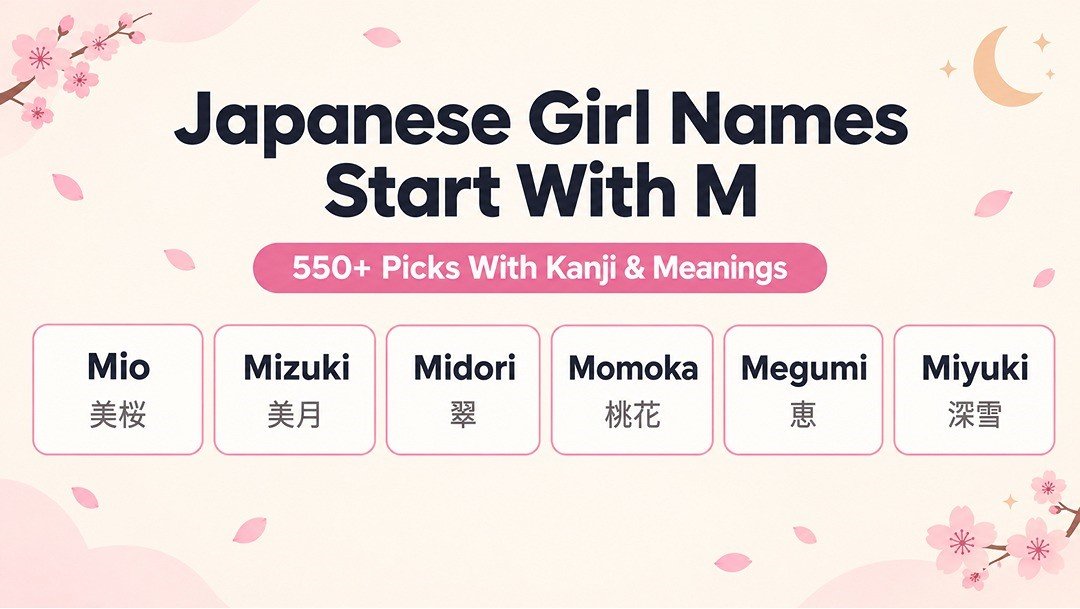
Japanese girl names that start with M means female given names that begin with the sounds ma, mi, mu, me or mo, such as Mio, Mizuki and Momoka. One name can be written with several kanji, so its meaning depends on the characters a family picks.
This works best for parents, writers, gamers and anyone who wants a real Japanese girl name with a verified kanji spelling. It won’t help if you need legal naming advice for a specific country.
How to read the lists: every entry shows the name, its kanji, a simple sound guide, the literal meaning and the style. Kanji spellings are common ones, but Japanese readings aren’t legally fixed, so a family can read the same kanji differently. Check any spelling on Jisho.org before you commit.
- What’s A Cute M Name for a Girl?
- Why Japanese Names With M Are So Popular
- Japanese Names That Start With M
- Japanese Girl Names That Start with Mi
- Japanese Girl Names That Start with Mu
- Unique Japanese Names that start With M
- Popular Japanese Names That Start With M
- Japanese Girl Names Starting with M with Meaning
- Cute Japanese Names Starting With M
- Male Japanese Names That Start With M
- Female Japanese Names That Start With M
- Japanese Last Names That Start With M
- Gender Neutral Japanese Names That Start With M
- Cool Japanese Names That Start With M
- Unisex Japanese Names Beginning With M
- Asian Names That Start with M Girl
- Tips for Choosing the Right Japanese Name
- Closing Insights: Japanese Names That Start With M
- Fascinating Facts About Japanese Names Beginning With “M”
- Why “M” Names Hold a Special Place in Japanese Culture
- Conclusion
- FAQs
This guide covers Japanese girl names and girl-friendly names that start with M. It does NOT cover names written only in katakana, and the male, surname and pan-Asian sections are not part of the 550+ count.
What’s A Cute M Name for a Girl?
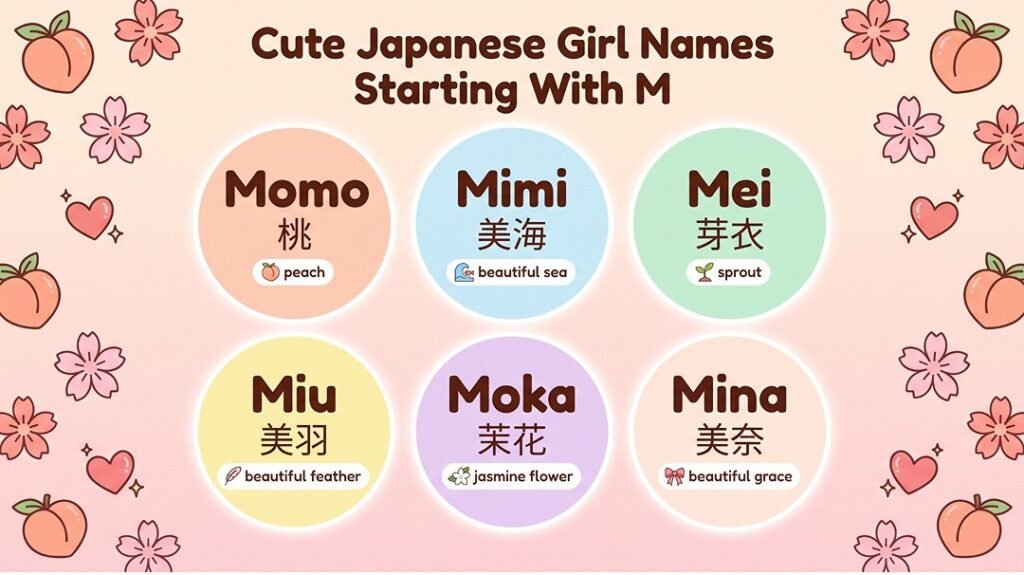
A cute M name for a Japanese girl is usually short and soft, like Momo, Mimi, Mei or Miu. Short and sweet wins here. According to Nippon.com’s report on Meiji Yasuda Life’s 2025 survey, half of the girls’ top-ten names used a single kanji, so brief names fit today’s style.
Cute also depends on the kanji. Momoka (桃花) means “peach blossom”, which feels sweet and playful. Mimi (美海) pairs “beauty” with “sea”. If you’re picking for a baby, say it out loud first, because a name that’s easy to say in both Japanese and English tends to stick for life.
Why Japanese Names With M Are So Popular
Names that start with M are popular in Japan because the sound is soft and the kanji carry kind meanings. According to Nippon.com’s 2025 report on Meiji Yasuda data, 愛 (love) was the most common kanji in girls’ names for the fourth year in a row, which shows families lean toward warm meanings.
Mio means “beautiful cherry blossom” when it’s written 美桜, but the same sound can also mean “waterway” (澪) or “not yet ended” (未央). According to standard kanji dictionaries such as Jisho.org, one reading can carry many meanings, so the kanji decides the story. Check the characters before you choose a spelling.
Japanese Names That Start With M
Japanese names that start with M fall into five sound families. Those are Ma, Mi, Mu, Me and Mo. Mi is the biggest, and Ma follows it closely, while Mu and Me stay rare enough to feel special if you want something less common than the usual favorites.
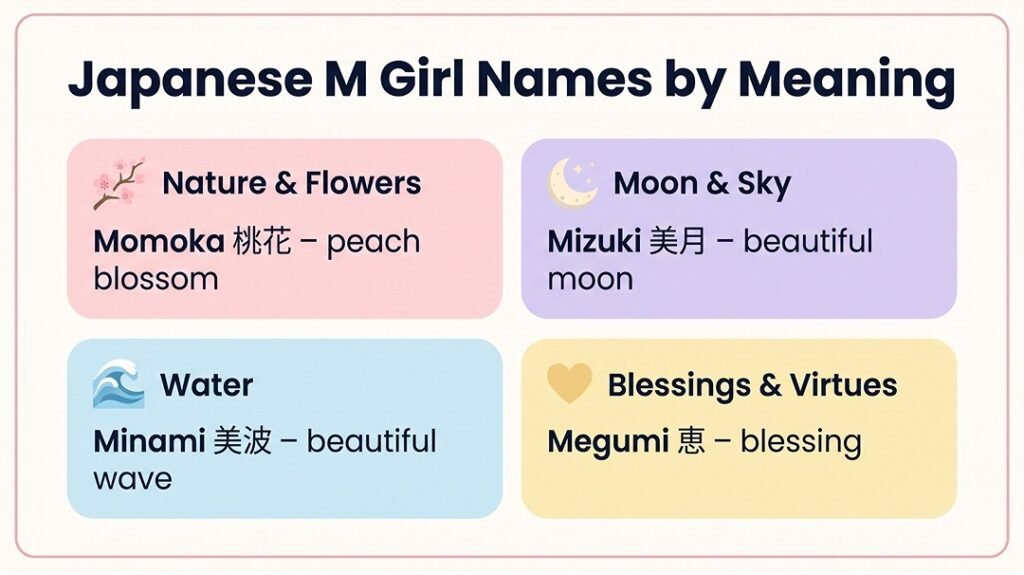
Every list below uses one format: name, kanji, sound guide, meaning and vibe. Easy to scan on a phone. Pronunciations use plain English syllables, so mee rhymes with “see” and oh sounds like the word “oh”. Meanings come from the literal kanji, which is why one sound can carry several different meanings.
Japanese Girl Names That Start with Mi
Mi names are the heart of this list. The sound is gentle, and it pairs with almost any second syllable. Many use the kanji 美 (mi), which means “beauty”, while others use 実 (fruit), 未 (not yet) or 深 (deep) to build a very different feeling from the same opening sound.
Scroll by the second letter. The tables below split Mi names into small groups, so you can jump straight to Mika, Mizuki or Miyu. Quick note: I left the “-ko” endings out of these tables on purpose, because they have their own traditional section later, and that keeps every name listed once.
Mi + A, E, F, H, CH, D (Mia to Midori)
| Name (Kanji) | Pronunciation | Meaning | Style/Vibe |
|---|---|---|---|
| Mia (美愛) | mee-ah | beautiful love | modern, global-friendly |
| Mie (美恵) | mee-eh | beautiful blessing | classic, gentle |
| Mifumi (美文) | mee-foo-mee | beautiful writing | bookish, refined |
| Mifuyu (美冬) | mee-foo-yoo | beautiful winter | calm, seasonal |
| Mihana (美花) | mee-hah-nah | beautiful flower | floral, soft |
| Miharu (美春) | mee-hah-roo | beautiful spring | fresh, warm |
| Mihina (美雛) | mee-hee-nah | beautiful little doll | sweet, vintage |
| Mihiro (美寛) | mee-hee-roh | beautiful generosity | kind, balanced |
| Miho (美穂) | mee-hoh | beautiful ear of grain | classic, earthy |
| Miho (美帆) | mee-hoh | beautiful sail | breezy, modern |
| Miho (実帆) | mee-hoh | fruitful sail | gentle, hopeful |
| Michi (美智) | mee-chee | beautiful wisdom | short, thoughtful |
| Michie (美智恵) | mee-chee-eh | beautiful wisdom and blessing | refined, traditional |
| Michika (美千花) | mee-chee-kah | beautiful thousand flowers | poetic, lush |
| Michiyo (美智代) | mee-chee-yoh | beautiful wisdom, generation | traditional, calm |
| Midori (翠) | mee-doh-ree | emerald green, kingfisher blue-green | nature, rising again |
| Midori (緑) | mee-doh-ree | green | fresh, timeless |
Mi + K (Mika to Miku)
| Name (Kanji) | Pronunciation | Meaning | Style/Vibe |
|---|---|---|---|
| Mika (美香) | mee-kah | beautiful fragrance | soft, popular |
| Mika (美夏) | mee-kah | beautiful summer | bright, sunny |
| Mika (実夏) | mee-kah | fruitful summer | warm, natural |
| Mikana (美奏) | mee-kah-nah | beautiful melody | musical, graceful |
| Miki (美希) | mee-kee | beautiful hope | upbeat, classic |
| Miki (美樹) | mee-kee | beautiful tree | graceful, strong |
| Miki (実希) | mee-kee | true hope | gentle, sincere |
| Mikiyo (美紀代) | mee-kee-yoh | beautiful era, generation | traditional |
| Mikoto (美琴) | mee-koh-toh | beautiful koto (zither) | elegant, musical |
| Miku (未来) | mee-koo | future | modern, hopeful |
| Miku (美空) | mee-koo | beautiful sky | airy, bright |
| Miku (美久) | mee-koo | beautiful and lasting | sweet, enduring |
Mi + M, N (Mimi to Mion)
| Name (Kanji) | Pronunciation | Meaning | Style/Vibe |
|---|---|---|---|
| Mimi (美海) | mee-mee | beautiful sea | cute, breezy |
| Mimi (美々) | mee-mee | doubled beauty | playful, sweet |
| Mimika (美々香) | mee-mee-kah | beautiful fragrance, doubled | soft, charming |
| Mimori (美森) | mee-moh-ree | beautiful forest | calm, natural |
| Mina (美奈) | mee-nah | beautiful grace | classic, gentle |
| Mina (美菜) | mee-nah | beautiful greens | fresh, popular |
| Mina (美那) | mee-nah | beautiful (phonetic na) | soft, simple |
| Mina (実奈) | mee-nah | fruitful grace | warm, modern |
| Minae (美苗) | mee-nah-eh | beautiful seedling | young, hopeful |
| Minami (南) | mee-nah-mee | south | warm, simple |
| Minami (美波) | mee-nah-mee | beautiful wave | ocean, popular |
| Minase (水瀬) | mee-nah-seh | water shallows | rare, flowing |
| Mino (美乃) | mee-noh | beautiful (of) | soft, rounded |
| Mino (実乃) | mee-noh | fruit (of) | earthy, gentle |
| Minori (実里) | mee-noh-ree | fruitful village | harvest, wholesome |
| Minori (稔) | mee-noh-ree | harvest, ripening | warm, steady |
| Mion (美音) | mee-ohn | beautiful sound | musical, modern |
Mi + O, R (Mio to Mirin)
| Name (Kanji) | Pronunciation | Meaning | Style/Vibe |
|---|---|---|---|
| Mio (美桜) | mee-oh | beautiful cherry blossom | modern, soft, very popular |
| Mio (澪) | mee-oh | waterway, channel | elegant, watery |
| Mio (未央) | mee-oh | not yet ended | poetic, literary |
| Mio (美緒) | mee-oh | beautiful cord | classic, graceful |
| Mio (美央) | mee-oh | beautiful center | balanced, clear |
| Mio (実桜) | mee-oh | fruitful cherry blossom | sweet, gentle |
| Miori (美織) | mee-oh-ree | beautiful weave | crafted, refined |
| Mira (美蘭) | mee-rah | beautiful orchid | rare, exotic |
| Mirai (未来) | mee-rye | future | hopeful, modern |
| Mirai (美来) | mee-rye | beautiful coming | bright, optimistic |
| Mirei (美玲) | mee-ray | beautiful tinkling jade | delicate, clear |
| Mirei (美麗) | mee-ray | beautiful, lovely | elegant, graceful |
| Mirin (美凛) | mee-reen | beautiful dignity | crisp, confident |
| Mirin (実凛) | mee-reen | true dignity | modern, composed |
Mi + S (Misa to Misuzu)
| Name (Kanji) | Pronunciation | Meaning | Style/Vibe |
|---|---|---|---|
| Misa (美沙) | mee-sah | beautiful sand | soft, classic |
| Misa (美紗) | mee-sah | beautiful gauze | delicate, light |
| Misaki (美咲) | mee-sah-kee | beautiful bloom | cheerful, very popular |
| Misaki (実咲) | mee-sah-kee | true bloom | fresh, natural |
| Misaki (岬) | mee-sah-kee | cape, headland | scenic, bold |
| Misao (操) | mee-sah-oh | fidelity, constancy | classic, steady |
| Misato (美里) | mee-sah-toh | beautiful village | warm, homey |
| Misato (美郷) | mee-sah-toh | beautiful hometown | nostalgic, gentle |
| Misono (美園) | mee-soh-noh | beautiful garden | gentle, floral |
| Misora (美空) | mee-soh-rah | beautiful sky | open, airy |
| Misuzu (美鈴) | mee-soo-zoo | beautiful bell | chime-like, classic |
Mi + TS (Mitsuba to Mitsuru)
| Name (Kanji) | Pronunciation | Meaning | Style/Vibe |
|---|---|---|---|
| Mitsuba (三葉) | mee-tsoo-bah | three leaves | plant-inspired, fresh |
| Mitsue (光枝) | mee-tsoo-eh | light, branch | traditional, soft |
| Mitsuki (満月) | mee-tsoo-kee | full moon | luminous, calm |
| Mitsuki (光希) | mee-tsoo-kee | light hope | bright, hopeful |
| Mitsumi (光美) | mee-tsoo-mee | light and beauty | glowing, sweet |
| Mitsuyo (光代) | mee-tsoo-yoh | light, generation | traditional, warm |
| Mitsuru (満) | mee-tsoo-roo | full, satisfied | strong, unisex-leaning |
Mi + W, Y (Miu to Miyuri)
| Name (Kanji) | Pronunciation | Meaning | Style/Vibe |
|---|---|---|---|
| Miu (美羽) | mee-oo | beautiful feather | light, popular |
| Miu (美雨) | mee-oo | beautiful rain | gentle, poetic |
| Miwa (美和) | mee-wah | beautiful harmony | peaceful, classic |
| Miwa (実和) | mee-wah | true harmony | calm, sincere |
| Miya (美夜) | mee-yah | beautiful night | mysterious, soft |
| Miya (美弥) | mee-yah | beautiful, ever more | gentle, flowing |
| Miyabi (雅) | mee-yah-bee | elegance, refinement | refined, literary |
| Miyabi (美雅) | mee-yah-bee | beautiful elegance | graceful, formal |
| Miyako (都) | mee-yah-koh | capital city | classic, grand |
| Miyano (美弥乃) | mee-yah-noh | beautiful, ever more (of) | soft, vintage |
| Miyo (美世) | mee-yoh | beautiful world | timeless, calm |
| Miyo (美代) | mee-yoh | beautiful generation | traditional |
| Miyu (美優) | mee-yoo | beautiful gentleness | very popular, tender |
| Miyu (美結) | mee-yoo | beautiful bond | warm, loving |
| Miyu (深優) | mee-yoo | deep gentleness | tender, modern |
| Miyu (美柚) | mee-yoo | beautiful yuzu citrus | fruity, fresh |
| Miyuki (深雪) | mee-yoo-kee | deep snow | poetic, classic |
| Miyuki (美幸) | mee-yoo-kee | beautiful happiness | cheerful, warm |
| Miyuki (美雪) | mee-yoo-kee | beautiful snow | soft, wintry |
| Miyuki (実幸) | mee-yoo-kee | true happiness | sincere, warm |
| Miyuri (美百合) | mee-yoo-ree | beautiful lily | graceful, floral |
Mi + Z (Mizuho to Mizuna)
| Name (Kanji) | Pronunciation | Meaning | Style/Vibe |
|---|---|---|---|
| Mizuho (瑞穂) | mee-zoo-hoh | fresh ears of rice | poetic, old Japan |
| Mizuki (瑞希) | mee-zoo-kee | auspicious hope | lucky, popular |
| Mizuki (美月) | mee-zoo-kee | beautiful moon | elegant, celestial |
| Mizuki (水月) | mee-zoo-kee | water moon | dreamy, calm |
| Mizuha (瑞葉) | mee-zoo-hah | auspicious leaf | fresh, lucky |
| Mizue (瑞恵) | mee-zoo-eh | auspicious blessing | lucky, gentle |
| Mizore (霙) | mee-zoh-reh | sleet | rare, icy |
| Mizuna (瑞菜) | mee-zoo-nah | auspicious greens | fresh, lucky |
Japanese Girl Names That Start with Mu
Mu names are one of the rarest M families, and that is their charm. The sound is round and warm, and it often points to harmony, dreams or wheat. Names like Mutsumi (睦美) and Mugi (麦) feel calm and a little old-world, which suits parents who want something quiet that still has a clear meaning.
Rare isn’t random, though. Mutsuki (睦月) is the old name for the first lunar month, so it carries a real seasonal story. Murasaki (紫) means “purple” and has a famous literary echo, but it also works as a given name with a regal, quiet feel.
| Name (Kanji) | Pronunciation | Meaning | Style/Vibe |
|---|---|---|---|
| Mugi (麦) | moo-gee | wheat, barley | earthy, cozy |
| Mugiho (麦穂) | moo-gee-hoh | ears of wheat | warm, golden |
| Mugino (麦乃) | moo-gee-noh | wheat (of) | gentle, rustic |
| Mutsumi (睦美) | moo-tsoo-mee | harmonious beauty | calm, kind |
| Mutsumi (睦) | moo-tsoo-mee | harmony, friendliness | warm, classic |
| Mutsuki (睦月) | moo-tsoo-kee | month of harmony, old name for January | seasonal, poetic |
| Mutsuki (睦希) | moo-tsoo-kee | harmonious hope | gentle, modern |
| Mutsue (睦恵) | moo-tsoo-eh | harmony and blessing | traditional |
| Mutsuyo (睦代) | moo-tsoo-yoh | harmony, generation | vintage, gentle |
| Mutsuka (睦花) | moo-tsoo-kah | harmony flower | soft, floral |
| Murasaki (紫) | moo-rah-sah-kee | purple | regal, literary |
| Mumi (夢美) | moo-mee | dream and beauty | dreamy, modern |
| Muneyo (宗代) | moo-neh-yoh | origin, generation | vintage, formal |
| Mukuge (木槿) | moo-koo-geh | rose of Sharon (hibiscus) | rare, floral |
| Mua (夢愛) | moo-ah | dream love | modern, whimsical |
Unique Japanese Names that start With M
Unique here means rare but real. These names use uncommon kanji or poetic words, yet they still read naturally in Japanese. Skip the invented mashups you see on some sites. A name like Mafuyu (真冬), meaning “midwinter”, is uncommon and still completely natural, and that balance is what makes a pick feel special instead of strange.
- Maaya (茉彩) – mah-ah-yah – jasmine and color – bright, modern
- Maaya (麻彩) – mah-ah-yah – hemp and color – natural, artistic
- Madoka (円) – mah-doh-kah – circle – peaceful, round
- Madoka (円香) – mah-doh-kah – circle, fragrance – gentle, sweet
- Madoka (円花) – mah-doh-kah – circle, flower – soft, floral
- Mashiro (真白) – mah-shee-roh – pure white – clean, calm
- Mahoro (真秀) – mah-hoh-roh – true excellence – rare, refined
- Mahoroba (まほろば) – mah-hoh-roh-bah – an ideal, beautiful land (old poetic word) – literary, dreamy
- Memi (芽実) – meh-mee – bud and fruit – fresh, hopeful
- Memi (芽美) – meh-mee – bud and beauty – soft, young
- Meguri (巡) – meh-goo-ree – cycle, turn – rare, flowing
- Momoe (百恵) – moh-moh-eh – hundred blessings – classic, warm
- Momoe (桃恵) – moh-moh-eh – peach blessing – sweet, gentle
- Momoyo (百世) – moh-moh-yoh – hundred ages – timeless, calm
- Mayuri (繭里) – mah-yoo-ree – cocoon village – rare, soft
- Mayuri (真由里) – mah-yoo-ree – true reason, village – gentle, classic
- Maiha (舞羽) – my-hah – dancing feather – graceful, light
- Maika (舞花) – my-kah – dance flower – floral, lively
- Maika (舞香) – my-kah – dance fragrance – sweet, airy
- Maina (舞奈) – my-nah – dance, grace – bright, modern
- Makina (真紀奈) – mah-kee-nah – true era, grace – soft, modern
- Makina (茉希奈) – mah-kee-nah – jasmine, hope, grace – floral, hopeful
- Manaka (愛華) – mah-nah-kah – love, blossom – warm, floral
- Manaka (真奈花) – mah-nah-kah – true grace flower – gentle, floral
- Manaya (愛彩) – mah-nah-yah – love and color – bright, modern
- Manao (愛央) – mah-nah-oh – love, center – balanced, warm
- Mano (真乃) – mah-noh – true (of) – simple, calm
- Mano (茉乃) – mah-noh – jasmine (of) – soft, floral
- Mano (愛乃) – mah-noh – love (of) – gentle, sweet
- Maori (真織) – mah-oh-ree – true weave – crafted, refined
- Marika (真里香) – mah-ree-kah – true village fragrance – classic, soft
- Marina (麻里奈) – mah-ree-nah – hemp, village, grace – modern, breezy
- Masayo (雅代) – mah-sah-yoh – elegant generation – refined, traditional
- Masayo (正代) – mah-sah-yoh – correct generation – steady, traditional
- Masami (正美) – mah-sah-mee – correct beauty – classic, composed
- Maya (真夜) – mah-yah – true night – mysterious, soft
- Maya (茉耶) – mah-yah – jasmine (phonetic) – modern, floral
- Mayo (麻代) – mah-yoh – hemp generation – vintage, simple
- Mayu (茉結) – mah-yoo – jasmine bond – sweet, modern
- Mayu (舞優) – mah-yoo – dance, gentleness – graceful, kind
- Mayuka (麻由香) – mah-yoo-kah – hemp, reason, fragrance – soft, classic
- Mayumi (麻由美) – mah-yoo-mee – hemp, reason, beauty – classic, gentle
- Moeri (萌里) – moh-eh-ree – sprout village – fresh, soft
- Moeno (萌乃) – moh-eh-noh – sprout (of) – light, sweet
- Momono (桃乃) – moh-moh-noh – peach (of) – cute, soft
- Momona (桃奈) – moh-moh-nah – peach, grace – cute, gentle
- Momoka (桃香) – moh-moh-kah – peach fragrance – sweet, fruity
- Machi (真智) – mah-chee – true wisdom – short, thoughtful
- Maho (茉穂) – mah-hoh – jasmine, ear of grain – floral, earthy
- Mari (万里) – mah-ree – ten thousand ri (a very long way) – adventurous, bold
- Mari (鞠) – mah-ree – ball – playful, traditional craft
- Maki (茉希) – mah-kee – jasmine hope – soft, hopeful
- Mai (舞衣) – my – dance, clothing – graceful, simple
- Mena (芽菜) – meh-nah – bud, greens – fresh, young
- Mahina (真陽菜) – mah-hee-nah – true sun, greens – sunny, modern
- Marie (真理恵) – mah-ree-eh – true reason, blessing – elegant, classic
- Makie (蒔絵) – mah-kee-eh – maki-e, gold lacquer art – artistic, rare
Skip anime-only compound names for a real baby, however cute they look on screen. Japan only accepts names written with approved kanji, and readings can confuse people, so a clear spelling saves years of correcting teachers and doctors. For a character or username, though, go wild.
Popular Japanese Names That Start With M
Popular M names are the ones families have used widely for decades. Think Mai, Mana, Mayu, Mari and Megumi. They last because they’re easy to read, easy to say, and flexible across kanji. Even so, trends in Japan move quickly, and the top kanji can change from one year to the next as new athletes, shows and ideas shape what families want.
Names with several popular spellings are the tricky ones. Mayu can be 真由 (“true reason”) or 繭 (“cocoon”), and the two feel nothing alike. Check the kanji before you commit. Skip that step and you could end up with a lovely sound attached to a meaning you never wanted, which can happen easily when a list shows only romanized spellings.
| Name (Kanji) | Pronunciation | Meaning | Style/Vibe |
|---|---|---|---|
| Mai (舞) | my | dance | graceful, classic |
| Mai (麻衣) | my | hemp clothing | natural, popular |
| Mai (真衣) | my | true clothing | simple, clean |
| Mana (愛) | mah-nah | love | warm, timeless |
| Mana (真奈) | mah-nah | true grace | gentle, classic |
| Mana (真菜) | mah-nah | true greens | fresh, soft |
| Mana (愛菜) | mah-nah | love and greens | sweet, fresh |
| Mana (茉奈) | mah-nah | jasmine, grace | floral, soft |
| Manami (愛美) | mah-nah-mee | love and beauty | very popular, warm |
| Manami (真奈美) | mah-nah-mee | true grace, beauty | classic, gentle |
| Mao (真央) | mah-oh | true center | modern, popular |
| Mao (茉央) | mah-oh | jasmine, center | soft, modern |
| Mao (麻央) | mah-oh | hemp, center | simple, natural |
| Mari (真里) | mah-ree | true village | classic, warm |
| Mari (麻里) | mah-ree | hemp village | simple, friendly |
| Mari (真理) | mah-ree | true reason | thoughtful, steady |
| Maria (麻里亜) | mah-ree-ah | phonetic spelling of the international name Maria | international, soft |
| Marina (茉莉奈) | mah-ree-nah | jasmine, grace | international-friendly |
| Marina (真里奈) | mah-ree-nah | true village, grace | gentle, modern |
| Marin (真凛) | mah-reen | true dignity | crisp, modern |
| Marin (茉凛) | mah-reen | jasmine, dignity | floral, confident |
| Mami (真美) | mah-mee | true beauty | classic, warm |
| Mami (茉美) | mah-mee | jasmine beauty | soft, floral |
| Mami (麻美) | mah-mee | hemp beauty | simple, gentle |
| Maki (真希) | mah-kee | true hope | upbeat, classic |
| Maki (麻紀) | mah-kee | hemp, era | classic, calm |
| Maki (真紀) | mah-kee | true era | classic, steady |
| Mayu (真由) | mah-yoo | true reason | soft, classic |
| Mayu (繭) | mah-yoo | cocoon | delicate, quiet |
| Mayuka (真由花) | mah-yoo-kah | true reason flower | floral, gentle |
| Mayumi (真由美) | mah-yoo-mee | true reason, beauty | classic, warm |
| Mayuna (真由奈) | mah-yoo-nah | true reason, grace | modern, soft |
| Maya (真弥) | mah-yah | true, ever more | soft, simple |
| Maya (麻耶) | mah-yah | hemp (phonetic ya) | simple, airy |
| Mayo (真代) | mah-yoh | true generation | traditional |
| Masami (雅美) | mah-sah-mee | elegant beauty | refined, classic |
| Masumi (真澄) | mah-soo-mee | true clarity | clear, calm |
| Maho (真帆) | mah-hoh | true sail | breezy, bright |
| Maho (麻帆) | mah-hoh | hemp sail | breezy, simple |
| Mei (芽衣) | may | sprout, clothing | modern, popular |
| Mei (芽依) | may | sprout, to rely on | gentle, modern |
| Mei (萌依) | may | sprouting, to rely on | sweet, soft |
| Meika (芽花) | may-kah | bud flower | floral, soft |
| Megumi (恵美) | meh-goo-mee | blessing, beauty | timeless, warm |
| Megumi (恵) | meh-goo-mee | blessing, grace | timeless, gentle |
| Moe (萌) | moh-eh | sprout, bud | cute, anime-friendly |
| Moeka (萌花) | moh-eh-kah | sprout flower | sweet, floral |
| Moeka (萌香) | moh-eh-kah | sprout fragrance | sweet, soft |
| Moemi (萌美) | moh-eh-mee | sprout beauty | soft, young |
| Momo (桃) | moh-moh | peach | cute, classic |
| Momo (百々) | moh-moh | hundred, hundred | playful, lucky |
| Momona (桃菜) | moh-moh-nah | peach greens | cute, fresh |
| Moka (茉花) | moh-kah | jasmine flower | modern, floral |
| Moena (萌奈) | moh-eh-nah | sprout, grace | soft, modern |
| Mone (萌音) | moh-neh | sprouting sound | musical, soft |
| Momone (桃音) | moh-moh-neh | peach sound | cute, musical |
Japanese Girl Names Starting with M with Meaning
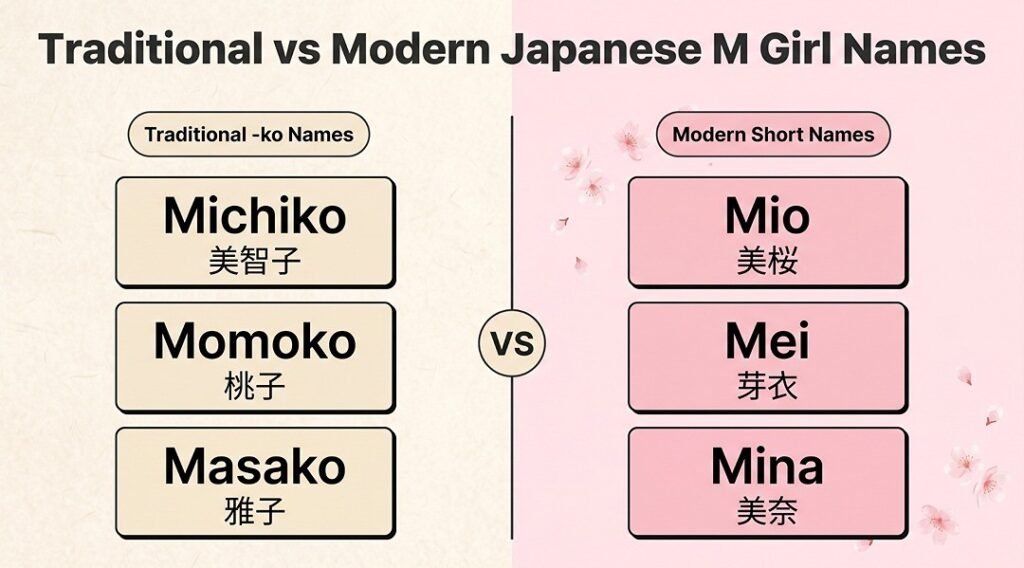
Meaning is where Japanese names get fun. The same sound can mean “beautiful”, “blessing” or “peach”, and the kanji decides which one. Below, names are grouped by theme, from nature and flowers to seasons and sky, water, virtues and blessings and traditional -ko names.
Nature and Flowers
- Mari (茉莉) – mah-ree – jasmine – floral, fragrant
- Marika (茉莉花) – mah-ree-kah – jasmine flower – floral, soft
- Momiji (紅葉) – moh-mee-jee – crimson leaves, maple – autumnal, classic
- Mokuren (木蓮) – moh-koo-ren – magnolia – rare, floral
- Mayuri (真百合) – mah-yoo-ree – true lily – graceful, floral
- Momoha (桃葉) – moh-moh-hah – peach leaf – fresh, gentle
- Mikan (蜜柑) – mee-kahn – mandarin orange – cute, quirky, rare as a name
- Momoka (百花) – moh-moh-kah – hundred flowers – lush, poetic
- Moeha (萌葉) – moh-eh-hah – sprouting leaf – fresh, hopeful
- Maiha (舞葉) – my-hah – dancing leaf – airy, graceful
Seasons and Sky
- Mafuyu (真冬) – mah-foo-yoo – midwinter – crisp, calm
- Maharu (真春) – mah-hah-roo – true spring – fresh, warm
- Manatsu (真夏) – mah-nah-tsoo – midsummer – sunny, bold
- Mahiru (真昼) – mah-hee-roo – midday – bright, open
- Mayuki (真雪) – mah-yoo-kee – true snow – pure, quiet
- Masora (真空) – mah-soh-rah – true sky – open, airy
- Mikazuki (三日月) – mee-kah-zoo-kee – crescent moon – rare, celestial
- Meika (明花) – may-kah – bright flower – sunny, soft
- Mei (明) – may – bright – short, luminous
- Manaka (愛夏) – mah-nah-kah – love and summer – warm, lively
Water
- Minamo (水面) – mee-nah-moh – water surface – calm, clear
- Mizuka (水香) – mee-zoo-kah – water fragrance – fresh, soft
- Mizue (水絵) – mee-zoo-eh – water picture – artistic, calm
- Mio (水緒) – mee-oh – water cord – flowing, gentle
- Manami (愛海) – mah-nah-mee – love and sea – ocean, warm
- Manami (真波) – mah-nah-mee – true wave – fresh, lively
- Mizuki (水希) – mee-zoo-kee – water hope – hopeful, clear
- Marin (海凛) – mah-reen – sea, dignity – crisp, modern
Virtues and Blessings
- Megu (恵) – meh-goo – blessing – short, gentle
- Megu (愛) – meh-goo – love – warm, simple
- Manae (愛恵) – mah-nah-eh – love, blessing – warm, classic
- Manae (真苗) – mah-nah-eh – true seedling – young, hopeful
- Masae (雅恵) – mah-sah-eh – elegant blessing – refined, traditional
- Masae (昌恵) – mah-sah-eh – prosperous blessing – lucky, traditional
- Mika (美佳) – mee-kah – beautiful, excellent – bright, classic
- Mika (美加) – mee-kah – beautiful, adding – soft, simple
- Miki (美貴) – mee-kee – beautiful, noble – elegant, classic
- Miki (美輝) – mee-kee – beautiful radiance – glowing, modern
- Mitsue (満恵) – mee-tsoo-eh – full blessing – traditional, warm
- Miyo (美恵) – mee-yoh – beautiful blessing – classic, gentle
- Manami (愛実) – mah-nah-mee – love and fruit – warm, sincere
- Masami (昌美) – mah-sah-mee – prosperous beauty – lucky, classic
Traditional -ko Names
The ending -ko (子) means “child”. It was the default for Japanese girls through much of the 20th century, and it still reads as classic, formal and a little vintage.
- Michiko (美智子) – mee-chee-koh – beautiful wisdom child – classic, formal
- Michiko (道子) – mee-chee-koh – path child – traditional, steady
- Mieko (美恵子) – mee-eh-koh – beautiful blessing child – classic, gentle
- Mihoko (美保子) – mee-hoh-koh – beautiful protection child – traditional, warm
- Mikako (美加子) – mee-kah-koh – beautiful, adding, child – classic, soft
- Mikiko (美紀子) – mee-kee-koh – beautiful era child – classic, calm
- Minako (美奈子) – mee-nah-koh – beautiful grace child – classic, gentle
- Mineko (峰子) – mee-neh-koh – peak child – traditional, strong
- Mineko (美音子) – mee-neh-koh – beautiful sound child – musical, vintage
- Misako (美沙子) – mee-sah-koh – beautiful sand child – soft, classic
- Mitsuko (光子) – mee-tsoo-koh – light child – bright, traditional
- Mitsuko (満子) – mee-tsoo-koh – full child – warm, vintage
- Miwako (美和子) – mee-wah-koh – beautiful harmony child – peaceful, classic
- Miyoko (美代子) – mee-yoh-koh – beautiful generation child – traditional, calm
- Miyako (美弥子) – mee-yah-koh – beautiful, ever more, child – gentle, classic
- Mimiko (美々子) – mee-mee-koh – doubled beauty child – sweet, vintage
- Miko (美子) – mee-koh – beautiful child – short, simple
- Mayako (真矢子) – mah-yah-koh – true arrow child – crisp, traditional
- Machiko (真智子) – mah-chee-koh – true wisdom child – thoughtful, classic
- Machiko (町子) – mah-chee-koh – town child – homey, vintage
- Makiko (真紀子) – mah-kee-koh – true era child – classic, steady
- Mamiko (真美子) – mah-mee-koh – true beauty child – warm, classic
- Mariko (真理子) – mah-ree-koh – true reason child – thoughtful, classic
- Masako (雅子) – mah-sah-koh – elegant child – refined, formal
- Masako (昌子) – mah-sah-koh – prosperous child – lucky, traditional
- Matsuko (松子) – mah-tsoo-koh – pine child – old-fashioned, strong
- Mayuko (真由子) – mah-yoo-koh – true reason child – gentle, classic
- Meiko (明子) – may-koh – bright child – luminous, classic
- Moeko (萌子) – moh-eh-koh – sprout child – fresh, soft
- Momoko (桃子) – moh-moh-koh – peach child – sweet, classic
- Motoko (素子) – moh-toh-koh – plain, simple child – humble, vintage
- Maiko (舞子) – my-koh – dance child – graceful, traditional
- Mugiko (麦子) – moo-gee-koh – wheat child – rustic, warm
- Mutsuko (睦子) – moo-tsoo-koh – harmony child – calm, traditional
- Muneko (宗子) – moo-neh-koh – origin child – formal, vintage
Or maybe I should say it this way: meaning is a choice, not a fact. One reading, several kanji, several stories. Mio can be a cherry blossom, a waterway or something “not yet ended”, and all three are legitimate. Pick the story you actually like.
Cute Japanese Names Starting With M
Cute names are short, bouncy and easy to love. Most have two or three syllables and repeat a soft sound, like Mimi, Momo and Meme. They fit a baby, a nickname, a pet or an anime heroine just as well, because the sound does the work before the meaning even enters.
Here’s the thing: cute doesn’t have to mean childish. A name like Mirumo or Mochi will make people smile now, but it may feel playful at forty. Keep a more serious kanji behind a cute reading, and the name grows up with her. Use the table to compare.
| Name (Kanji) | Pronunciation | Meaning | Style/Vibe |
|---|---|---|---|
| Mochi (望月) | moh-chee | full moon (also the word for rice cake) | sweet, playful |
| Meme (芽芽) | meh-meh | doubled sprout | tiny, sweet |
| Mumu (夢夢) | moo-moo | doubled dream | whimsical, soft |
| Mamu (真夢) | mah-moo | true dream | dreamy, soft |
| Mimu (美夢) | mee-moo | beautiful dream | dreamy, light |
| Mimiru (美々琉) | mee-mee-roo | doubled beauty, lapis | sweet, modern |
| Mirumo (未留望) | mee-roo-moh | not yet, stay, hope | quirky, anime-friendly |
| Mikuru (未来流) | mee-koo-roo | future flow | anime-friendly, rare |
| Mirura (美蘭羅) | mee-roo-rah | beautiful orchid, net | rare, sparkly |
| Momomi (桃実) | moh-moh-mee | peach fruit | fruity, sweet |
| Momorin (桃凛) | moh-moh-reen | peach dignity | cute with backbone |
| Momoi (桃衣) | moh-moh-ee | peach clothing | soft, quirky |
| Momoha (桃羽) | moh-moh-hah | peach feather | light, sweet |
| Mokoto (茉琴) | moh-koh-toh | jasmine koto | musical, soft |
| Mamika (真美花) | mah-mee-kah | true beauty flower | floral, bright |
| Mamina (真美奈) | mah-mee-nah | true beauty grace | soft, modern |
| Mahiro (愛陽) | mah-hee-roh | love and sun | sunny, warm |
| Mihiru (美陽) | mee-hee-roo | beautiful sun | sunny, bright |
| Mihari (美波里) | mee-hah-ree | beautiful wave village | sea-breezy, soft |
| Miko (美湖) | mee-koh | beautiful lake | calm, simple |
| Mitsumo (光萌) | mee-tsoo-moh | light sprout | glowing, young |
| Mikuna (美久菜) | mee-koo-nah | beautiful, lasting, greens | fresh, soft |
| Mimuka (美夢花) | mee-moo-kah | beautiful dream flower | dreamy, floral |
| Meiri (芽衣里) | may-ree | sprout, clothing, village | soft, modern |
| Meirin (芽凛) | may-reen | sprout, dignity | crisp, young |
| Meika (芽衣花) | may-kah | sprout, clothing, flower | floral, soft |
| Mayuha (真優羽) | mah-yoo-hah | true gentleness feather | light, tender |
| Maimi (舞美) | my-mee | dance and beauty | graceful, sweet |
| Maiko (舞心) | my-koh | dance heart | lively, warm |
| Mairi (舞莉) | my-ree | dance jasmine | floral, graceful |
| Mamiha (真美羽) | mah-mee-hah | true beauty feather | light, airy |
| Mikorin (美子凛) | mee-koh-reen | beautiful child, dignity | sweet, modern |
| Momochi (桃千) | moh-moh-chee | peach thousand | quirky, lucky |
| Mimiri (美々里) | mee-mee-ree | doubled beauty village | rounded, sweet |
| Mitsuna (光奈) | mee-tsoo-nah | light, grace | glowing, soft |
| Mituki (光月) | mee-tsoo-kee | light moon | gentle, glowing |
| Mizuri (水里) | mee-zoo-ree | water village | calm, rare |
| Mirune (美琉音) | mee-roo-neh | beautiful lapis sound | musical, rare |
| Marumi (円美) | mah-roo-mee | round beauty | soft, balanced |
| Marimo (毬藻) | mah-ree-moh | moss ball | rare, quirky, nature |
| Mayoi (迷) | mah-yoh-ee | wandering | rare, literary |
| Mukuri (椋里) | moo-koo-ree | muku tree village | rare, natural |
Male Japanese Names That Start With M
Quick note: this section is for context, not the main list. Readers search “Japanese names that start with M” without a gender filter, and a lot of competing lists mix boys’ names into girls’ lists. Below are the common boys’ M names, so you can spot them and avoid them for a girl. None of these are counted in the 550+.
Most use endings like -to, -ru, -ki, -o and -hiro, which sound strong and steady. Makoto, Masato, Minato and Masaru are the classic examples. Some can cross over, which the unisex section covers, but a name like Masahiro is almost never given to a girl in Japan.
| Name (Kanji) | Pronunciation | Meaning | Style/Vibe |
|---|---|---|---|
| Makoto (誠) | mah-koh-toh | sincerity | classic, upright |
| Masato (雅人) | mah-sah-toh | elegant person | refined, steady |
| Masaru (勝) | mah-sah-roo | victory | strong, bold |
| Masahiro (雅弘) | mah-sah-hee-roh | elegant, broad | formal, classic |
| Masaki (正樹) | mah-sah-kee | correct tree | steady, strong |
| Masashi (正志) | mah-sah-shee | correct will | determined, formal |
| Masayuki (雅之) | mah-sah-yoo-kee | elegant (of) | traditional |
| Masanori (正則) | mah-sah-noh-ree | correct rule | formal, firm |
| Masao (正雄) | mah-sah-oh | correct hero | classic, strong |
| Minato (湊) | mee-nah-toh | harbor | modern, calm |
| Minoru (稔) | mee-noh-roo | harvest | warm, steady |
| Mitsuo (光男) | mee-tsoo-oh | light man | classic, bright |
| Mitsuhiro (光弘) | mee-tsoo-hee-roh | light, broad | formal, warm |
| Mikio (幹雄) | mee-kee-oh | trunk, hero | steady, traditional |
| Mamoru (守) | mah-moh-roo | protect | strong, protective |
| Manabu (学) | mah-nah-boo | study | scholarly, calm |
| Masumi (将澄) | mah-soo-mee | leader, clear | crossover possible |
| Morio (守男) | moh-ree-oh | guard man | vintage, strong |
| Munehiro (宗弘) | moo-neh-hee-roh | origin, broad | formal, vintage |
| Michio (道雄) | mee-chee-oh | path hero | traditional, steady |
| Mitsuki (光輝) | mee-tsoo-kee | light radiance | crossover possible |
| Mikito (幹人) | mee-kee-toh | trunk person | modern, strong |
| Mahito (真人) | mah-hee-toh | true person | modern, simple |
| Maito (舞斗) | my-toh | dance, big dipper | modern, stylish |
| Masamune (正宗) | mah-sah-moo-neh | correct origin | legendary swordsmith name |
Female Japanese Names That Start With M
These are girl names that are clearly feminine in Japan. They lean on endings like -ka, -na, -mi, -e, -yo, -ri and -ko. The endings signal gender to Japanese readers, much like -a does in Spanish. That signal helps, because the name reads as a girl’s name at first glance, even to someone who can’t read the kanji.
Use this section when you want zero ambiguity. If you’re writing a female character, this is the safest group, because no reader will question the gender. And one more thing: the lists below are ordered by ending, so you can scan for the sound family that fits your surname best.
Endings in -ka and -na
| Name (Kanji) | Pronunciation | Meaning | Style/Vibe |
|---|---|---|---|
| Maika (舞佳) | my-kah | dance, excellent | graceful, bright |
| Makana (真花菜) | mah-kah-nah | true flower greens | floral, soft |
| Makaha (真佳羽) | mah-kah-hah | true excellent feather | light, airy |
| Manaka (真菜花) | mah-nah-kah | true greens flower | floral, soft |
| Mayuka (茉優香) | mah-yoo-kah | jasmine, gentle, fragrance | sweet, tender |
| Miyuka (美優花) | mee-yoo-kah | beautiful gentle flower | tender, floral |
| Mizuka (瑞花) | mee-zoo-kah | auspicious flower | lucky, floral |
| Momoka (萌桃花) | moh-moh-kah | sprout peach flower | sweet, young |
| Mikuna (美紅奈) | mee-koo-nah | beautiful crimson grace | bold, soft |
| Mirina (美凛奈) | mee-ree-nah | beautiful dignity grace | crisp, modern |
| Miona (美緒奈) | mee-oh-nah | beautiful cord grace | soft, modern |
| Mitsuna (満奈) | mee-tsoo-nah | full grace | warm, classic |
| Mihona (美帆奈) | mee-hoh-nah | beautiful sail grace | breezy, soft |
| Miruna (美瑠奈) | mee-roo-nah | beautiful lapis grace | gem-like, modern |
| Moemina (萌美奈) | moh-eh-mee-nah | sprout beauty grace | soft, young |
| Mahona (真穂奈) | mah-hoh-nah | true grain grace | earthy, gentle |
| Marika (茉里花) | mah-ree-kah | jasmine village flower | floral, classic |
| Mizuna (水菜) | mee-zoo-nah | water greens | fresh, simple |
| Mayana (真弥奈) | mah-yah-nah | true, ever more, grace | soft, modern |
| Maiya (舞弥) | my-yah | dance, ever more | graceful, flowing |
Endings in -mi, -e and -yo
| Name (Kanji) | Pronunciation | Meaning | Style/Vibe |
|---|---|---|---|
| Madomi (円美) | mah-doh-mee | circle beauty | calm, round |
| Mahomi (真帆美) | mah-hoh-mee | true sail beauty | breezy, warm |
| Matsumi (松美) | mah-tsoo-mee | pine beauty | old-world, strong |
| Mizumi (湖) | mee-zoo-mee | lake | calm, rare |
| Moemi (萌実) | moh-eh-mee | sprout fruit | young, fruitful |
| Manae (茉苗) | mah-nah-eh | jasmine seedling | floral, hopeful |
| Matsue (松江) | mah-tsoo-eh | pine inlet | old-world, calm |
| Mayue (真由恵) | mah-yoo-eh | true reason, blessing | classic, warm |
| Mikie (美喜恵) | mee-kee-eh | beautiful joy, blessing | classic, happy |
| Miyae (美弥恵) | mee-yah-eh | beautiful, ever more, blessing | gentle, vintage |
| Mutsue (睦枝) | moo-tsoo-eh | harmony branch | gentle, vintage |
| Machiyo (真千代) | mah-chee-yoh | true thousand generations | traditional, lucky |
| Masuyo (真寿代) | mah-soo-yoh | true longevity generation | traditional, lucky |
| Matsuyo (松代) | mah-tsoo-yoh | pine generation | vintage, strong |
| Mineyo (峰代) | mee-neh-yoh | peak generation | vintage, bold |
| Mikiyo (美貴代) | mee-kee-yoh | beautiful noble generation | formal, classic |
| Minayo (美奈代) | mee-nah-yoh | beautiful grace generation | gentle, vintage |
| Masayo (昌代) | mah-sah-yoh | prosperous generation | lucky, traditional |
| Morie (森恵) | moh-ree-eh | forest blessing | natural, calm |
| Momoyo (桃代) | moh-moh-yoh | peach generation | sweet, vintage |
Endings in -ri, -ru and -ra
| Name (Kanji) | Pronunciation | Meaning | Style/Vibe |
|---|---|---|---|
| Mahori (真織) | mah-hoh-ree | true weave | crafted, refined |
| Mikari (美花里) | mee-kah-ree | beautiful flower village | floral, soft |
| Mitori (美鳥) | mee-toh-ree | beautiful bird | light, free |
| Mimori (美守) | mee-moh-ree | beautiful protection | caring, calm |
| Mishiri (美汐里) | mee-shee-ree | beautiful tide village | sea-soft, rare |
| Miyori (美依里) | mee-yoh-ree | beautiful rely village | gentle, soft |
| Mayori (真依里) | mah-yoh-ree | true rely village | soft, modern |
| Morika (森花) | moh-ree-kah | forest flower | natural, floral |
| Momori (桃里) | moh-moh-ree | peach village | sweet, soft |
| Maruru (円瑠) | mah-roo-roo | round lapis | gem-like, soft |
| Miru (美留) | mee-roo | beautiful stay | short, gentle |
| Miruka (美瑠香) | mee-roo-kah | beautiful lapis fragrance | gem-like, sweet |
| Mira (未羅) | mee-rah | not yet, net | modern, airy |
| Maira (舞良) | my-rah | dance, good | graceful, bright |
| Meira (芽依良) | may-rah | sprout, rely, good | soft, modern |
Endings in -ho, -ki, -yu and -n
| Name (Kanji) | Pronunciation | Meaning | Style/Vibe |
|---|---|---|---|
| Misaho (美沙穂) | mee-sah-hoh | beautiful sand, ear of grain | soft, earthy |
| Mikiho (美貴穂) | mee-kee-hoh | beautiful noble grain | graceful, warm |
| Mikaho (美佳穂) | mee-kah-hoh | beautiful excellent grain | bright, gentle |
| Mihono (美帆乃) | mee-hoh-noh | beautiful sail (of) | breezy, soft |
| Masaho (雅穂) | mah-sah-hoh | elegant grain | refined, earthy |
| Mayuho (真由穂) | mah-yoo-hoh | true reason, grain | calm, classic |
| Manaho (愛穂) | mah-nah-hoh | love and grain | warm, gentle |
| Momoho (桃穂) | moh-moh-hoh | peach grain | sweet, earthy |
| Moeho (萌穂) | moh-eh-hoh | sprout grain | young, fresh |
| Maiho (舞穂) | my-hoh | dance grain | graceful, light |
| Mitsuho (光穂) | mee-tsoo-hoh | light grain | glowing, warm |
| Minaho (美奈穂) | mee-nah-hoh | beautiful grace grain | soft, classic |
| Miyuho (美優穂) | mee-yoo-hoh | beautiful gentle grain | tender, warm |
| Meiho (芽衣穂) | may-hoh | sprout, clothing, grain | fresh, soft |
| Maki (茉樹) | mah-kee | jasmine tree | floral, steady |
| Maki (真輝) | mah-kee | true radiance | bright, modern |
| Miki (美姫) | mee-kee | beautiful princess | regal, elegant |
| Mizuki (瑞姫) | mee-zoo-kee | auspicious princess | lucky, regal |
| Misaki (美沙季) | mee-sah-kee | beautiful sand season | soft, seasonal |
| Mayuki (真幸) | mah-yoo-kee | true happiness | warm, classic |
| Miyuna (美優奈) | mee-yoo-nah | beautiful gentle grace | tender, modern |
| Miyune (美優音) | mee-yoo-neh | beautiful gentle sound | musical, tender |
| Mayune (真由音) | mah-yoo-neh | true reason, sound | musical, calm |
| Mayuri (麻友里) | mah-yoo-ree | hemp, friend, village | friendly, soft |
| Marin (茉鈴) | mah-reen | jasmine bell | chime-like, floral |
| Mion (未音) | mee-ohn | not yet, sound | musical, hopeful |
| Mirin (未凛) | mee-reen | not yet, dignity | crisp, modern |
| Miori (未織) | mee-oh-ree | not yet, weave | crafted, hopeful |
| Mamika (茉美花) | mah-mee-kah | jasmine beauty flower | floral, sweet |
| Mitsuha (光葉) | mee-tsoo-hah | light leaf | fresh, glowing |
| Mitsuka (光花) | mee-tsoo-kah | light flower | bright, floral |
| Mitsune (光音) | mee-tsoo-neh | light sound | musical, bright |
| Moeri (萌恵里) | moh-eh-ree | sprout, blessing, village | fresh, warm |
Japanese Last Names That Start With M
Japanese surnames are not first names, so they sit outside the 550+ count. Still, many readers search them because they want a full name for a character or a pen name. Most surnames come from nature and places, which is why so many start with Mat- (pine), Mori (forest) and Miya- (shrine).
In Japan the family name comes first, so a girl named Mio from the Matsumoto family is written Matsumoto Mio. In English contexts, people often flip it. Check which order your audience expects before you publish, because getting it wrong on a character sheet looks careless.
| Surname (Kanji) | Pronunciation | Meaning | Style/Vibe |
|---|---|---|---|
| Matsumoto (松本) | mah-tsoo-moh-toh | base of the pine | very common |
| Matsuda (松田) | mah-tsoo-dah | pine field | classic |
| Matsui (松井) | mah-tsoo-ee | pine well | simple, strong |
| Matsushita (松下) | mah-tsoo-shee-tah | below the pine | well-known |
| Matsumura (松村) | mah-tsoo-moo-rah | pine village | rural, calm |
| Matsuyama (松山) | mah-tsoo-yah-mah | pine mountain | scenic |
| Matsuura (松浦) | mah-tsoo-oo-rah | pine bay | coastal |
| Matsuoka (松岡) | mah-tsoo-oh-kah | pine hill | calm, strong |
| Maeda (前田) | mah-eh-dah | front field | very common |
| Maekawa (前川) | mah-eh-kah-wah | front river | flowing |
| Maruyama (丸山) | mah-roo-yah-mah | round mountain | gentle |
| Marui (丸井) | mah-roo-ee | round well | simple |
| Masuda (増田) | mah-soo-dah | increasing field | lucky |
| Masuko (益子) | mah-soo-koh | benefit child | rare |
| Mashima (真島) | mah-shee-mah | true island | calm |
| Mase (間瀬) | mah-seh | space, rapids | rare |
| Mori (森) | moh-ree | forest | short, common |
| Morita (森田) | moh-ree-tah | forest field | common |
| Moriyama (森山) | moh-ree-yah-mah | forest mountain | scenic |
| Morimoto (森本) | moh-ree-moh-toh | base of the forest | common |
| Morikawa (森川) | moh-ree-kah-wah | forest river | flowing |
| Morishita (森下) | moh-ree-shee-tah | below the forest | calm |
| Morioka (盛岡) | moh-ree-oh-kah | flourishing hill | place-name feel |
| Motoki (元木) | moh-toh-kee | origin tree | simple |
| Motomura (本村) | moh-toh-moo-rah | main village | rural |
| Murakami (村上) | moo-rah-kah-mee | upper village | literary fame |
| Murata (村田) | moo-rah-tah | village field | common |
| Murayama (村山) | moo-rah-yah-mah | village mountain | scenic |
| Muramatsu (村松) | moo-rah-mah-tsoo | village pine | calm |
| Mukai (向井) | moo-kah-ee | facing the well | simple |
| Mukaiyama (向山) | moo-kah-ee-yah-mah | facing the mountain | scenic |
| Miyamoto (宮本) | mee-yah-moh-toh | base of the shrine | very common |
| Miyazaki (宮崎) | mee-yah-zah-kee | shrine cape | well-known |
| Miyata (宮田) | mee-yah-tah | shrine field | common |
| Miyake (三宅) | mee-yah-keh | three houses | distinctive |
| Miyagi (宮城) | mee-yah-gee | shrine castle | place-name feel |
| Miura (三浦) | mee-oo-rah | three bays | coastal |
| Mizuno (水野) | mee-zoo-noh | water field | clear |
| Mizutani (水谷) | mee-zoo-tah-nee | water valley | flowing |
| Minami (南) | mee-nah-mee | south | short, bright |
| Minamoto (源) | mee-nah-moh-toh | source, origin | historic clan name |
| Mitsui (三井) | mee-tsoo-ee | three wells | business-famous |
| Mochizuki (望月) | moh-chee-zoo-kee | full moon | poetic |
| Mitani (三谷) | mee-tah-nee | three valleys | scenic |
| Mino (美濃) | mee-noh | beautiful field | old province name |
Gender Neutral Japanese Names That Start With M
Some Japanese names work for any gender, and the kanji often tips the balance. A name like Mitsuki can read as feminine with 美月 (“beautiful moon”) and masculine with 光輝 (“light radiance”). That’s why gender-neutral names are a growing trend. The Japan Times reported that gender-neutral names rose in popularity in 2023.
Every name below is girl-friendly and listed with a girl-leaning kanji. That choice matters. Pick the spelling that signals “girl” if you want clarity, or a neutral spelling if you want flexibility. Both are valid, and parents who go neutral usually say they prefer a name that doesn’t box a child in.
| Name (Kanji) | Pronunciation | Meaning | Style/Vibe |
|---|---|---|---|
| Mahiro (真央) | mah-hee-roh | true center | calm, balanced |
| Mahiro (真優) | mah-hee-roh | true gentleness | soft, popular |
| Mahiro (茉央) | mah-hee-roh | jasmine center | floral, clean |
| Mahiro (真尋) | mah-hee-roh | true seeking | curious, neutral |
| Mashiro (茉白) | mah-shee-roh | jasmine white | clean, soft |
| Makoto (真琴) | mah-koh-toh | true koto | musical, neutral |
| Mio (澪央) | mee-oh | waterway, center | watery, balanced |
| Mitsuki (美月希) | mee-tsoo-kee | beautiful moon hope | moon, hopeful |
| Mizuki (瑞月) | mee-zoo-kee | auspicious moon | lucky, calm |
| Mizuki (美瑞希) | mee-zoo-kee | beautiful auspicious hope | lucky, bright |
| Mikoto (命) | mee-koh-toh | life, destiny | rare, strong |
| Mikoto (美言) | mee-koh-toh | beautiful words | poetic, soft |
| Minato (美奈都) | mee-nah-toh | beautiful grace city | modern, urban |
| Minato (港) | mee-nah-toh | port | calm, trending |
| Minori (美乃里) | mee-noh-ree | beautiful (of) village | soft, gentle |
| Michiru (満) | mee-chee-roo | fullness | calm, flowing |
| Michiru (美千瑠) | mee-chee-roo | beautiful thousand lapis | gem-like, soft |
| Michiru (道流) | mee-chee-roo | path flow | flowing, neutral |
| Madoka (的) | mah-doh-kah | target, clear | rare, crisp |
| Mayo (茉世) | mah-yoh | jasmine world | soft, simple |
| Miyabi (美也美) | mee-yah-bee | beautiful, also, beauty | refined, formal |
| Miyuu (美夕) | mee-yoo | beautiful evening | dusky, soft |
| Misuzu (弥鈴) | mee-soo-zoo | ever more bell | chime-like, gentle |
| Mizuho (水穂) | mee-zoo-hoh | water, ear of grain | earthy, neutral |
| Mikaze (美風) | mee-kah-zeh | beautiful wind | airy, free |
| Mikage (美影) | mee-kah-geh | beautiful shadow | mysterious, rare |
| Mikoto (深琴) | mee-koh-toh | deep koto | musical, deep |
| Mirai (弥来) | mee-rye | ever more coming | hopeful, modern |
| Mirai (光来) | mee-rye | light coming | bright, hopeful |
| Mafuyu (茉冬) | mah-foo-yoo | jasmine winter | calm, floral |
| Manato (愛音) | mah-nah-toh | love sound | musical, neutral |
| Mitsuru (美鶴) | mee-tsoo-roo | beautiful crane | graceful, lucky |
| Mitsuru (光流) | mee-tsoo-roo | light flow | luminous, neutral |
| Mizuto (美瑞) | mee-zoo-toh | beautiful auspicious | lucky, neutral |
| Maki (槇) | mah-kee | podocarp tree | tree, neutral |
| Mei (命) | may | life | strong, short |
| Michi (道) | mee-chee | path | short, neutral |
| Miyu (深有) | mee-yoo | deep existence | soft, neutral |
| Mamoru (茉守) | mah-moh-roo | jasmine protect | protective, soft |
| Meguru (巡琉) | meh-goo-roo | cycle, lapis | flowing, neutral |
Cool Japanese Names That Start With M
Cool names feel sharp, stylish and a little mysterious. They suit a game character, a stage name or a gamer tag more often than a baby, though plenty of real girls carry names like Mirei and Madoka. Think of sound first. Crisp consonants and long vowels make a name feel sleek.
One caution. Cool doesn’t mean copy-paste from anime. Madoka and Mikasa, for example, are famous for fictional characters, so readers will link them to those stories. That’s fine for a username, and awkward if you want a name that’s yours alone.
| Name (Kanji) | Pronunciation | Meaning | Style/Vibe |
|---|---|---|---|
| Mikage (御影) | mee-kah-geh | honored shadow | shadowy, stylish |
| Mikazuki (美三月) | mee-kah-zoo-kee | beautiful third moon | rare, celestial |
| Mirei (魅怜) | mee-ray | charm, clever | sharp, modern |
| Mizore (水霙) | mee-zoh-reh | water sleet | icy, cool |
| Mayoi (真宵) | mah-yoh-ee | true dusk | dusky, mysterious |
| Maira (真空羅) | my-rah | true sky net | sleek, airy |
| Murasame (村雨) | moo-rah-sah-meh | passing shower | poetic, rare |
| Meiya (冥夜) | may-yah | dark night | gothic, bold |
| Meisa (冥紗) | may-sah | dark gauze | gothic, soft |
| Mikuri (御栗) | mee-koo-ree | honored chestnut | quirky, cool |
| Miraku (美楽) | mee-rah-koo | beautiful joy | musical, bright |
| Mokuren (木蓮華) | moh-koo-ren | magnolia blossom | rare, floral |
| Miyazuki (宮月) | mee-yah-zoo-kee | shrine moon | elegant, rare |
| Midorika (翠香) | mee-doh-ree-kah | emerald fragrance | green, fresh |
| Mizukiri (水霧) | mee-zoo-kee-ree | water mist | foggy, quiet |
| Marei (茉玲) | mah-ray | jasmine tinkling jade | clear, delicate |
| Mirei (未玲) | mee-ray | not yet, tinkling jade | crisp, modern |
| Mirei (美怜) | mee-ray | beautiful clever | sharp, elegant |
| Mahana (真花奈) | mah-hah-nah | true flower grace | floral, stylish |
| Mahane (真羽音) | mah-hah-neh | true feather sound | light, musical |
| Mizuha (水羽) | mee-zoo-hah | water feather | cool, light |
| Mikuno (美玖乃) | mee-koo-noh | beautiful black jade (of) | gem-like, rare |
| Marune (円音) | mah-roo-neh | round sound | smooth, musical |
| Meine (芽音) | may-neh | sprout sound | fresh, musical |
| Maone (真央音) | mah-oh-neh | true center sound | balanced, musical |
| Mazuki (真月) | mah-zoo-kee | true moon | clean, celestial |
| Maruka (円華) | mah-roo-kah | round blossom | smooth, floral |
| Matsuri (祭) | mah-tsoo-ree | festival | lively, rare |
| Matsuribi (祭火) | mah-tsoo-ree-bee | festival fire | bold, rare |
| Mizuyuki (水雪) | mee-zoo-yoo-kee | water snow | cold, clear |
| Meigetsu (名月) | may-geh-tsoo | harvest moon | autumnal, poetic |
| Meikyo (明鏡) | may-kyoh | clear mirror | calm, rare |
| Meiwa (明和) | may-wah | bright harmony | peaceful, formal |
| Mikuzuki (美久月) | mee-koo-zoo-kee | beautiful lasting moon | celestial, rare |
| Miharuka (美遥) | mee-hah-roo-kah | beautiful distance | far-reaching, soft |
Unisex Japanese Names Beginning With M
Unisex is not quite the same as gender neutral. Unisex names are given to both boys and girls at roughly equal rates, while gender-neutral names lean on spelling to stay open. Both help parents who want flexibility. And honestly, that flexibility is the point.
Gender neutral vs unisex: gender neutral names are best suited for parents who want the kanji to decide the feel, because spelling can lean either way. Unisex names work better when you want one reading used equally by girls and boys. The key difference is whether the spelling or the sound carries the gender.
| Name (Kanji) | Pronunciation | Meaning | Style/Vibe |
|---|---|---|---|
| Mio (深緒) | mee-oh | deep cord | soft, neutral |
| Mizuki (水樹) | mee-zoo-kee | water tree | calm, natural |
| Mizuki (美月輝) | mee-zoo-kee | beautiful moon radiance | glowing, neutral |
| Minato (湊人) | mee-nah-toh | harbor person | calm, neutral |
| Mitsuki (満希) | mee-tsoo-kee | full hope | hopeful, neutral |
| Mitsuki (光月) | mee-tsoo-kee | light moon | luminous, neutral |
| Michiru (満瑠) | mee-chee-roo | full lapis | gem-like, neutral |
| Mikoto (尊) | mee-koh-toh | noble, divine | rare, strong |
| Misaki (岬咲) | mee-sah-kee | cape bloom | scenic, neutral |
| Misaki (美崎) | mee-sah-kee | beautiful cape | scenic, neutral |
| Minori (実紀) | mee-noh-ree | fruit era | harvest, neutral |
| Minori (稔里) | mee-noh-ree | ripening village | warm, neutral |
| Madoka (円佳) | mah-doh-kah | circle, excellent | round, neutral |
| Madoka (茉斗香) | mah-doh-kah | jasmine dipper fragrance | floral, neutral |
| Maki (真樹) | mah-kee | true tree | steady, neutral |
| Maki (万紀) | mah-kee | ten thousand era | long-lasting, neutral |
| Mayu (真悠) | mah-yoo | true distant | calm, neutral |
| Mayu (麻悠) | mah-yoo | hemp distant | natural, neutral |
| Michi (満智) | mee-chee | full wisdom | wise, neutral |
| Michi (路) | mee-chee | road | simple, neutral |
| Mina (未奈) | mee-nah | not yet grace | soft, neutral |
| Mirai (未来輝) | mee-rye | future radiance | bright, neutral |
| Mikuru (美来) | mee-koo-roo | beautiful coming | modern, neutral |
| Mizuho (美瑞穂) | mee-zoo-hoh | beautiful auspicious grain | warm, neutral |
| Mitsuru (充) | mee-tsoo-roo | fulfilled | strong, neutral |
| Mitsuru (光瑠) | mee-tsoo-roo | light lapis | luminous, neutral |
| Mei (明衣) | may | bright clothing | short, neutral |
| Mei (芽生) | may | sprouting life | fresh, neutral |
| Mei (萌衣) | may | sprout clothing | soft, neutral |
| Mahiro (茉尋) | mah-hee-roh | jasmine seeking | floral, neutral |
| Mahiro (愛尋) | mah-hee-roh | love seeking | warm, neutral |
| Mahiro (麻尋) | mah-hee-roh | hemp seeking | natural, neutral |
| Manabi (学美) | mah-nah-bee | study beauty | scholarly, rare |
| Mayo (茉羽) | mah-yoh | jasmine feather | light, neutral |
| Mio (澪音) | mee-oh | waterway sound | musical, neutral |
| Mio (美生) | mee-oh | beautiful life | warm, neutral |
| Miyu (美友) | mee-yoo | beautiful friend | friendly, neutral |
| Miyu (深結) | mee-yoo | deep bond | warm, neutral |
| Miki (深樹) | mee-kee | deep tree | steady, neutral |
| Miki (幹) | mee-kee | trunk | strong, neutral |
| Mizu (水) | mee-zoo | water | short, pure |
Asian Names That Start with M Girl
Many readers searching for M names for girls also browse names from nearby cultures. These aren’t Japanese, so they sit outside the 550+ count. Still, a quick look helps if you’re writing a pan-Asian cast or you’re not sure the Japanese route fits.
The meanings come from each language’s standard naming sources, and spellings vary by romanization. Treat the tables as a starting point. Mandarin tones, Korean hanja and Thai honorifics can all change how a name is written, so confirm with a native speaker if the name matters.
| Name | Origin | Meaning | Style/Vibe |
|---|---|---|---|
| Mei (美, 梅) | Chinese | beautiful, plum blossom | classic, short |
| Meilin (美琳) | Chinese | beautiful jade | elegant, soft |
| Meiying (美英) | Chinese | beautiful flower | classic, graceful |
| Mingyu (明玉) | Chinese | bright jade | clear, refined |
| Mulan (木兰) | Chinese | magnolia | brave, literary |
| Minh (明) | Vietnamese | bright, clear | neutral, common |
| Mai (梅) | Vietnamese | apricot blossom | soft, spring |
| My (美) | Vietnamese | beautiful | short, simple |
| Mi-na (미나) | Korean | beautiful, grace | soft, popular |
| Min-ji (민지) | Korean | clever, wisdom | modern, common |
| Mi-rae (미래) | Korean | future | hopeful, modern |
| Min-seo (민서) | Korean | clever, auspicious | modern, popular |
| Mi-so (미소) | Korean | smile | sweet, bright |
| Mali (มะลิ) | Thai | jasmine | floral, classic |
| Malai (มาลัย) | Thai | garland | festive, floral |
| Mayuree (มยุรี) | Thai | peahen | graceful, rare |
| Mook (มุก) | Thai | pearl, common nickname | cute, shiny |
| Mina (मीना) | Indian (Hindi) | precious stone, fish | classic, simple |
| Meera (मीरा) | Indian (Hindi) | prosperous, saint-poet | devotional, classic |
| Maya (माया) | Indian (Sanskrit) | illusion | mystical, classic |
| Madhuri (माधुरी) | Indian (Sanskrit) | sweetness | warm, classic |
| Malati (मालती) | Indian (Sanskrit) | jasmine | floral, rare |
| Maharani (महारानी) | Indian (Sanskrit) | great queen | regal, formal |
| Maya (Maya) | Filipino | maya bird, sparrow | light, free |
| Marikit | Filipino | beautiful | rare, soft |
| Mayumi (Mayumi) | Filipino and Japanese | true reason, beauty (in Japanese) | crossover, soft |
| Mutya | Filipino | pearl, muse | gentle, rare |
| Melati | Indonesian | jasmine | floral, national flower |
| Mawar | Indonesian | rose | floral, bold |
| Mutiara | Indonesian | pearl | elegant, shiny |
| Manis | Malay | sweet | sweet, simple |
| Mawar (Mawar) | Malay | rose | floral, classic |
| Mahsuri | Malay | legendary heroine | historic, rare |
| Munira | Arabic (Central Asian use too) | luminous, enlightening | bright, formal |
| Mahira | Central Asian | skilled | strong, modern |
| Munisa | Central Asian | companion | warm, rare |
| Mohira | Uzbek | beautiful-faced | graceful, rare |
| Malika | Central Asian | queen | regal, popular |
| Mehrinigor | Central Asian | kind beloved | rare, warm |
| Mei Ling (美玲) | Hakka and Cantonese | beautiful tinkling jade | gentle, classic |
| Menghan (梦涵) | Chinese | dream, inclusive | poetic, modern |
Tips for Choosing the Right Japanese Name
Most guides tell you to pick the prettiest name. That advice is incomplete. Some experts argue you should choose purely on meaning. That’s valid when you read Japanese and know what the kanji will mean to a Japanese reader. But if the name will mostly live in English-speaking places, sound and spelling matter just as much, so test both.
If you’re choosing a name for a real baby, here’s what actually works: pick the kanji first, then confirm the reading with a native speaker. It’s the step you’ll wish you’d done, and it’s one you can’t easily undo once paperwork is filed.
Most people assume Japanese girl names are mostly old-style -ko names. The data says otherwise. In Meiji Yasuda’s 2025 survey, half of the girls’ top ten were single-kanji names, and none of the ten used -ko. What most guides skip is that readings aren’t fixed, so one kanji can be read several ways.
I’ve seen conflicting data on Mio some lists call it unisex, others treat it as girls-only. My read is that it’s a girls’ name that boys occasionally share, though the kanji can tip it either way.
Use this short process. To pick a Japanese girl name that fits you, follow these steps: 1. Say the name aloud with your last name. 2. Check the kanji on Jisho.org. 3. Look at how common it is in Japan. 4. Confirm there’s no awkward English meaning. 5. Ask a Japanese speaker to read it.
How Kanji Changes a Meaning
One reading, many meanings. Mio is the clearest case, since 美桜, 澪 and 未央 all share the same sound with different stories. So the written form matters more than the romanized spelling. If a site only shows romaji, treat the meaning as a guess.
How to Say it in English
Pronounce the M like the English “m”, then a short ee or ah vowel. Keep the vowels pure. Japanese has five of them, and they don’t glide the way English vowels do. A flat, even rhythm sounds closer to the real thing than a stressed one.
Does it work with an English Surname?
Mostly yes. Short names like Mia, Mei and Mina pair easily with English surnames, while longer ones like Mizuhoko can feel long in a full signature. Check the initials, too, because short names can form unfortunate abbreviations.
How Common is it in Japan Today?
Check the yearly lists. Japan has no official ranking, so the main sources are Meiji Yasuda Life and Benesse (Tamahiyo). Their numbers come from their own customers, so each reflects a sample rather than the whole country. Neither is perfect, but together they show real trends.
Closing Insights: Japanese Names That Start With M
M names give you softness, range and plenty of meaning. You can go classic with Michiko, modern with Mio, poetic with Mizuki or rare with Mutsuki. Pick the kanji first and the sound second, and the rest falls into place. Short, clear names are the safest bet.
Take a final pass before you commit. Read the kanji, say the name aloud and check it on Jisho.org. If a Japanese friend frowns, listen to them. A name is a small thing you’ll say thousands of times, so a few extra minutes of checking now pays off for years.
Fascinating Facts About Japanese Names Beginning With “M”
Japan has no official baby name ranking. Two insurers fill the gap each year: Meiji Yasuda Life and Benesse. According to Nippon.com’s report on Meiji Yasuda’s 2025 survey, 翠 (Sui, Midori) took first place among girls’ names for the first time.
- Many Ms come from nature. Momo is a peach, Midori is green and Mizuki is the moon on water.
- Old months have names. Mutsuki (睦月) is the traditional name for January.
- -ko names are fading. Their “child” ending dominated last century, and modern parents choose shorter forms.
- One kanji can be a full name. Half of the 2025 girls’ top ten were single-kanji names, per Nippon.com.
- Readings can surprise. Mio is ranked by reading in the Meiji Yasuda lists because many kanji spellings share it.
Midori also starts with M, so that’s a good moment for the letter.
Why “M” Names Hold a Special Place in Japanese Culture
The m sound sits close to words for beauty (mi), water (mizu), forest (mori), peach (momo) and blessing (megumi). Families like that echo. A name feels like a small poem, and the sound itself carries hope. That is a big reason M names show up again and again across every era.
There’s also a cultural point worth knowing. In Japan, names carry wishes, not just labels. Parents pick kanji to wish their child beauty, kindness or luck. So when you pick an M name, you’re borrowing a tradition that treats naming as a blessing, and honoring that goes a long way.
| Option | Best For | Key Benefit | Limitation |
|---|---|---|---|
| Classic -ko names (Michiko) | Formal or vintage feel | Timeless, clear gender | Can sound dated today |
| Short modern names (Mio, Mei) | Babies and global use | Easy to say worldwide | Very common, less unique |
| Nature names (Midori, Momoka) | Poetic, meaningful picks | Rich visual meanings | Kanji must be checked |
| Rare literary names (Mutsuki) | Writers and unique picks | Stands out | Hard for non-Japanese readers |
Conclusion
Japanese girl names that start with M give you range, from soft Mio and Mei to classic Michiko and rare Mutsuki. The best pick is the one whose kanji, sound and meaning all fit what you want. Start with the theme, check the kanji, then say it out loud.
Bookmark this list, share it with someone who’s naming a baby or a character, and use Jisho.org to double-check any spelling you love. Which M name did you pick?
FAQs
What’s a cute M name for a girl?
Momo, Mimi, Mei, Miu and Moka are among the cutest. They’re short, soft and easy for English speakers to say. Pair a cute reading with a graceful kanji, like 桃 for Momo, and the name still works when she’s an adult.
What girl’s name begins with M?
Popular Japanese girl names that begin with M include Mio, Mei, Mana, Miyu, Misaki, Midori, Megumi and Mizuki. Each has several kanji options. Check the spelling before you choose.
What’s a cute M name for a Japanese girl?
Momo, Mimi, Mei and Miu are cute choices. They’re short and soft, and Momo means “peach,” which adds a sweet meaning.
Can I use a Japanese name if I’m not Japanese?
Yes. Many families outside Japan choose Japanese names out of love for the culture. Learn the meaning, learn the pronunciation, and use the real kanji. Respect for the detail is what separates appreciation from a costume.
What girl’s name begins with M in Japanese?
Common ones are Mio, Mei, Mana, Miyu, Misaki, Midori and Megumi. Mio and Mei are among the most popular readings in Japan.
What is a rare Japanese girl name?
Rare Japanese girl names include Mutsuki (睦月), Mizore (霙), Mahoroba (まほろば) and Murasaki (紫). They’re uncommon but real, and each has a clear meaning tied to nature, seasons or literature.
What are rare girl names that start with M?
Rare M girl names include Mayoi, Marimo, Mikazuki, Mokuren and Mugi. Most come from nature or old poetic words. They stand out, but expect to explain the pronunciation often.
What is a unisex name in M?
Mitsuki, Minato, Mizuki, Mahiro and Makoto are the best-known unisex M names. The kanji often decides whether it reads as a girl’s or boy’s name, so choose your spelling with care.
What does Mizuki mean in Japanese?
It depends on the kanji. 美月 means “beautiful moon,” 瑞希 means “auspicious hope,” and 水月 means “water moon.”
What are unique M names?
Unique M names include Madoka, Mashiro, Mafuyu, Maiha and Memi. They’re uncommon without being invented. Look for natural kanji, a clear meaning and a sound that’s easy to read.
Are Japanese names always written in kanji?
No. Many are written in hiragana (みお) or katakana (ミオ), especially for modern or soft-looking names. Kanji gives more meaning, but kana is simpler and avoids reading mistakes.
Is Mio a girl’s name in Japanese?
Mostly, yes. Mio is widely used for girls, and it ranked among the top readings in Meiji Yasuda’s yearly lists. It’s occasionally given to boys, so the kanji is the clearest signal.
Where can I check kanji meanings?
Use Jisho.org for kanji, readings and meanings. For name origins, Behind the Name is a useful reference. For popularity, check the yearly Meiji Yasuda Life and Benesse (Tamahiyo) rankings.